right into this and I'll show you guys how. Now, for starters, government housing has been around since 1937, but for section 8 specifically, it came around in 1974, which is over 50 years ago at this point. It helps lowincome tenants who cannot afford a property to go ahead and get their rent subsidized directly by the government, paid for by your tax dollars. Now, the government will subsidize anywhere from 70 to 100% of a tenants's rent, and the tenant will be responsible from zero all the way to
How I Built a $10M+ Section 8 Empire by Age 23 – Starting with $0 Down
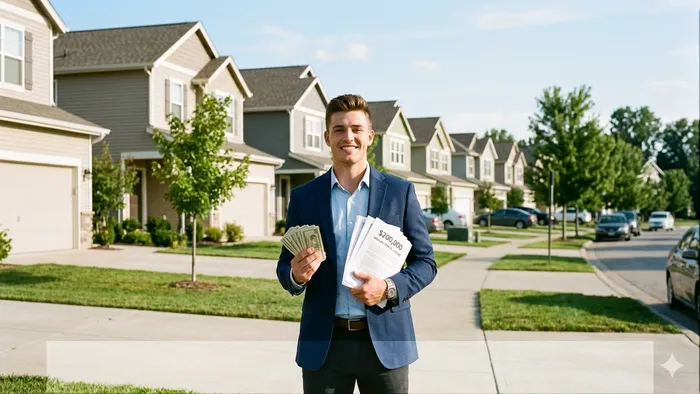
From zero down to 153 properties generating over $200,000 guaranteed every month
30% every single month. Now, the great thing about this program is that the payments are guaranteed on the first of every single month, which means you do not have to wait for late payments from cash tenants and it allows you to scale with predictability. In addition to that, to become a section 8 tenant, it takes about 10 to 15 years to actually get your voucher. Now, the crazy part is is that less than 10% of landlords accept section 8 tenants, which creates a massive opportunity for me and multiple other landlords. In
addition tothat, your average section 8 tenant stays in a house for 7 and 1/2 years, and your average market cash tenant stays in a house for right around 2 years. And what the government has done to incentivize landlords to accept section 8 is that they pay 10 to 30% above market rents, which has allowed me to cash flow more than any other investor that works with market tenants and helped me build a recessionproof business model that's feasible in any financial climate. And yes, to answer the question you're probably thinking
about, section 8 tenants do get paid during government shutdowns and they did get paid during COVID. So, it is completely recessionp proof. Now, let's get into step one, which is going to be setting up the right business structure to get you started with this business model and to protect yourself from having any potential lawsuits while owning these rental properties. Now, the structure that I recommend is a two LLC structure setup. It's a holding company in Wyoming, which allows you to have
anonymity and asset protection. Now, what anonymity means is that nobody knows that you own the property. And then under that holding LLC in Wyoming, you would have an operating LLC that holds the properties. Now, many investors will say that you should own one property per LLC. But considering these are $70,000 houses and you do not have much equity, what I do personally is generally going to be three to five properties per LLC. And you can go on busy.com, bis.com, and set this all up for under $200 and
Guaranteed Section 8 Rent – Deposited by the U.S. Government Every 1st of the Month
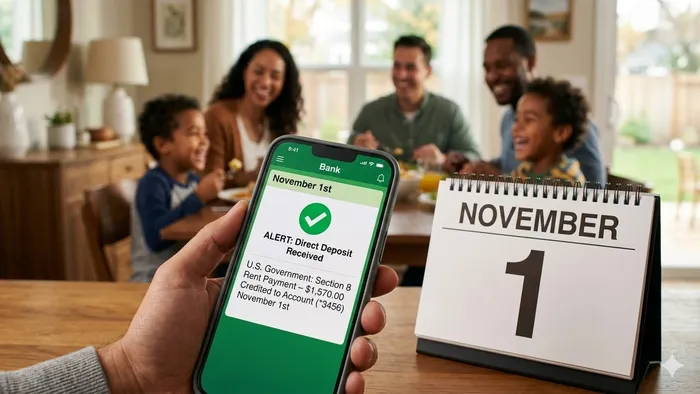
100% recession-proof: Section 8 payments arrive even during shutdowns and COVID
get started right now. And guys, trust me, this investment to set up your LLC will be well worth it because it has significant legal protection and potentially even some tax benefits that you didn't know about. Now, step two is where we're going to get into market selection. And the two primary locations that I generally look at are going to be the Midwest and the Southeast. When it comes to section A investing, where you're mainly focused on cash flow, you want to look for locations with low
purchase price and high rent potentials. And you could check the rents directly on hooduser.gov. It's called the rent to purchase price ratio, and that's going to be a big factor when it comes to choosing a location. My top markets to find properties sub $100,000 in the Midwest would be Ohio, including Cleveland, Toledo, and Akran. Additionally, you could also look at Indiana, where you can find properties sub $100,000 in Indianapolis. Now, generally in Ohio, you could end up cash flowing anywhere
from $400 to $800 every single month after all of your expenses with $8 to $15,000 down using traditional financing. Now, there's obviously ways to be able to get these properties under contract for $0 down, which we will shortly get into. Now, if you're focused on looking at the Southeast, you could look at Jackson, Mississippi, Birmingham, Alabama, Montgomery, Alabama, and even Shreveport or Lafayette, Louisiana. These are all locations where you could find properties under $100,000 that rent all
the way from $1,200 to $1,500 every single month. Now, please make sure to avoid locations that are not landlord friendly, like California, Oregon, or potentially even Washington. Now, keep in mind with a landlord friendly state, I'm able to evict a tenant under a couple weeks, and there's 5day eviction notices. If you think about a location like California, it might take you 6, 12, 18 months and tens of thousands of dollars to even get the process started. So, in brief, you want to find a
Top Section 8 Cash-Flow Markets in the Midwest & Southeast
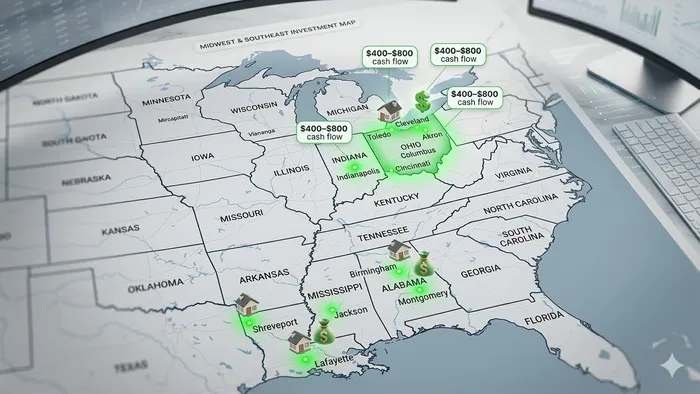
Prime locations with low purchase prices and high government-subsidized rents
location with a good price to rent ratio where you could have high cash flow, a minimum of $4 to $800 every single month. And you want to check huduser.gov to see exactly what section 8 pays in every specific zip code. And one of the most important steps when actually choosing a location with section 8 is to call the local housing authority and ask them how many outstanding vouchers they have. This is going to tell you how many section 8 tenants are waiting to be housed, which is extremely extremely
crucial when choosing a location to buy in right now and focusing on section 8 investing. In addition to that, once choosing a location, you need to ensure that there's supply on the market. Now, this is extremely important to have supply because this whole business model is made for scalability. Now, at this point, I have five main websites that I utilize to find on and offmarket deals under $100,000. The first one would be investorlift.com. This is where you can find completely offmarket deals sub
$100,000 that are under contract with wholesalers. Number two would be fsbo.com. This is foralebyowner.com. This essentially allows you to find properties that are listed by the owner directly where there's no agent involved. This is probably one of my top ones to find properties that are completely seller finance just because you can directly approach the agent. Number three would be roofstock.com. They have a section where you could find turnkey on and offmarket deals sub $100,000. And for me personally, I've
probably closed on over 10 deals just from this website alone. Number four would be directly from the MLS. Zillow, Realtor, Redfin.com are all feasible options. This is where you could find onmarket deals for seller financing, traditional financing, and this is pretty much where everybody looks for properties, but I still managed to close an additional 10 to 20 deals a year just from the MLS. Now, number five is going to be my personal favorite, which is a section 8 software that I created 6 months ago that has allowed me to find
offmarket deals that are completely seller financed with $0 down. This section 8 software uses AI to allow me to find seller financing deals that are on and off market under $100,000 coming out of pocket with as little as $5 to $10,000 down per property. It even has a map in the US designed to show you which locations are feasible for section A investing and what the average cash flow would look like per property with assigned property managers per specific location that we've already vetted out.
It's essentially an all-in-one tool that breaks down the entire process. And if you want to learn more about my section 8 software that I've recently created that utilizes AI, click the link down below. Now, let's go over my buying criteria for the properties that I'm looking at. Generally, I'm looking for properties under $100,000. I want to find a minimum of three bedrooms. And the reason for that is because I found that three-bedroom properties or fourbedroom properties generally have a
big jump from two-bedroom properties in terms of the fair market rent every single month. I like to find properties that are under 1,500 square f feet. And the reason for that is because it's less maintenance. A lot of investors do get confused when I mention 1500 ft², but I want you to think about this. If a section 8 tenant just moves out of my property and it's 1,000 ft² versus 2500 ft² and I have to repaint all of the walls, which one is going to be cheaper? Obviously, the one with the,000 ft² just
because it's less money out of my pocket to flip the property and get it back on the market. And I generally like to look for properties that are built after 1950. Now, not a lot of people know this, but that is the year that housing code violations became more formalized and enforced. I will say that I do sometimes buy properties built prior to 1950, but generally there's specific requirements that I'm looking for. And finally, I'm looking for a low crime area. Generally, you can verify this on
spotcrime.com or crimemapping.com because obviously if I buy a property in a high crime area, it's going to take me a lot longer to actually find a section 8 tenant. And I like to look for properties with as little money down as possible, potentially even $0 down if applicable. If you're getting into this and you only have about $5,000 down, I would focus on seller financing deals on fsbo.com because generally these are motivated sellers who are willing to accept seller financing offers. A lot of
the times you can go on Zillow.com or FSBO.com, filter above 30 days on the market to find sellers that have had their property listed for above 30 days and you can offer them full asking price. But what you would want to ask them is to finance the property and become the bank for you. Which essentially means that you could put zero or five or potentially even 10% down on these properties without having to find a bank to finance them for you. Now, obviously to incentivize them, you can give them a higher interest rate. In
addition to that, you could also go ahead and mention the tax benefits that they're going to be getting by seller financing the property to you rather than selling it all at once in bulk to a cash buyer. Option number two is to go ahead and find private money, which is exactly what I did when I started real estate. To scale from my third property all the way until my 10th property, they essentially put up the down payment. What you do is find the tenant, manage the property, get the property running
and cash flowing, and then you guys end up splitting the profits and the cash flow every single month. And finally, just like I did, you would essentially go ahead and have a buyout clause. And after you've built up enough cash flow and your property has built up enough equity, you can essentially go ahead and buy them out of the deal. And option number three is to get a business line of credit or some sort of working capital loan. Once you have an LLC established, you could go ahead and apply for a business credit card from
Real Deal Example: $71,000 Property Cash-Flowing $750/Month
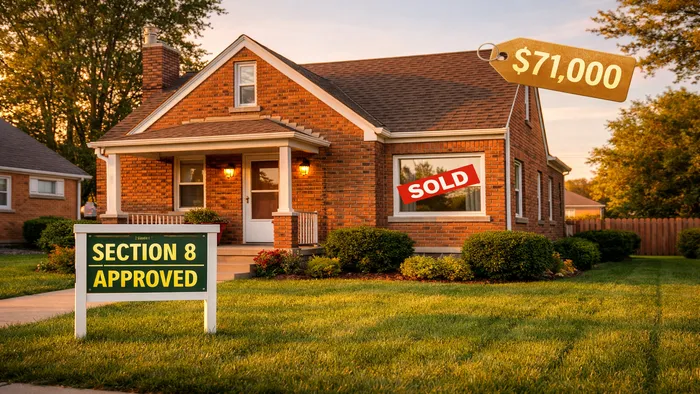
My recent Louisiana deal: $1,570/month government rent – only $10,650 down
Bank of America. You can get approved for 10, 20, 30, potentially even up to $100,000 down for 0% interest for 12 to 18 months. And from there, you could use that capital to be able to buy properties that are offm market with equity. That way, you could refinance within 12 months and pay back those credit cards. Now, that's the seller financing aspect. Let's get into traditional financing. The vast majority of investors that I'm working with on a day-to-day basis are doing DSCR loans,
which stand for debt service coverage ratio. For these specific loans, rather than looking at you as the investor and your W2s, your property history, your tax history, they look at the property to make sure that it actually cash flows. The requirements for a DSCR loan are generally going to be to have a 620 plus credit score to put 15 or 20% down on these properties depending on your level of experience. And yes, a portion of that could come from seller financing, and the down payment directly
could come from the business line of credit. And the property must have a 1.25 debt service ratio, which means your rent divided by your debt service. Now, this is an example of a deal that I most recently did in Louisiana. It was $71,000 for the purchase price. Now, due to the level of experience that I have and the relationship that I've built with these lenders year-over-year, I'm able to put 15% down on the specific property, which would be $10,650 out of my pocket for the down payment.
Now, the monthly rent for this specific property was $1,570 every single month, guaranteed by the US government. Now, let me give you a breakdown of the monthly expenses on the property. The mortgage was $415 every single month. The property taxes on this house were $83 every single month. The insurance was $72 every single month. The maintenance at 8% was $125 a month. And the management at 8% was $125 every single month as well. Now, after all of my expenses on this specific property, I ended up cash
flowing right around $750 every single month, which brought my debt service ratio well above the 1.25 minimum that they were looking for. So, they ended up financing the loan. Now, even if you considered seller financing this property with $0 down, all the numbers would still work. Once you finance the property, let's get into the section 8 inspections. Every single time you buy a property and you want to rent it to a section 8 tenant, Section 8 requires that you have an inspection to ensure
that the house is functionable. You could find the exact Section A inspection checklist online by typing in your county section 8 inspection checklist on Google and it goes over the entire step by step, but essentially they're trying to ensure that the house is livable for the tenant. They're looking for working plumbing and electricity. They want to ensure that there's no leaks or water damage through the entire property. There's proper ventilation and obviously the AC is functionable as well. There's
functioning smoke detectors, no peeling paint, and obviously no holes in the walls additionally or any rodents in the property. And this is exactly why I recommend going for turnkey properties when getting started with section 8 because it requires less work to pass the inspection and it essentially allows you to move quicker to get the property rented and start moving on to the next deal. Now obviously if you are buying a fixer upper, which is generally not my business model, you need to budget for
repairs. You need to work with contractors. You need to wait an extended period of time, which is generally not what I prefer to do. Turnkey makes this process a lot easier, especially for new investors that want to do this completely out of state. And keep in mind, these inspections do happen yearly, so obviously you want to have the property manager ensure that the house is wellmaintained. Generally, my property manager personally will visit the property at least two to three times every single year to check up. And
once again, you could find the section A inspection checklist directly online. Now, in order to get the section A inspection, you need to have a tenant lined up. So, let me go through my entire process of finding the perfect section 8 tenant. There are two major ways you should find a section 8 tenant. Number one will be on affordable.com. You can list your property directly on there and tenants will reach out to on a daily basis. And the second one will be Facebook Marketplace. Believe it or not,
my property managers have found well over 70% of my section 8 tenants directly on Facebook Marketplace. So, it's extremely crucial. Now, obviously, when listing the property, it's extremely important to mention that you do accept section 8 in the description. And as I mentioned below, considering many landlords do not accept section 8, you will get flooded with applications in the beginning just because the amount of demand from section 8 tenants. Now, let's get into a quick preview of
exactly how I screen my tenants and a list of things that you need to take notes of to ensure that you find the perfect section 8 tenant. Number one, the first thing you want to do is have them fill out a section 8 application and pay the application fee. Once that's done, you're going to have all of their information, including their background checks, arrest record, and obviously their current credit score. Now, although that's very important, there's a couple other extra details that are
going to go into this process, such as getting their current and past landlord's information. This is going to be crucial because if they're not willing to provide it, well, guess what? That just means that they're not taking care of their current property. we pretty much know why they're leaving. Now, it's obviously not the case for all the tenants, but it is just a rule of thumb. Number two would be to check their car. Now, obviously, this is hyper specific, but if a tenant comes to the
The Section 8 Snowball: Scale from 1 Property to 153+ with Cash Flow Alone

Use monthly cash flow to buy more properties – true passive income snowball effect
property and their car is all busted up, they have a flat tire, the inside is wrecked, well, guess what? That just shows you how that current tenant is living and how they're potentially even going to treat your property as well. Number three would be do an athome interview to see exactly how that current tenant is living. Because trust me, this is probably one of the most important steps. And this goes into exactly how they're going to treat your current property. If the current tenant
has busted up walls, all the doors are broken, nothing is working in the household, all the lights are not functional, whatever the case may be, it's flooded, well, go ahead and assume that's how they're going to treat your current property. But on the other hand, if you have a tenant that's completely taken care of, everything looks nice, clean, in order, well, that would probably make sense to move forward with that specific tenant. And number four, which is very important as well, is
check their eviction history. Generally, we do not accept section 8 tenants with an eviction history just because we do not want to run into that process with a section 8 tenant and have to waste time. I'm looking for a tenant that wants to spend 7, 10, 15 years potentially in a property. Now, just remember, of course, there's going to be a lot of stigma surrounded by section 8 tenants, but your average section 8 tenant waits 10 to 15 years to actually get approved for the program and become a section 8
tenant. So, guess what? A lot of them do treat the property pretty well because they don't want to risk getting kicked off of the free rent. And if they do damage your property and they are a section 8 tenant, they could actually get kicked off of the property if I do report it to section 8, which a lot of people do not even know. And lastly, once you found the perfect section 8 tenant, you want to utilize my bulletproof lease to protect yourself. And there's three major clauses that I have in this lease that separate it from
all the other landlords. Number one is going to be the repair clause. This requires tenants to become responsible for the first $150 of any repairs that they've afflicted within the property. Number two is going to be the lockout clause. This requires to pay the tenant for any locksmith charges if they get locked out of the property. And number three is going to be the maintenance clause. This requires a tenant to handle lawn care and snow removal. Now, let's get into the management portion. As I
mentioned, I own over 46 properties in Ohio, and I've never even been there. And this is because I have successfully delegated this process to property managers that take care of the renting, the leases, the section 8 process while I live completely out of state. Now, to find a property manager, you want to go on a website called thumbtac.com. This is where I find the vast majority of my property managers. And on average, each one is going to end up charging anywhere from 8 to 10%. They handle the tenant
placement, the rent collection, the section 8 paperwork, and even the maintenance coordination and monthly checkups to ensure the properties are in good condition. Now, if you're only planning on getting a couple properties and you are doing this instate, it may make sense to just self-manage. But if you're trying to build a business out of this that is scalable and you want to have 10, 15, 20, 30 properties, it definitely makes sense to find a management company or a local property manager to do this just so you turn into
an investor rather than the day-to-day landlord, which is what I preach. Now, I understand a lot of landlords are scared of doing this out of state, but I just want you to consider this one example. If a plumbing issue pops up in a property and it's 5 minutes away from you versus 5 hours away from you, what is your game plan? I'm going to go ahead and assume instead of you actually going under the property to fix the issue, you're going to call a plumber. So, I want you to ask yourself this one
specific question. If you're going to call a plumber and the property is 5 minutes away from you or 5 hours away from you, why does it matter whether or not you're located in the same state as the property? Well, the answer is it doesn't. And once I realized that, that's essentially allowed me to take this business model to whole new levels without ever having to see my properties in Ohio. And for me personally, I probably spend right around an hour a day even managing my properties. And
that only consists of me speaking to my property manager to ensure everything is in order. Now, let's get into scaling your portfolio. Obviously, the first property is going to be the most difficult for you. But once the first one is completed, it just becomes a process and a system that you need to follow to close on your fifth, 10th, 20th, 50th, and even potentially your 100 plus. Now, once again, there are multiple different ways you could scale this. Whether this is seller financing, raising capital, using the existing cash
flow from these properties, or even potentially burning these houses to be able to buy, rehab, rent, and then refinance these houses. But I want you to consider this. Section 8 becomes a snowball effect once you have enough properties. Each property on average is going to cost you right around 8 to potentially up to $15,000 down with traditional financing. So, for example, if you've built a portfolio with right around 10, potentially even 20 properties, let's assume each one is generating $500 a month on average. That
is $10,000 a month in guaranteed passive income every single month. So, with $10,000 a month in passive income, you're essentially able to buy an additional property every single month. So, you're using the existing cash flow from these properties to buy more and more without having to come any more out of pocket than you were before. And let's also remember with real estate, you're making money four to five different ways depending on your scenario. Number one, you're generating
the guaranteed passive income every single month. Number two, these properties are appreciating every single year from anywhere from 4 to 10% just depending on the market. Number three, there are rent increases with section 8 that are above market rent increases. Some of my properties that I've purchased in 2020, 2021, 2022 now have rents that are $5 to $600 a month above what I initially rented them out for. Number four, you are paying down your principal payments every single month with these specific properties. So, you
have more equity in these houses month over month. And number five, you have massive, massive tax benefits when buying real estate. if you have W2 income or if you're 1099. Either way, you could still benefit from owning some type of real estate in your portfolio. And with Donald Trump bringing back bonus appreciation, that is a huge plus for real estate investors in 2025. Now, if you're interested in getting started with Section 8, but you feel like it's too overwhelming to be able to buy your
first property on your own, you might want to listen to this. Over the past five to six years of owning these rental properties, I've generated a recessionp proof blueprint that has essentially allowed over a thousand students that I've worked with have a 92% success rate closing their first section 8 rental property in 8 weeks. Using all of my resources, I've successfully been able to help individuals all the way from finding their first property, getting their first tenant, getting the property
managers, passing the section A inspection, all the way to getting it rented out and start generating cash flow. For example, I've helped people get started like Christian right here who now has 16 properties after joining our section A mentorship program. And keep in mind that was all achievable within 3 to 4 months of initially starting the program. And Jason, who had no real estate experience or no knowledge about investing, who now owns nine properties, generating over $5,000 every single month into his pocket.