Bridge Loan for Home Purchase in USA 2026
The Real Timing Trap Facing 2026 Home Buyers Across the USA
In 2026, the average competitive-market home goes under contract in under 14 days — but the average home sale takes 45–60 days to close, leaving move-up buyers stuck either losing their dream home to a cash offer or carrying two mortgages at once. If you own a home with equity and need to buy before you sell, a bridge loan for home purchase is the financial tool that closes that gap.
Quick Answer: 2026 Bridge Loan Snapshot for USA Home Buyers
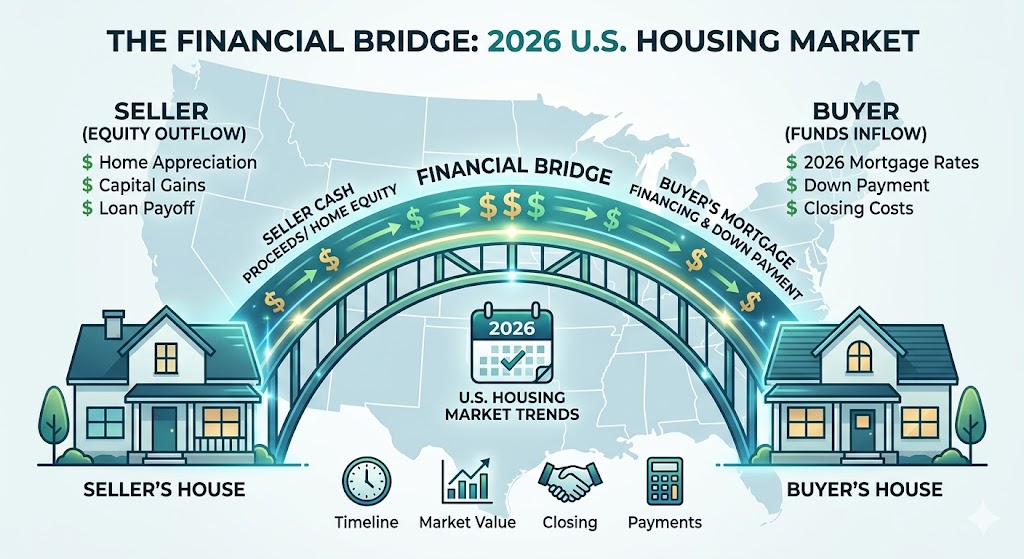
A bridge loan is a short-term, asset-backed loan that uses the equity in your current home to fund the down payment — or the full purchase — of your next home before your old home sells. In 2026, bridge loans typically run 6–12 months and carry rates higher than conventional mortgages because lenders hold them on their own books rather than selling them to the secondary market.
| Bridge Loan Detail | 2026 USA Typical Range |
|---|---|
| Loan Term | 6–12 months typical; up to 24 months with some portfolio lenders |
| Interest Rate (2026) | 8.5%–10.5% (Prime ~7.5% + lender spread of 1%–3%) |
| Max Loan-to-Value | Up to 80% of departing home's appraised value minus existing mortgage |
| Typical Loan Amount | $50,000–$500,000 depending on equity and market tier |
| Closing Costs | 1.5%–3% of bridge loan amount (origination + title + appraisal) |
| Min Credit Score | 680 for most lenders; 720+ for best rates; 760+ for interest-only structures |
| Min Equity Required | 20%–30% equity in departing property |
Real Example: How a Bridge Loan Works on a 2026 USA Home Purchase
Sarah and Marcus are a dual-income couple in suburban Columbus, Ohio. They own a home currently appraised at $340,000 with a remaining mortgage balance of $198,000, giving them $142,000 in equity — but almost none of it in liquid savings. Their target home is listed at $465,000 in a Dublin, Ohio neighborhood where homes routinely go under contract within a week. The sellers won't accept a sale-contingent offer in this market, and Sarah and Marcus can't pull $93,000 for a 20% down payment out of thin air.
Their portfolio lender calculates a bridge loan as follows: $340,000 × 80% = $272,000 minus the $198,000 balance = $74,000 bridge loan. Combined with $19,000 in savings, they cover the $93,000 down payment. The bridge loan at 9.5% costs $585 per month in interest. Their new mortgage on $372,000 at 6.875% (30-year fixed) runs $2,443 per month. While their old home is still listed, they carry both the bridge interest ($585) and their old mortgage ($1,090) alongside the new payment — a total of $4,118 per month for approximately 55 days until closing on the Columbus home.
When the Columbus home sells at $338,500 (slightly under list), the net proceeds after paying off the $198,000 mortgage, $74,000 bridge loan, and closing costs leave Sarah and Marcus with approximately $52,000 — which they redirect to an emergency fund. The full bridge-to-payoff cycle runs 68 days and costs $1,326 in total bridge interest, a fraction of the equity captured by winning a competitive offer without a contingency clause.
A subtle adjustment would have saved them more: had they priced the Columbus home $8,000 under market on day one, comparable data suggests it likely would have sold in under 10 days, cutting bridge interest costs by nearly $390 and eliminating one month of overlapping mortgage payments entirely.
How Bridge Loan Mechanics Work Differently Across USA Market Types in 2026
Bridge loan strategy doesn't work the same way from city to city — the size, rate, lender type, and risk profile all shift based on where you're buying. In high-cost coastal metros like San Francisco and Boston, where the median home price tops $900,000 and $700,000 respectively, buyers frequently need $300,000–$500,000 bridge loans. Lenders in those markets require jumbo bridge products, run stricter debt-to-income calculations, and typically demand combined DTI below 43% even with strong equity. At a 9.5% rate, a $400,000 bridge loan costs $3,167 per month in interest alone — an uncomfortable but often necessary carrying cost when a home purchase nets $200,000+ in equity gains over a three-year hold.
In competitive Sun Belt markets — Austin, Nashville, Charlotte — the driver isn't loan size, it's speed. Median prices in these markets range from $380,000 to $510,000, and bridge loans are used less as a necessity and more as a tactical move to compete without a contingency, functioning almost like a cash offer alternative. A $120,000 bridge loan in Nashville at 9.25% costs $924 per month — and in a market where sellers routinely choose clean offers over contingent ones, that cost is often worth it to secure the property. In affordable Midwest and Southern markets like Indianapolis, Memphis, or Tulsa — where median prices run $220,000–$310,000 — bridge loan amounts are smaller ($40,000–$90,000), but equity is often thinner too, which makes lender approval tighter on the LTV side.
The 2026 lender landscape matters here. Big national retail banks — Chase, Bank of America, Wells Fargo — have largely pulled back from residential bridge lending since 2023, citing portfolio risk. Regional banks, community credit unions, and independent portfolio lenders now carry most of this market. Private and hard money lenders fill the edges where conventional bridge products won't reach, but at 11%–14% rates — nearly double what a portfolio lender charges a well-qualified borrower. If you're buying in a major metro, finding a lender who actively originates bridge loans in your area is the single most important step before submitting any offer.
| Market Type | Example City | Typical Bridge Loan Size | 2026 Rate Range | Key Lender Type |
|---|---|---|---|---|
| High-Cost Coastal | San Francisco, Boston | $300,000–$500,000+ | 9.0%–10.5% | Jumbo portfolio lenders |
| Competitive Mid-Tier | Austin, Nashville | $100,000–$200,000 | 8.75%–10.0% | Regional banks, credit unions |
| Affordable Entry-Level | Indianapolis, Memphis | $40,000–$90,000 | 8.5%–9.75% | Community banks, credit unions |
Credit Score and Qualification Reality for 2026 Bridge Loan Borrowers
Bridge loans are portfolio products — your lender writes the rules, not Fannie Mae or Freddie Mac. In practice, this means stricter credit floors and much heavier scrutiny on combined debt-to-income than a conventional purchase mortgage. Most portfolio lenders in 2026 require a minimum 680 FICO score, but the real threshold where rates meaningfully improve is 720+. At 760 and above, some lenders will offer interest-only bridge structures that keep monthly cash outflow lower during the transition period. A borrower with a 690 score and the same equity as a 740-score borrower will pay roughly 0.75%–1.25% more on the bridge loan rate — a real difference worth addressing before you apply.
- DTI stack reality: Lenders calculate your combined DTI by adding the bridge loan interest payment, your existing mortgage (if the home hasn't sold yet), and your new mortgage payment together. On a $465,000 purchase with a $74,000 bridge loan and a remaining old mortgage of $1,090/month, your combined monthly debt load could hit $4,100+. At a gross household income of $135,000/year ($11,250/month), that's a 36.4% DTI — within limits. At $105,000/year, that same picture hits 39.2% — still passable, but at the edge of many lenders' 40% maximum for bridge products. Know your numbers before you apply.
- Pending sale vs. no listing: If your departing home is already under contract when you apply for a bridge loan, lenders treat your exit strategy as confirmed. Approval odds improve noticeably and some lenders will drop the rate by 0.25%–0.50%. If you haven't listed yet, lenders may still approve you but will require a signed listing agreement, a current CMA supporting your estimated sale price, and evidence of buyer demand in your local market. The difference between "listed and under contract" vs. "not yet listed" is the single biggest approval variable most buyers underestimate.
- W-2 vs. self-employed income: W-2 borrowers generally qualify faster and at better terms because income documentation is straightforward. Self-employed borrowers need two full years of tax returns, and lenders use the lower of the two-year average — not the most recent year. If your 2024 income was $180,000 but 2023 was $130,000, your qualifying income is $155,000, which compresses your maximum bridge loan size. Self-employed borrowers should expect a more intensive underwriting review and sometimes a 0.25%–0.50% rate premium over W-2 borrowers with identical credit profiles.
Bridge Loan vs. Alternative Financing Options for 2026 USA Home Buyers
Many buyers first hear about bridge loans after their HELOC gets frozen or their contingent offer gets rejected — meaning they find this product reactively, not proactively. Understanding all the tools available before you make an offer is what separates buyers who win cleanly from those who scramble at the last minute. The comparison below is anchored to a common 2026 scenario: you own a home worth $320,000 with a $185,000 balance (giving you $135,000 in equity) and you're targeting a $430,000 purchase with a 20% down payment requirement of $86,000.
A bridge loan lets you tap up to $71,000 of your equity (80% of $320,000 = $256,000 - $185,000 balance) quickly — enough to cover most of the down payment with modest savings topping the rest. A HELOC on the same home could theoretically reach the same amount, but here's the critical 2026 reality: most mortgage lenders will freeze or reduce a HELOC line once your home is listed for sale. If you apply for a HELOC with the intent to list in 60 days, you may find the line slashed or cancelled before you can draw it. This makes HELOCs unreliable in fast markets. Home equity loans are more stable (fixed lump sum), but they take 30–45 days to close — too slow in markets where winning offers close in under 21 days.
The 80-10-10 piggyback structure works well if you have enough cash to cover 10% down without touching your home equity — it avoids PMI on the new purchase but doesn't unlock equity you haven't already saved. A sale contingency offer remains the lowest-cost option on paper, but in competitive 2026 markets, sellers routinely reject contingent offers when they have competing non-contingent bids — making this a viable choice only in soft, buyer-friendly markets where inventory exceeds 3 months of supply.
| Financing Option | Down Payment Unlocked | Approx. 2026 Rate | Best Use Case | Key Risk |
|---|---|---|---|---|
| Bridge Loan | Up to 80% LTV minus balance (~$71,000 in example) | 8.5%–10.5% | Competitive market, fast close needed (under 21 days) | Dual carrying costs for 45–90 days |
| HELOC on Departing Home | Up to 85–90% CLTV (~$73,000 in example) | Prime + 0.5%–1.5% (~8.0%–9.0% variable) | Plenty of lead time, home not yet listed | Lender may freeze line when home goes to market |
| Home Equity Loan | Up to 80–85% CLTV (~$57,000–$87,000) | 7.5%–9.5% fixed | You need a set lump sum and have 30–45 days | Second lien complicates new purchase underwriting |
| 80-10-10 Piggyback | Avoids PMI with 10% down; no equity tap needed | First: ~6.75%; Second: ~9.0%–10.0% | Buyers with 10% saved but not 20% | Requires 10% cash savings upfront |
| Sale Contingency Offer | Full equity available after sale | No additional cost | Buyer's market; 4+ months inventory; patient sellers | Offer rejected in any competitive market |
Step-by-Step: How to Get a Bridge Loan for a 2026 USA Home Purchase
- Step 1 — Calculate your real equity position: Don't rely on Zillow estimates. Hire a local real estate agent for a free comparative market analysis (CMA) or pay $350–$500 for a licensed appraisal. Then run the bridge loan formula: (appraised value × 80%) minus your remaining mortgage balance. On a $310,000 home with a $175,000 balance, that's ($248,000 - $175,000) = $73,000 maximum bridge loan. This is your buying power before you even apply.
- Step 2 — Find a bridge-loan-active lender: Skip the big retail banks — they rarely carry residential bridge products in 2026. Target regional banks with portfolio lending divisions, community credit unions, and independent mortgage lenders who specifically advertise bridge financing. Ask these three questions upfront: (1) Is the bridge loan interest-only or fully amortizing? (2) What are the extension options and fees if my home doesn't sell on time? (3) Is there a prepayment penalty if I pay off in under 90 days?
- Step 3 — Get pre-approved on the new mortgage simultaneously: Many portfolio lenders will underwrite both the bridge loan and the new purchase mortgage together, stacking the DTI calculations in one review. Doing both with the same lender often improves approval odds because the lender can see the full transaction picture rather than reviewing two isolated applications. It also frequently simplifies the closing process — both transactions coordinated through one title team.
- Step 4 — List your departing home: Getting your current home listed — ideally with a signed purchase contract in hand — gives your lender concrete exit strategy evidence. A property listed and under contract at time of bridge application can unlock better rates and faster approval. Most bridge approvals complete in 14–21 days; with a strong file and an active listing, some portfolio lenders close bridge loans in under 10 business days.
- Step 5 — Close on the new home using bridge funds: At closing, bridge loan proceeds are wired directly to the title company and appear on your settlement statement as a separate funding source for the down payment. In same-week dual closings, your escrow officer will sequence the sale of your old home first and the purchase of the new home second — sometimes on consecutive days — to ensure proceeds flow correctly.
- Step 6 — Sell your home and retire the bridge loan: Once your departing home closes, the bridge loan is paid off from the net proceeds before any remaining equity reaches your hands. The payoff wires directly from the closing agent to your bridge lender. From bridge loan opening to full payoff, the typical cycle in 2026 runs 55–90 days in active markets — though in slower markets, plan for up to 5–6 months and ensure your bridge agreement includes at least one extension option.
Costly Mistakes 2026 Bridge Loan Borrowers Make (And How to Avoid Them)
- Overestimating sale price: Buyers frequently size their bridge loan assuming the top of their home's value range. When the home sells 4%–6% below expectations — common when sellers overprice by $15,000–$20,000 — the net proceeds may not fully retire the bridge loan. The fix is simple: run your bridge math against a sale price 5% below your list price. If it still works, proceed. If it doesn't, either reduce the bridge loan size or increase your cash buffer before applying.
- Ignoring the full payment stack: On a $430,000 purchase in a mid-tier market, a buyer carrying a $74,000 bridge loan at 9.5%, a new mortgage of $2,443/month, and an old mortgage of $1,090/month faces a combined monthly obligation of approximately $4,118 during the overlap period. At a $130,000 household income, that's 38% of gross monthly income going to housing — tight but manageable. At $95,000 household income, that same stack hits 52% — a serious cash flow strain that can surprise buyers who only focused on the new mortgage payment in isolation.
- Defaulting to hard money when you don't have to: Buyers who can't immediately find a portfolio bridge lender sometimes accept hard money terms out of convenience. At a 12% hard money rate vs. 9.5% from a portfolio lender, a $100,000 bridge loan running 90 days costs $3,000 vs. $2,375 — a $625 difference. On a $250,000 bridge loan, that same rate gap costs $1,563 more over 90 days. A few extra phone calls to regional banks and credit unions almost always uncover better options for borrowers with 700+ credit scores.
- No extension clause in the original agreement: If your home sits unsold at month 6, your bridge lender can technically call the loan. Negotiating a 3–6 month extension option before you sign — at a pre-agreed extension fee of 0.5%–1% of the bridge amount — gives you a safety net that costs nothing unless you actually need it. Never sign a bridge loan agreement without it.
- Opening new credit lines during the bridge period: A new car loan, credit card, or any credit inquiry between bridge approval and final payoff can trigger a mid-process credit re-pull. If your score drops or your DTI shifts, lenders may revise terms or delay funding. Freeze all new credit activity the moment your bridge application is submitted and don't unfreeze it until both closings are complete.
Bridge Loan Cost Comparison with Real 2026 USA Numbers
| Scenario | Bridge Loan Amount | Rate (2026 Est.) | Monthly Interest Cost | 90-Day Total Cost | Net Position at Payoff |
|---|---|---|---|---|---|
| Entry-Level Buyer — Indianapolis, IN ($240K home, $145K balance) | $47,000 | 9.0% | $353/mo | $1,058 | ~$28,000 remaining equity after payoff and costs |
| Mid-Tier Move-Up Buyer — Charlotte, NC ($390K home, $228K balance) | $84,000 | 9.5% | $665/mo | $1,995 | ~$74,000 remaining equity after payoff and costs |
| High-Cost Metro Buyer — Boston, MA ($820K home, $490K balance) | $166,000 | 10.25% | $1,418/mo | $4,254 | ~$146,000 remaining equity after payoff and costs |
The entry-level buyer in Indianapolis faces the tightest math. A $1,058 bridge cost over 90 days is manageable, but thin equity at payoff means less financial cushion post-sale. This is the scenario where a simultaneous close (where the sale and purchase happen on the same day) is worth aggressively pursuing — it eliminates the bridge loan cost entirely if the title company can coordinate both transactions. The mid-tier Charlotte buyer sits in the sweet spot: $1,995 in bridge costs against $84,000 in equity unlocked is a clear value trade, especially in a market where non-contingent offers reliably win bidding situations. The Boston buyer's $4,254 bridge cost sounds steep, but against a $650,000+ purchase where a clean offer may win over a $30,000-higher contingent bid, the economics strongly favor the bridge approach. The break-even test: if the bridge loan's total cost is less than the purchase price premium you'd have to offer to win with a contingency — and in most 2026 competitive markets, it is — the bridge loan wins financially.
How to Cut Your Bridge Loan Costs in 2026 — Strategies That Actually Work
- Choose interest-only payments: Most portfolio bridge lenders offer interest-only payment structures. On a $120,000 bridge at 9.5%, a fully amortizing 12-month loan runs $10,466/month (principal + interest). Interest-only on the same loan runs $950/month — a dramatic difference for buyers managing dual housing costs during the transition period. Always ask for interest-only as your default structure.
- Price your departing home to sell in the first 30 days: Every month the bridge loan stays open is real money. On a $100,000 bridge at 9.5%, each additional month costs $792. Pricing $8,000–$12,000 below the top of your range often generates multiple offers and an accelerated close that saves more in bridge interest than the price concession costs. Run the math before you set your list price — not after your first price reduction.
- Bundle bridge and purchase mortgage with one lender: Portfolio lenders who originate both your bridge loan and your new purchase mortgage often have pricing flexibility unavailable on standalone bridge applications. Ask specifically: "What's the rate if I do my purchase loan with you at the same time?" Bundled discounts of 0.25%–0.50% on the bridge rate are common and rarely advertised proactively.
- Time the bridge to avoid dual property tax due dates: In states like Texas, Illinois, and California, semi-annual property tax bills hit in April/May and October/November. Owning two homes across one of those due dates means paying property taxes on both simultaneously. On two $350,000 homes in a 1.5% effective tax rate market, that's an extra $2,625 in a single billing period. If you can close your old home sale 3–4 weeks before a tax due date, you avoid the double-billing entirely.
- Explore the simultaneous close option first: Before taking any bridge loan, ask your agent and title company whether a same-day back-to-back close is feasible. In this structure, your old home closes in the morning, proceeds wire to escrow, and your new home closes the same afternoon. When timing aligns, this eliminates bridge loan costs completely — no origination fee, no interest, no dual carrying period. It requires seller flexibility on both ends, but in non-peak-season markets, it's more achievable than buyers expect.
- Request a rate lock on your new mortgage before the bridge closes: Mortgage rates in 2026 are subject to Fed policy movement. If you apply for your purchase mortgage and bridge loan simultaneously, lock the new mortgage rate as early as the lender allows — typically 30–60 days. If rates rise 0.25% between your bridge application and your new mortgage close, the savings from an early lock can partially or fully offset your total bridge interest cost.
Frequently Asked Questions: Bridge Loans for USA Home Purchases in 2026
What is the current interest rate for a bridge loan in 2026?
Bridge loan rates in 2026 typically range from 8.5% to 10.5% for well-qualified borrowers, based on the Federal Reserve prime rate (approximately 7.5%) plus a lender spread of 1%–3%. For context, the current 30-year fixed mortgage rate runs approximately 6.5%–7.0% — so expect to pay roughly 2%–3.5% more for a bridge loan because of its short-term, portfolio-held nature. Hard money bridge loans from private lenders are higher still at 11%–14%, and those rates apply mainly to borrowers who can't qualify for conventional bridge products due to low credit scores or insufficient equity documentation.
Can I get a bridge loan if my home isn't listed yet?
Yes — many portfolio lenders will approve a bridge loan before your old home hits the market, but the approval criteria are stricter and rates are typically 0.25%–0.5% higher than if you were already listed. Lenders want to see a credible exit strategy, which means you should come prepared with a signed listing agreement, a CMA showing comparable sales within 90 days, and a confirmed list date. If your neighborhood has strong recent absorption data — homes selling in under 20 days — use that as supporting evidence. The clearer your exit plan, the better your terms.
How long does a bridge loan take to close in 2026?
Portfolio bridge loans in 2026 typically close in 10–21 days — significantly faster than the 30–45 days a conventional purchase mortgage requires. The primary timing variables are the appraisal (5–10 days in most markets), title work (3–7 days), and lender underwriting queue. Private and hard money bridge lenders can close in as few as 5–7 days for straightforward equity situations, though those faster timelines typically come with higher origination fees. If you're in a market where winning offers close in 14 days, confirm your bridge lender's timeline before making any offer.
What happens if my home doesn't sell before the bridge loan matures?
Most bridge loan agreements include a 6–12 month primary term with one or two extension options at a fee of 0.5%–1% of the bridge loan amount. On a $100,000 bridge loan, that's a $500–$1,000 extension fee for an additional 3–6 months of runway. If the home remains unsold after all extension periods are exhausted, the lender can declare the loan in default and force a sale — which is why building an aggressive price-reduction plan into your listing strategy from day one is non-negotiable. Negotiate extension terms before you sign, not after the maturity date arrives.
Is a bridge loan better than a HELOC for buying a new home?
In fast-moving 2026 markets, a bridge loan almost always wins over a HELOC — not because it's cheaper (it's not), but because HELOCs have a critical vulnerability: most lenders freeze or reduce HELOC lines once a property is listed for sale. A $80,000 HELOC you planned to draw at closing may get cut to $20,000 two weeks before you need it. Bridge loans don't have this risk — the lender knows the exit plan is the sale and structures the loan accordingly. On a $120,000 equity tap over 90 days, the HELOC at 8.5% costs $2,550 in interest vs. $2,850 at 9.5% for a bridge loan — a $300 difference that's rarely worth the unreliability risk in a competitive market.
Do all states allow bridge loans for residential purchases?
Bridge loans are legal in all 50 states, but institutional lender availability varies considerably. States with strong portfolio lender ecosystems — Texas, Florida, Colorado, and the Carolinas — have deep bridge lending markets with competitive rates. States with stricter consumer lending regulations or lower home values relative to national averages — including some parts of the Northeast and upper Midwest — may have fewer institutional bridge lenders active in the residential space, pushing more buyers toward private lenders at higher rates. If you're buying in a state where you're receiving few portfolio bridge loan quotes, a national independent mortgage broker with bridge loan experience can often source lenders from outside your immediate metro.
Your Next Step: Is a Bridge Loan Right for Your 2026 Home Purchase?
Run through these three questions right now: Do you have at least 20% equity in your current home? Is your credit score 680 or above? Are you buying in a market where contingent offers regularly get passed over? If you answered yes to all three, a bridge loan for home purchase is a serious option worth getting pre-approved on — getting a bridge pre-approval costs nothing and positions you to make clean, competitive offers. Use a mortgage calculator to test your combined carrying cost scenario before you apply, and talk to a local portfolio lender or independent mortgage broker who actively originates bridge products in your area — not a retail bank branch that may not carry this product at all.