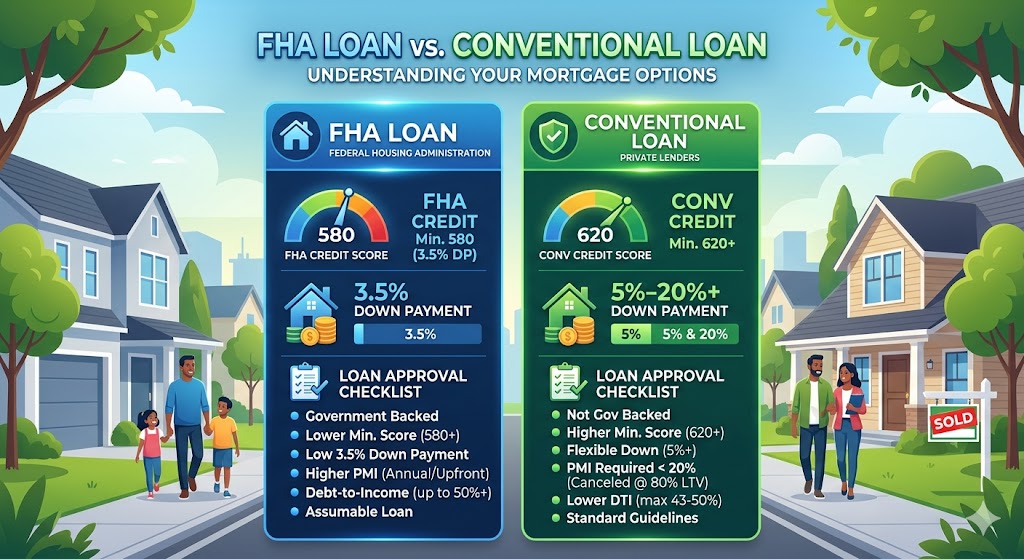
Conventional Loan vs FHA 2026
The Real 2026 Choice Between FHA and Conventional Loans
If you are comparing a conventional loan vs FHA in 2026, the real question is not only “which one can approve me?” — it is which loan gives you the lowest useful payment for your credit score, down payment, home price, and future refinance plan. On a $420,000 home, the difference between FHA, 3% conventional, 5% conventional, and 20% conventional can change your payment by hundreds of dollars each month before taxes and insurance.
Quick Answer: FHA vs Conventional Loan Snapshot for 2026
FHA is usually stronger for buyers with lower credit scores, smaller savings, or higher debt-to-income ratios. Conventional is usually stronger for buyers with cleaner credit, 5% to 20% down, and a plan to remove PMI instead of carrying FHA mortgage insurance for years.
| Detail | FHA Loan 2026 | Conventional Loan 2026 |
|---|---|---|
| Minimum Credit Score | 580 for 3.5% down; 500–579 may need 10% down | Usually 620 minimum, stronger pricing often starts around 680–740 |
| Minimum Down Payment | 3.5% | 3% for some first-time buyer programs; 5% is common |
| Mortgage Insurance | 1.75% upfront MIP plus annual MIP, often 0.55% for many 30-year low-down-payment loans | PMI usually required under 20% down and may be removable later |
| Best For | Credit-challenged buyers, low-savings buyers, and buyers needing more flexible approval | Stronger-credit buyers, buyers with 5%+ down, and buyers focused on long-term cost |
| Loan Limit | $541,287 floor; up to $1,249,125 in high-cost areas for one-unit homes | $832,750 baseline; up to $1,249,125 in high-cost areas for one-unit homes |
| Seller Acceptance | Can work well, but some sellers worry about FHA appraisal repairs | Often viewed as a cleaner offer in competitive markets |
Real Example: Comparing FHA and Conventional on the Same Home
Maria and Daniel want to buy a $420,000 home in 2026. Their combined income is $92,000, they have $25,000 saved, and Maria’s middle credit score is 642. They are not trying to buy luxury property; they are trying to keep enough cash after closing for moving costs, repairs, and an emergency fund.
With an FHA loan, their 3.5% down payment is $14,700. The base loan is $405,300, and if the 1.75% upfront FHA mortgage insurance premium is financed, the starting loan balance is about $412,393. At 6.28% APR over 30 years, the principal and interest payment is about $2,547. Add estimated FHA monthly MIP of about $186, and the loan payment before taxes and homeowners insurance is about $2,733.
With a conventional 3% down loan, their down payment is $12,600 and the loan amount is $407,400. At the same 6.28% APR, the principal and interest payment is about $2,516. If PMI is estimated at 0.65% of the loan amount per year because of their 642 score and low down payment, PMI adds about $221 per month. That puts the conventional 3% payment near $2,737 before taxes and homeowners insurance.
On paper, FHA and 3% conventional look almost tied in this case. The real difference is approval strength and future flexibility. FHA may be easier for their credit profile, but conventional PMI may be removable later if they build equity and meet the servicer’s rules. If they waited three months, improved the score to around 680, and used a 5% conventional setup, the payment could move closer to $2,614 instead of about $2,733.
How FHA and Conventional Loans Work Differently in 2026
FHA loans are insured by the Federal Housing Administration. That insurance helps lenders approve some buyers who may not fit a clean conventional profile. A buyer with a 600 score, a small down payment, and a higher debt load may have a better chance with FHA than with conventional.
The tradeoff is cost structure. FHA loans usually include an upfront mortgage insurance premium of 1.75% of the base loan amount, and most low-down-payment 30-year FHA buyers also pay annual mortgage insurance each month. On a $400,000 purchase with 3.5% down, the base loan is $386,000, the financed upfront MIP is about $6,755, and the monthly MIP at 0.55% is about $177.
Conventional loans are not government-insured the same way. They follow Fannie Mae or Freddie Mac-style rules when they are conforming loans. The 2026 baseline conforming loan limit for a one-unit home is $832,750, which gives conventional buyers more standard-market buying power than FHA’s $541,287 floor in many lower-cost counties.
The practical meaning is simple: FHA can be easier to enter, while conventional can be cheaper to exit. If your credit score is weak today, FHA may help you buy sooner. If your score is strong and your down payment is at least 5%, conventional often deserves a serious side-by-side quote.
| Feature | FHA | Conventional |
|---|---|---|
| Government Backing | Yes, FHA-insured | No FHA insurance; follows conventional investor rules |
| Credit Flexibility | Stronger for lower scores | Stronger pricing for higher scores |
| Long-Term Insurance | MIP can last a long time, sometimes life of loan | PMI can often be removed after enough equity |
Credit Score Reality: FHA vs Conventional Approval in 2026
Credit score is one of the biggest decision points in the conventional loan vs FHA 2026 comparison. FHA rules allow 3.5% down at 580 or higher, while many conventional loans need at least 620. But approval is not the same as good pricing.
- At 580–619, FHA is usually the more realistic path. A conventional approval may be difficult, and if it works, the PMI and rate can be expensive.
- At 620–679, both options may be possible. FHA may still win on approval flexibility, but conventional can start to compete if the borrower has 5% down and stable income.
- At 680–740+, conventional often becomes stronger. PMI can be lower, seller confidence may improve, and the borrower may avoid FHA’s upfront MIP.
A buyer with a 620 score and 3% down may not get the same conventional pricing as a buyer with a 740 score and 10% down. That is why you should compare the full monthly payment, not just the minimum score rule.
Down Payment Difference Between FHA and Conventional Loans
FHA is famous for 3.5% down, but conventional can go as low as 3% for eligible buyers. That does not automatically make conventional cheaper. A lower down payment can raise PMI, and a weaker credit score can make conventional pricing worse.
Use the down payment as the first filter, not the final answer. On a $300,000 home, the difference between FHA 3.5% down and conventional 3% down is only $1,500. On a $650,000 home, the difference is $3,250. That small cash difference may matter, but the monthly mortgage insurance difference may matter more.
If you have exactly 3% to 3.5% saved, the better loan may depend on your score and debt-to-income ratio. If you have 5% down, conventional gets more competitive. If you have 20% down, conventional usually becomes the cleaner choice because you can avoid PMI altogether.
| Home Price | FHA 3.5% Down | Conventional 3% Down | Conventional 5% Down |
|---|---|---|---|
| $300,000 | $10,500 | $9,000 | $15,000 |
| $420,000 | $14,700 | $12,600 | $21,000 |
| $650,000 | $22,750 | $19,500 | $32,500 |
The hidden mistake is using all savings for down payment. A buyer who puts 5% down but has no repair money left may be in a weaker position than a buyer who uses FHA, keeps reserves, and improves credit after closing.
Mortgage Insurance: The Biggest Cost Difference in 2026
Mortgage insurance is where the conventional loan vs FHA 2026 decision gets serious. FHA has two layers: upfront MIP and monthly annual MIP. Conventional usually has PMI only when you put less than 20% down.
On a $420,000 purchase with FHA 3.5% down, the monthly MIP estimate is about $186. On a conventional 3% down loan with an estimated 0.65% PMI factor, PMI is about $221 per month. But if that same buyer qualifies for a 5% down conventional loan with better PMI around 0.45%, the PMI estimate drops to about $150 per month.
| Loan Feature | FHA Mortgage Insurance | Conventional PMI |
|---|---|---|
| Upfront Cost | Usually 1.75% of base loan amount | Usually no upfront PMI requirement |
| Monthly Cost | Often around 0.55% annually for many 30-year low-down-payment loans | Varies by credit score, down payment, and loan profile |
| Can It Be Removed? | Often requires refinance unless FHA rules allow cancellation based on loan term and LTV | Can often be requested at 80% balance-to-original-value and may auto-terminate later |
2026 Loan Limits: FHA vs Conventional Buying Power
Loan limits matter when the home price is above entry-level. In 2026, the baseline conforming loan limit for a one-unit conventional mortgage is $832,750. FHA’s one-unit floor is $541,287 in lower-cost areas, with higher FHA limits in high-cost counties up to $1,249,125.
This means conventional can offer more room in many normal-cost markets. For example, a buyer using 5% down on an $800,000 home would need a $760,000 loan, which fits under the 2026 conforming baseline. The same loan amount may be above the FHA floor in many counties, unless that county has a higher FHA limit.
In high-cost areas, both FHA and conventional limits can reach $1,249,125 for one-unit homes. But payment strength still matters. A larger approved loan does not mean the payment is safe after taxes, insurance, HOA dues, and repairs.
Seller Acceptance: Why Conventional Offers Can Look Stronger
In a competitive offer situation, conventional loans can look cleaner to a seller. The reason is not that FHA buyers are bad buyers. The reason is that FHA has property condition standards, and sellers may worry that the FHA appraisal will require repairs before closing.
For example, James offers $410,000 on a home that needs peeling paint repaired, a missing handrail fixed, and an older roof reviewed. With FHA, those items may trigger more questions before closing. With conventional, the lender still cares about value and safety, but the seller may expect fewer repair-related delays.
That does not mean FHA buyers cannot win. A strong FHA offer can include a solid preapproval, realistic closing timeline, clean documents, and enough savings to handle small repair negotiations. If the home is in good condition and priced fairly, FHA can still be a serious offer.
- FHA appraisal concerns can matter more on older homes, fixer homes, and properties with visible safety issues.
- Conventional buyers may appear stronger when they have higher credit, larger down payment, or fewer repair conditions.
- FHA buyers can compete by choosing homes in better condition and keeping cash reserves for inspection and closing issues.
If James switched from FHA to a 5% conventional loan after raising his score and adding $6,000 more cash, his offer could look cleaner without changing the purchase price.
Who Should Choose FHA and Who Should Choose Conventional in 2026?
The best choice depends on where your file is weak. If your weak point is credit score, FHA may solve the approval problem. If your weak point is long-term cost, conventional may solve the insurance problem. If your weak point is cash, both loans need to be priced carefully.
| Buyer Situation | Better Loan Choice | Reason |
|---|---|---|
| Credit score around 580–619 with limited savings | FHA | More flexible credit path and 3.5% down if score is 580+ |
| Score around 680+ with only 3% down | Compare both | Conventional may work, but PMI must be checked against FHA MIP |
| Buyer with 10% or 20% down | Conventional | Lower or no PMI can make long-term cost better |
| Buyer in a competitive offer situation | Often conventional | Sellers may view it as cleaner, especially on older homes |
FHA vs Conventional Payment Comparison with Real 2026 Numbers
| Loan Type | Down Payment | Estimated Monthly Payment | Best For |
|---|---|---|---|
| FHA Loan on $420,000 home | $14,700 | About $2,733 before taxes and insurance | Buyer with lower credit or approval flexibility needs |
| Conventional 3% Down on $420,000 home | $12,600 | About $2,737 before taxes and insurance | Eligible buyer with limited cash and decent credit |
| Conventional 5% Down on $420,000 home | $21,000 | About $2,614 before taxes and insurance | Buyer with better credit and more savings |
| Conventional 20% Down on $420,000 home | $84,000 | About $2,075 before taxes and insurance | Buyer who can avoid PMI completely |
Mistakes Buyers Make When Comparing FHA and Conventional Loans
- Choosing FHA only because the credit score rule looks easier, then ignoring the upfront MIP and long-term monthly MIP cost.
- Choosing conventional only because it sounds stronger, then discovering that PMI and rate pricing are high with a low score.
- Comparing interest rate only instead of comparing full payment, cash to close, mortgage insurance, and refinance options.
- Ignoring property condition. A home with safety or repair issues can create more FHA friction than a clean, move-in-ready home.
Tips to Save Money When Choosing Between FHA and Conventional
- Ask the lender for FHA and conventional quotes using the same home price, same credit score, same taxes, and same insurance estimate.
- Compare the payment after mortgage insurance, not just the interest rate.
- If your score is close to 680, ask whether a small credit improvement could lower PMI enough to make conventional better.
- If you are buying an older home, check whether FHA appraisal repairs could slow the deal or cost money before closing.
- If you are in a high-cost county, confirm both FHA and conventional limits before assuming one loan can cover the price.
- If FHA helps you buy now, keep a refinance plan for later if your credit, equity, or income improves.
FAQ
Is FHA better than conventional in 2026?
FHA can be better if your credit score is lower, your savings are limited, or your debt-to-income ratio needs more flexibility. Conventional can be better if your credit is stronger, you have 5% or more down, and you want mortgage insurance that may be removed later.
Can a conventional loan have a lower down payment than FHA?
Yes. FHA usually requires 3.5% down with a 580+ score, while some conventional programs allow 3% down for eligible buyers. The smaller down payment does not always mean lower cost because PMI can change the monthly payment.
Which loan is easier to qualify for, FHA or conventional?
FHA is often easier for buyers with weaker credit or tighter debt ratios. Conventional usually needs a cleaner file, and many lenders want at least a 620 score. Stronger conventional pricing often comes with higher scores, larger down payments, and stable income.
Which loan has cheaper mortgage insurance?
Conventional PMI can be cheaper for strong-credit buyers, especially with 5%, 10%, or 15% down. FHA MIP can be more predictable, but the upfront MIP and long-term monthly MIP can make it costly if you keep the loan for many years.
Do sellers prefer conventional loans over FHA loans?
Some sellers prefer conventional loans because they expect fewer property-condition issues during appraisal. FHA buyers can still win if the home is in good condition, the preapproval is strong, and the offer has clean terms.
Your Next Step Before Choosing FHA or Conventional
Before you choose, run both loan types with the same home price, down payment, credit score, taxes, homeowners insurance, and mortgage insurance. A mortgage calculator can show the payment difference fast, but a lender quote will show the real pricing for your exact file.