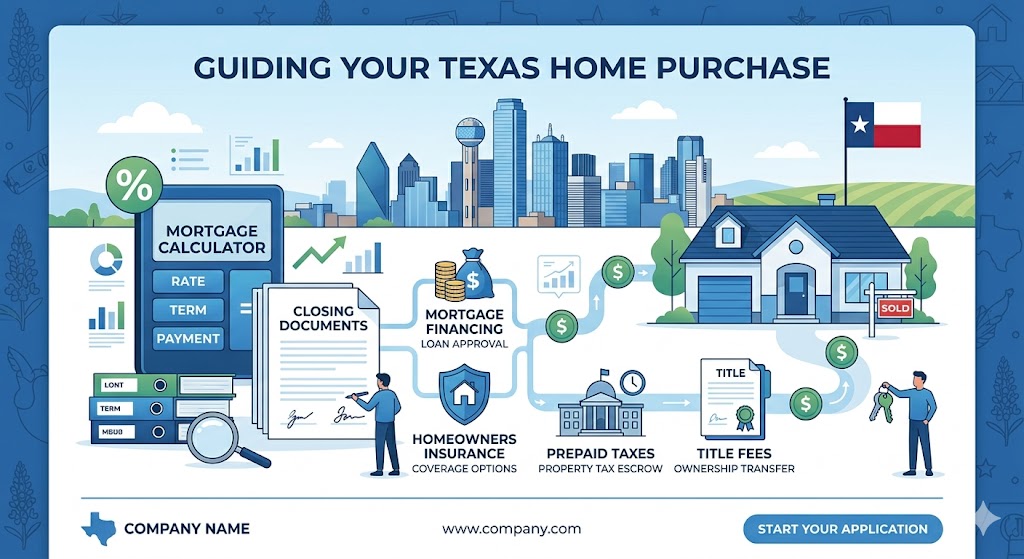
Mortgage Closing Costs Calculator Texas
The Real Closing Cost Problem Texas Home Buyers Face
In Texas, you can qualify for a mortgage and still feel short on closing day because the down payment is only one part of the cash you need. On a $341,800 Texas home, a buyer may need about $8,500 to $12,000 for closing costs before adding the down payment, prepaid taxes, insurance, and escrow reserves.
Quick Answer: Texas Mortgage Closing Costs Snapshot
A Texas mortgage closing costs calculator should estimate both lender/title fees and the prepaid items that push your real cash to close higher. For many Texas buyers, a safe starting estimate is about 2.5% to 3.5% of the purchase price before the down payment.
| Closing Cost Detail | Texas Estimate |
|---|---|
| Typical Home Price Used | $341,800 example Texas home price |
| Estimated Buyer Closing Costs | $8,545 to $11,963 before down payment |
| Lender Fees | $1,500 to $4,500 depending on origination, underwriting, processing, and discount points |
| Title and Escrow Fees | $2,000 to $4,500 depending on title policy, settlement fee, recording, and county charges |
| Prepaid Property Taxes | $800 to $2,400 for many buyers, higher in tax-heavy counties |
| Homeowners Insurance Prepaids | $2,000 to $4,000 for first-year premium plus escrow setup |
| Total Cash to Close | About $20,500 to $24,000 with 3.5% FHA down payment on a $341,800 home |
Real Example: Estimating Closing Costs on a Texas Home
Maria and Daniel are buying a $365,000 home near New Braunfels, between San Antonio and Austin. Their household income is $94,000, and they choose an FHA loan because they want to keep the down payment low while saving cash for moving and repairs.
With 3.5% down, their base loan amount is $352,225. After the FHA upfront mortgage insurance premium is added, the financed loan balance is about $358,389. At 6.28% APR on a 30-year fixed loan, the principal and interest payment is about $2,214 per month before taxes, insurance, and monthly mortgage insurance.
The closing cost estimate changes fast after Texas-specific items are added. They budget $9,800 for lender/title/settlement costs, $1,500 for tax escrow, and $3,180 for the first year of homeowners insurance and insurance escrow. Their full cash to close is not just the $12,775 down payment; it is closer to $27,255 when closing costs and prepaids are included.
This is why a mortgage closing costs calculator Texas buyers use should separate lender charges from prepaid property taxes and insurance. A buyer who only estimates “3.5% down” may walk into closing short by $10,000 or more. If Maria and Daniel negotiated a $5,000 seller credit before signing the contract, their cash to close could drop from about $27,255 to about $22,255 without changing the loan amount.
How a Texas Mortgage Closing Costs Calculator Should Work
A useful Texas calculator should ask for the purchase price, down payment, loan type, loan amount, county, interest rate, lender fees, estimated title fees, homeowners insurance, and property tax estimate. If it only multiplies the price by 3%, it may miss the biggest pressure point in Texas: tax and insurance escrows.
For example, using a $341,800 home and a 1.40% effective property tax estimate, annual property taxes are about $4,785, or about $399 per month. If the buyer’s county, school district, or special district pushes the effective rate closer to 2.00%, the same home could create about $6,836 in annual property taxes, or about $570 per month. That difference does not always show up clearly when a buyer only compares interest rates.
The calculator should also show the difference between closing costs and total cash to close. Closing costs include lender charges, title charges, recording fees, and prepaid items. Cash to close includes those costs plus your down payment, minus earnest money, lender credits, and seller credits. The CFPB Loan Estimate and Closing Disclosure separate these numbers because they answer different questions: “What are the fees?” and “How much money must you bring?”
Texas buyers should use the calculator before making an offer, then again after receiving a Loan Estimate. That second check matters because two lenders can quote the same 6.28% APR but show different origination fees, discount points, lender credits, and escrow estimates. A $2,000 difference in lender fees may not change the monthly payment much, but it can decide whether you have enough money for closing day.
Texas Closing Cost Fees Buyers Should Enter in the Calculator
Texas closing costs usually come from four buckets: lender fees, third-party fees, title/settlement charges, and prepaid items. The lender controls some charges, but taxes, insurance, and title-related costs often depend on the property, county, and loan setup.
| Fee Category | What It Covers | Texas Estimate |
|---|---|---|
| Lender Origination Fee | Charge for making the loan, often shown as a percentage or flat fee | $0 to $3,500 |
| Appraisal Fee | Independent home value report required by the lender | $550 to $850 |
| Credit Report Fee | Credit pull and related verification cost | $30 to $100 |
| Title Insurance | Title policy and related title work tied to ownership and lien checks | $1,800 to $3,800 on many mid-priced Texas homes |
| Settlement or Escrow Fee | Closing office, document handling, and settlement work | $400 to $900 |
| Recording Fees | County recording of deed and mortgage documents | $100 to $300 |
| Prepaid Property Taxes | Initial tax escrow deposit or tax proration at closing | $800 to $2,400, higher in some counties |
| Homeowners Insurance | First-year premium and escrow setup | $2,000 to $4,000 for many buyers |
Why Texas Property Taxes Can Change Your Cash to Close
Texas has no state income tax, but property taxes can be a heavy part of homeownership. A mortgage closing costs calculator Texas buyers trust should let you adjust the property tax rate instead of using one flat national estimate. The difference can be large even when the home price is the same.
Take two buyers purchasing $350,000 homes. Buyer A uses a 1.40% property tax estimate, so the annual tax estimate is about $4,900, or $408 per month. Buyer B uses a 2.20% property tax estimate, so the annual tax estimate is about $7,700, or $642 per month. The monthly difference is about $234, and the lender may also collect a larger escrow deposit at closing.
This matters because tax escrow is not just a future monthly payment. At closing, the lender may collect several months of property tax reserves to set up the escrow account. If your estimate is too low, the calculator may show a comfortable cash-to-close number that later jumps after the lender reviews the property, county, and tax bill timing.
Texas buyers should also watch tax proration. Depending on the closing date, the seller may credit part of the year’s taxes, or the buyer may need more money held for future bills. This is one reason the Closing Disclosure can look different from the first estimate. A similar buyer who checks county tax numbers before the offer stage can avoid a late $1,500 to $3,000 surprise in escrow money.
Closing Cost Differences by Loan Type in Texas
Loan type changes the down payment, mortgage insurance, seller credit rules, and total cash needed. The mortgage closing costs calculator Texas buyers use should not treat FHA, conventional, VA, and USDA loans the same.
| Loan Type | Closing Cost Pattern | Best Texas Buyer Use Case |
|---|---|---|
| FHA Loan | Low 3.5% down payment, upfront mortgage insurance can be financed, monthly MIP added | Buyer with fair credit or limited savings in San Antonio, Fort Worth, Killeen, or outer Houston areas |
| Conventional Loan | Often lower total cost for stronger credit, PMI may be removable later | Buyer with 680+ credit and 3% to 5% down in Dallas, Austin suburbs, or Houston suburbs |
| VA Loan | Often $0 down, VA funding fee may apply unless exempt, seller credits can help | Eligible veteran or service member near San Antonio, Killeen, El Paso, Corpus Christi, or Fort Cavazos area |
| USDA Loan | $0 down in eligible rural/suburban areas, guarantee fee may be financed | Buyer looking outside major city cores, such as smaller towns near Waco, East Texas, or parts of outer metro counties |
Texas Cash to Close: Down Payment Plus Closing Costs
Your down payment is not your full closing-day number. Cash to close includes your down payment, lender fees, title charges, prepaid taxes, prepaid insurance, escrow reserves, and any credits applied to the file.
Here is a simple Texas example using a $341,800 home and a 3.5% FHA down payment. The down payment is $11,963, but the buyer may still need another $10,500 to $12,000 for closing costs and prepaids. That puts the realistic cash-to-close target near $22,500 to $24,000 before subtracting earnest money or seller credits.
| Item | Example Amount |
|---|---|
| Texas Home Price | $341,800 |
| Down Payment | $11,963 at 3.5% |
| Loan Amount | $335,609 after estimated financed FHA upfront MIP |
| Estimated Buyer Closing Costs | $8,545 to $11,963 |
| Prepaids and Escrows | $2,500 to $5,000 depending on taxes and insurance |
| Total Cash to Close | About $22,500 to $29,000 before credits |
How Seller Credits Can Reduce Texas Closing Costs
Seller credits are one of the cleanest ways to lower upfront closing costs in Texas. Instead of lowering the price by a small amount, the seller agrees to pay part of the buyer’s approved closing costs. The buyer still has to qualify for the loan, but the cash needed at closing can drop.
For example, a Houston-area buyer purchases a $320,000 home with 5% down. The loan amount is $304,000, and the estimated principal and interest payment at 6.28% APR is about $1,878 per month. If the buyer’s closing costs and prepaids are $10,800, a $6,000 seller credit can reduce the out-of-pocket closing cost portion to $4,800.
The effect is different from a price cut. A $6,000 price reduction may only lower the monthly principal and interest payment by about $35 to $40, depending on the loan. A $6,000 seller credit can solve an immediate cash shortage. That is why seller credits may be more useful for first-time buyers in Fort Worth, San Antonio, and outer Houston areas where monthly affordability and cash savings both matter.
Seller credits are easier to ask for when listings sit longer, when the home needs repairs, or when the seller has already reduced the price. They are harder in tight neighborhoods where multiple buyers compete for the same home. In a similar situation, using a $6,000 seller credit instead of a small price cut could keep the monthly payment almost the same while protecting the buyer’s emergency savings after closing.
- Seller credits are often easier in slower Texas submarkets where listings have been active for 45 to 80 days.
- Seller credits may be harder in competitive Austin neighborhoods, strong Dallas suburbs, or homes priced below nearby competition.
- Loan type matters because FHA, conventional, VA, and USDA loans have different rules for how much seller help can be used.
Closing Costs Can Look Different Across Texas Cities
A Texas-wide estimate is useful, but city-level costs can move because home prices, taxes, insurance, and buyer competition are not the same across the state. Austin buyers often face higher prices, while Houston buyers may pay close attention to flood insurance and property tax escrow.
| Texas Area | Buyer Cost Pressure | What to Watch |
|---|---|---|
| Dallas-Fort Worth | Medium to high because prices vary widely by suburb | Property tax escrow, new-build incentives, and lender fee differences |
| Houston | Medium, but insurance and flood-zone costs can change the estimate | Homeowners insurance, flood insurance, and tax district differences |
| Austin | High because purchase prices remain higher than many Texas metros | Jumbo loan risk, larger down payments, and bigger title cost estimates |
| San Antonio | Medium because prices are lower than Austin but taxes still matter | FHA affordability, escrow setup, and seller credit opportunities |
| El Paso | Lower purchase price pressure, but loan and escrow math still matter | VA usage, FHA loans, and county tax estimate accuracy |
Texas Closing Cost Mistakes Buyers Should Avoid
- Using only the down payment number. A Texas FHA buyer with 3.5% down on a $341,800 home needs about $11,963 for the down payment, but the full cash to close can be twice that amount after fees and prepaids.
- Ignoring property tax escrow. A 1.40% tax estimate on a $350,000 home is about $408 per month, but a 2.20% estimate is about $642 per month.
- Comparing only interest rates. One lender may offer a lower rate but charge points or higher origination fees, so the Loan Estimate matters.
- Assuming seller credits are automatic. A seller may help in a slower market, but a well-priced home in a strong Dallas or Austin suburb may not come with much room to negotiate.
- Waiting until the Closing Disclosure to check the numbers. The CFPB says the Closing Disclosure shows final loan terms, projected payments, fees, and other closing costs, so review it line by line before signing.
Ways to Lower Closing Costs on a Texas Mortgage
You may not control every fee, but you can reduce mistakes and compare better offers. The goal is not just the lowest monthly payment; it is the cleanest balance between upfront cash and long-term loan cost.
- Compare Loan Estimates from at least two or three Texas lenders, not just online rate quotes.
- Ask whether lender credits are available, then check how much the rate increases in exchange.
- In slower Texas markets, ask for a seller credit before asking for a small price cut.
- Check property tax estimates by county, especially in Harris, Dallas, Bexar, Travis, Collin, Denton, and Fort Bend counties.
- Review homeowners insurance early if the property is near the Gulf Coast, in a hail-prone area, or in a flood zone.
- Avoid buying discount points unless you plan to keep the loan long enough for the monthly savings to recover the upfront cost.
FAQ About Texas Mortgage Closing Costs
How much are closing costs on a house in Texas?
Many Texas buyers should estimate about 2.5% to 3.5% of the purchase price for buyer closing costs before the down payment. On a $341,800 home, that means about $8,545 to $11,963, but taxes, insurance, lender fees, and seller credits can move the number.
Does a Texas mortgage closing costs calculator include the down payment?
A good calculator should show closing costs and total cash to close separately. Closing costs are the fees and prepaids, while cash to close includes the down payment plus those costs minus credits and earnest money.
Are Texas property taxes included in closing costs?
Property taxes can affect closing through prepaid taxes, prorations, and escrow reserves. This matters in Texas because property tax estimates can create a large monthly and upfront escrow difference between counties.
Can the seller pay closing costs in Texas?
Yes, seller credits can pay eligible buyer closing costs when the contract and loan rules allow it. The exact limit depends on loan type, down payment, occupancy, and lender rules, so the buyer should confirm it before counting on the credit.
What is the biggest closing cost for Texas buyers?
For some buyers, title charges or lender fees are the biggest visible costs. For many Texas buyers, prepaid property taxes and homeowners insurance create the larger cash pressure because they affect both closing-day money and monthly escrow.
Your Next Step Before Closing on a Texas Home
Use a mortgage closing costs calculator Texas buyers can adjust by price, loan type, county tax estimate, insurance, lender fees, and seller credits. Then compare the result with your Loan Estimate and Closing Disclosure so you know the full cash to close before signing.