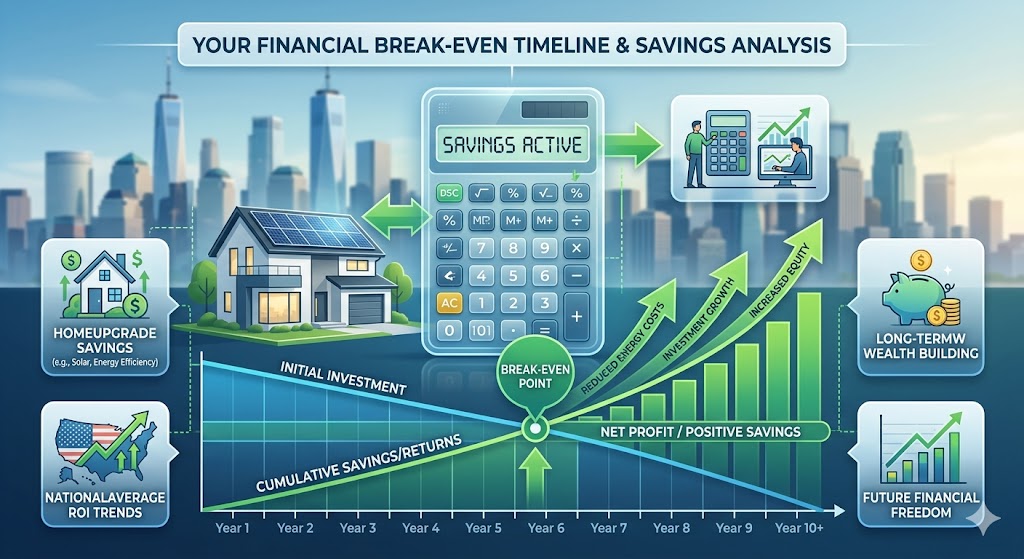
Mortgage Refinance Break Even Calculator USA
The Real Challenge for American Homeowners Considering Refinance
If you refinance a $320,000 mortgage and pay $8,000 in closing costs, even a $200 monthly saving still takes about 40 months to pay back. That is why the mortgage refinance break even calculator USA matters more than the rate quote alone.
Quick Answer: USA Mortgage Refinance Snapshot
A refinance usually makes sense when your monthly savings recover closing costs before you expect to sell, move, or refinance again. With 2026 refinance costs often near 2%–6% of the new loan amount, many USA homeowners need a break-even window of 24–48 months.
| Detail | USA National Number |
|---|---|
| Median Home Value | About $403,200, based on Q1 2026 U.S. median new home sale price |
| Typical Refinance Loan Amount | $250,000–$400,000 for many standard owner-occupied refinances |
| Average Monthly Savings Potential | $150–$350 when dropping roughly 0.75%–1.25% on a $300,000–$350,000 balance |
| Typical Closing Costs | 2%–6% of the new loan amount, or about $6,000–$18,000 on a $300,000 refinance |
| Conforming Loan Limit | $832,750 for a one-unit property in most of the USA in 2026 |
| Current 30-Year Refi Rate | About 6.4%–6.8% for many 30-year refinance quotes, depending on credit, points, and loan type |
Real Example: Refinancing Across the USA
Maria and Luis own a home in a middle-priced suburb outside Atlanta. Their home is worth about $410,000, close to the national median range, and they owe $318,000 on their current mortgage. Their household income is $118,000, and their existing loan has 28 years left at 7.25%.
Their current principal and interest payment is about $2,214 per month. A lender offers them a new 30-year refinance at 6.28% APR with $7,900 in closing costs. The new payment on the same $318,000 balance would be about $1,964 per month, before taxes and insurance.
That creates a monthly savings of about $250. The break-even point is $7,900 divided by $250, which equals about 32 months. If Maria and Luis keep the home for 5 years, the gross savings would be about $15,000, and the net savings after closing costs would be about $7,100.
This is a realistic mortgage refinance break even calculator USA result because the rate drop is not huge, but the balance is large enough for the payment change to matter. If they expected to sell in 18 months, the refinance would likely fail; if they stay 7 years, it becomes much stronger. A similar borrower who takes a slightly lower-cost quote at $6,500 instead of $7,900 could break even around month 26 instead of month 32.
How the Refinance Break-Even Point Works in the USA
The refinance break-even formula is simple: closing costs divided by monthly savings equals months to break even. If your refinance costs $9,000 and lowers your payment by $225 per month, your break-even period is 40 months. You do not truly save money until you pass that point.
The hard part is using honest numbers. Some lenders show a lower payment by restarting the loan term from 25 or 28 years back to 30 years. That can reduce the monthly payment but may increase total interest if you keep the loan for the full term.
For example, a $300,000 mortgage at 7.25% with 28 years left has a payment near $2,088. Refinancing to a fresh 30-year loan at 6.28% drops the payment to about $1,853, saving $235 per month. But if closing costs are $8,500, the break-even period is still about 36 months.
- Fast break-even: $6,000 costs ÷ $300 savings = 20 months.
- Moderate break-even: $8,500 costs ÷ $235 savings = 36 months.
- Weak break-even: $12,000 costs ÷ $150 savings = 80 months.
In a higher-rate environment, many USA homeowners need a larger rate drop before refinancing works. If your current loan is already near 6.25%, a new 6.28% APR loan may not help unless you need cash out, remove mortgage insurance, or change loan terms.
Key Factors That Determine Your USA Refinance Break-Even
Your break-even result depends on three numbers: your new closing costs, your monthly savings, and how long you will keep the home. A $400,000 loan usually creates bigger payment swings than a $180,000 loan, so the same 0.75% rate drop can matter more on larger balances.
Credit score also changes the math. A borrower with a 760 score may qualify for a lower rate or lower points than a borrower near 660. The CFPB also warns borrowers to compare loan estimates because the lowest advertised rate may come with higher upfront charges.
- Rate drop threshold: A 0.50% drop may be weak unless your balance is large; a 1.00% drop often creates clearer savings.
- Credit score impact: A stronger score can reduce rate, points, or mortgage insurance cost.
- Planned stay: If you may sell within 2 years, a 40-month break-even period is usually too long.
The mortgage refinance break even calculator USA should be used before you choose a lender, not after. It helps you see whether the offer is saving real money or only making the monthly payment look smaller.
Best Refinance Loan Types for American Homeowners
A rate-and-term refinance works best when your main goal is a lower rate, shorter term, or better loan structure. This is the cleanest break-even calculation because you compare old payment, new payment, and closing costs without adding new cash debt.
A cash-out refinance is different. If you owe $280,000 and refinance into a $340,000 loan, your payment may rise even if the rate is decent. That can still make sense for home repairs or debt consolidation, but the break-even question must include the new cash use, not just the mortgage payment.
FHA streamline refinance can help FHA borrowers because it may reduce paperwork and may not require a full appraisal in many cases. HUD and FHA rules still matter, and borrowers must check mortgage insurance because a lower rate can be partly offset by FHA mortgage insurance premiums.
Jumbo refinance applies when the loan is above the conforming loan limit in your area. In most of the USA, the 2026 one-unit conforming limit is $832,750, so loans above that amount may need jumbo pricing, stricter reserves, and stronger credit.
| Refi Type | Typical Costs | Best Use Case |
|---|---|---|
| Rate-and-Term Refinance | 2%–5% of loan amount | Lower monthly payment, reduce rate, or switch from 30-year to 15-year |
| Cash-Out Refinance | 3%–6% of loan amount | Access home equity for repairs, payoff, or major planned expenses |
| FHA Streamline Refinance | Often lower documentation, costs vary | Existing FHA borrowers who want a lower payment with less paperwork |
| Jumbo Refinance | 2%–6% of loan amount, often stricter pricing | High-balance borrowers above conforming loan limits |
How to Use the Mortgage Refinance Break Even Calculator USA
Use the calculator with your real loan statement, not rough memory. A difference of $1,500 in closing costs or $40 in monthly savings can change the break-even result by several months.
- Step 1: Gather your current unpaid balance, interest rate, remaining term, and principal-and-interest payment from your mortgage statement.
- Step 2: Get at least two realistic refinance quotes with the new rate, APR, lender fees, points, appraisal, title, and recording charges.
- Step 3: Enter the new loan amount, closing costs, current payment, and new payment into the mortgage refinance break even calculator USA.
- Step 4: Compare the break-even month with your expected stay. A 30-month break-even is useful if you expect to keep the loan for 5–7 years.
- Step 5: Check total interest, not only monthly savings, especially if you restart a 25-year loan into a new 30-year loan.
The calculator should guide your next question to the lender: “How much am I paying upfront to get this lower payment?” That one question often separates a strong refinance from a weak one.
Common Refinance Mistakes American Homeowners Make
The biggest mistake is treating the new monthly payment as the full answer. A lower payment can hide higher total interest, a longer term, or expensive discount points.
- Ignoring the break-even timeline: Saving $175 per month sounds good, but $9,000 in costs takes about 51 months to recover.
- Chasing the lowest rate: A 6.125% quote with two points can cost more than a 6.375% quote with lower fees.
- Refinancing too often: Paying $7,000 in costs every 18–24 months can erase most savings.
- Forgetting mortgage insurance: FHA and conventional loans can have very different monthly insurance costs.
- Skipping APR: The note rate shows interest, but APR helps show rate plus certain loan costs.
Freddie Mac and CFPB-style comparison habits are useful here: compare the full Loan Estimate, not only the headline rate. The best refinance is the one that improves your numbers after costs, not the one that looks cheapest in an ad.
Refinance Savings Comparison with Real USA Numbers
The table below uses a $320,000 refinance balance and realistic 2026-style rate ranges. Taxes, insurance, and HOA dues are not included because they usually continue whether you refinance or not.
Scenario A shows a strong refinance because the rate drop is large and the closing costs are controlled. Scenario B is weaker because the payment savings are smaller, even though the closing costs look normal. Scenario C has higher costs because cash-out and pricing adjustments can add fees.
| Scenario | Monthly Savings | Break-Even | 5-Year Net Savings |
|---|---|---|---|
| Drop from 7.50% to 6.28% on $320,000 with $7,800 costs | About $305 | About 26 months | About $10,500 |
| Drop from 6.90% to 6.28% on $320,000 with $7,200 costs | About $177 | About 41 months | About $3,400 |
| Cash-out style refi from 7.75% to 6.40% with $11,000 costs | About $334 before cash-use adjustments | About 33 months | About $9,000 |
The mortgage refinance break even calculator USA becomes more powerful when you test several versions. Change only one number at a time: closing costs, rate, loan term, or cash-out amount. This shows whether the refinance works because of real savings or because one assumption is too optimistic.
For many homeowners, the best result is not always the lowest rate. A no-point quote at a slightly higher rate may beat a lower-rate quote if you plan to move within 3 years. If you plan to keep the home for 10 years, paying a reasonable point for a lower rate may become more attractive.
Pro Tips to Lower Your Break-Even Point Nationwide
- Compare at least 3 lenders because a $1,200 fee difference can cut several months from your break-even timeline.
- Ask for both a no-point quote and a discount-point quote so you can compare upfront cost against monthly savings.
- Improve your credit score before applying; even a small rate improvement can save $40–$90 per month on larger loans.
- In high-cost states, check title, attorney, and recording charges carefully because local closing costs can change the result.
- In lower-cost Midwest and Southern markets, watch fixed fees because they can feel larger as a percentage of smaller loans.
- Use a shorter term only if the payment still fits your budget; a 15-year refinance can save interest but may raise the monthly bill.
Frequently Asked Questions
What is a good break-even period for refinancing?
A break-even period under 36 months is often strong if you plan to stay in the home for at least 5 years. A 48–60 month break-even can still work, but only when you are confident you will keep the loan long enough.
Are refinance closing costs tax deductible?
Some mortgage points may be deductible over the life of the loan, but many refinance closing costs are not deducted the same way regular interest is. IRS rules can change by situation, so homeowners should check a tax professional before assuming a deduction.
How accurate is the break-even calculator?
The mortgage refinance break even calculator USA gives a strong estimate when you enter real lender quotes. It becomes less accurate if you guess the rate, ignore points, or leave out title, appraisal, and lender fees.
Should I refinance if my payment only drops by $100?
A $100 monthly drop can work only if closing costs are very low or you plan to keep the loan for many years. If costs are $6,000, your break-even point is 60 months, which is too long for many homeowners.
Does cash-out refinancing use the same break-even math?
Cash-out refinancing needs extra care because you are borrowing more money, not just lowering the rate. You should compare the new mortgage payment, the use of the cash, and the cost of other options such as a HELOC or personal loan.
Ready to Calculate Your Refinance Break-Even?
Use the mortgage refinance break even calculator USA before you accept a quote. Enter your real loan balance, new rate, closing costs, and monthly savings so you can see whether the refinance pays you back fast enough.