USDA Loan Eligibility 2026
The Real USDA Eligibility Problem for USA Home Buyers in 2026
You can find a home with $0 down USDA financing in 2026 and still fail eligibility because the address, household income, or monthly debt does not fit the program. The mistake is thinking USDA means “farm loan,” when many eligible homes are in small towns and outer suburbs, not cornfields.
Quick Answer: USDA Loan Eligibility 2026 Snapshot for USA Buyers
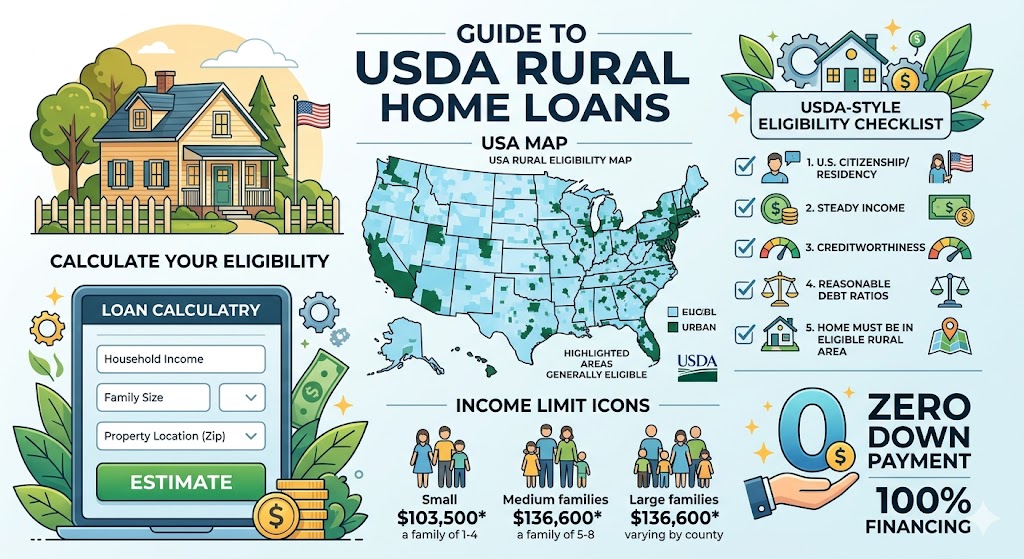
USDA loan eligibility 2026 usually comes down to five checks: the home must be in an eligible rural area, your household income must fit the local limit, you must live in the home, your credit must support approval, and your debt must leave room for the new payment.
| USDA Eligibility Factor | 2026 USA Requirement to Check |
|---|---|
| Property Location | The exact address must show as USDA-eligible on the official USDA property eligibility map |
| Household Income | Total household income generally must be at or below 115% of area median income for the county and household size |
| Down Payment | 0% down may be allowed for eligible USDA Guaranteed loan buyers |
| Occupancy | The home must be your primary residence, not a rental, flip, second home, or vacation property |
| Credit Profile | USDA has no official minimum credit score, but many lenders look for about 640+ for easier automated approval |
| Debt-to-Income Ratio | Many files are reviewed near 29% housing DTI and 41% total DTI, with possible flexibility for strong compensating factors |
| Loan Type | USDA Guaranteed is through approved lenders; USDA Direct is for lower-income buyers through Rural Development |
Real Example: Checking USDA Eligibility on a USA Rural Home in 2026
James and Alicia are a married couple with one child looking near Cleveland, Tennessee, outside the Chattanooga metro core. Their household income is $82,000, and they are considering a $285,000 single-family home in a small-town area that appears eligible on the USDA map. They have 665 and 681 credit scores, one $410 car payment, and $95 in monthly credit card minimums.
With a USDA Guaranteed loan, they use $0 down. The base loan amount is $285,000, and the 1% upfront guarantee fee adds about $2,850 if financed, making the total loan about $287,850. At 6.28% APR on a 30-year fixed loan, the principal and interest payment is about $1,778 per month, and the 0.35% annual USDA fee adds about $84 per month in the first year.
Now the full payment must include taxes and insurance. If local property taxes are estimated at $210 per month and homeowners insurance is $155 per month, the estimated full payment is about $2,227. Their gross monthly income is about $6,833, so the housing payment is around 32.6% of gross income, and total monthly debt with the car and cards is about $2,732, or about 40.0%.
This file could still make sense because the property appears eligible, the household income fits many USDA county limits, and the total DTI is close to a common USDA comfort zone. The weak spot is the housing ratio, so the lender may want strong credit, clean payment history, and stable income. If James and Alicia bought at $270,000 instead of $285,000, their full payment could fall by roughly $100 per month and make the USDA approval cleaner.
How USDA Property Eligibility Works Across the USA in 2026
USDA property eligibility is address-based. A buyer can qualify on income and credit, but the loan still fails if the property sits outside a USDA-eligible area. This matters most near metro edges, where one ZIP code may qualify and the next neighborhood may not.
A downtown condo in Nashville, Austin, Phoenix, or Raleigh is usually a poor USDA target because dense city centers rarely match the rural housing purpose. A home 35 to 55 minutes away in a small town may have a better chance. Examples include areas outside Chattanooga, parts of rural North Carolina, small towns in Indiana, or outer counties near Kansas City and St. Louis.
Do not guess eligibility from how the street looks. Some outer suburbs look developed but still show eligible on the USDA map. Some homes with farmland nearby may fail because the address falls inside an ineligible metro boundary. This is why you should check the exact address before paying for an inspection or writing a USDA-only offer.
| Property Type | USDA Eligibility Risk | What Buyer Should Verify |
|---|---|---|
| Dense city-center home | High risk of being ineligible | Check map before assuming any $0 down option works |
| Outer suburb near metro edge | Mixed risk; some addresses qualify and some fail | Search the exact address, not only the city name |
| Small-town single-family home | Often stronger USDA fit | Confirm property condition, income limit, and appraisal value |
| Rural manufactured home | Possible but more lender restrictions | Confirm age, foundation, title status, and lender overlay rules |
USDA Income Limits 2026: Why Household Size Changes Eligibility
USDA loan eligibility 2026 uses household income, not just the income of the person signing the loan. The common rule for USDA Guaranteed loans is that adjusted household income cannot exceed 115% of the area median income for the location. That means the same buyer may qualify in one county and fail in another.
- If your spouse, adult child, or another adult lives in the home, their income may need to be counted even if they are not on the mortgage.
- Income limits usually separate 1–4 person households from 5–8 person households, so a family of six may have a higher limit than a single buyer.
- Higher-cost counties may have higher USDA income limits, while lower-cost rural counties may use lower limits.
Credit Score and Debt-to-Income Reality for USDA Buyers in 2026
USDA does not publish one simple minimum credit score for every buyer, but many approved lenders use 640 as an important line because it can help with automated underwriting. A 640+ score does not guarantee approval. A buyer with high car debt, recent late payments, or thin income can still run into trouble.
Here is a real DTI-style example. Tasha earns $5,750 per month before tax and wants a USDA home near Asheboro, North Carolina, for $260,000. With the 1% USDA upfront fee financed, the loan is about $262,600. At 6.28% APR, principal and interest are about $1,622, and the first-year USDA annual fee is about $77 per month.
If taxes and insurance add $330 per month, the full housing payment is about $2,029. Tasha also has a $525 car loan and $110 in credit card minimums. Her total monthly debt becomes about $2,664, or 46.3% of gross income. The home may be eligible, but the debt load can make underwriting harder.
One fix is not always a bigger down payment because USDA is built around zero down. In Tasha’s case, paying off the $110 credit card minimum could drop total DTI by almost 2 percentage points. Paying off or refinancing the car could matter even more than saving another $2,000 for closing.
| Buyer Profile | USDA Eligibility Strength | What Could Help |
|---|---|---|
| 640+ credit with stable income | Strongest common path for automated review | Keep debts low and document income cleanly |
| 620–639 credit with low debt | Possible with lender flexibility, but not simple | Manual underwriting, reserves, and clean rent history may help |
| High income but high car debt | Weak if total DTI is too high | Lower monthly debts before choosing a higher-priced home |
| Low credit with strong savings | Depends heavily on lender overlay and credit history | Fix recent late payments and document nontraditional credit if allowed |
USDA Guaranteed vs USDA Direct Eligibility in 2026
Most buyers searching online for USDA loan eligibility 2026 mean the USDA Guaranteed loan. That program goes through approved lenders and helps low-to-moderate income buyers purchase eligible homes with 100% financing. USDA Direct is different because it is aimed at lower-income buyers and is handled through Rural Development, not a normal bank-style mortgage process.
| USDA Program | Best Fit | Eligibility Focus |
|---|---|---|
| USDA Guaranteed Loan | Low-to-moderate income buyer using an approved lender | 115% AMI limit, eligible address, repayment ability, primary residence |
| USDA Direct Loan | Low or very-low income buyer who needs deeper payment help | Lower income category, local Rural Development review, ability to repay |
| USDA Repair Loan/Grant | Existing rural homeowner needing safety or repair help | Age, income, property use, and repair purpose rules |
USDA Zero Down Payment Does Not Mean Zero Cash Needed in 2026
USDA can remove the down payment, but it does not remove every cost. You may still need money for earnest money, inspection, appraisal, lender fees, title costs, prepaid taxes, homeowners insurance, and escrow setup. Seller credits can help, but they must fit the contract, loan rules, and appraisal.
For a $285,000 purchase, the USDA base loan can be $285,000 with $0 down. If the 1% upfront guarantee fee is financed, the loan becomes about $287,850. If closing costs and prepaids are $9,500 and the seller gives a $6,000 credit, the buyer may still need about $3,500 plus any inspection or upfront items already paid.
| Cost Item | Example Amount |
|---|---|
| Purchase Price | $285,000 |
| Down Payment | $0 |
| USDA Loan Amount | $287,850 with 1% upfront guarantee fee financed |
| Upfront Guarantee Fee | $2,850 |
| Estimated Closing Costs | $9,500 including lender, title, prepaids, and escrow setup |
| Seller Credit | $6,000 |
| Estimated Cash to Close | About $3,500 before counting earnest money already paid |
USDA Eligibility Can Look Very Different by USA State and County
USDA rules are national, but the result feels local. A $285,000 home may be common in parts of Ohio, Tennessee, Alabama, or Missouri, but it may be hard to find in many California or Colorado markets. Income limits, taxes, insurance, and USDA map boundaries change the real answer.
In many Southern small towns, USDA eligibility can fit a buyer earning $65,000 to $95,000 because home prices may sit near $220,000 to $320,000. In a Western high-cost rural county, the address may qualify, but the buyer may hit payment stress because the home costs $450,000 or more. The same zero-down feature creates very different risk.
Outer suburbs are the most confusing. A home near the edge of a fast-growing metro may qualify this year, but nearby areas can change as population and development grow. That is why address checks matter in places outside Charlotte, Dallas-Fort Worth, Nashville, Raleigh, Boise, Phoenix, and Tampa.
| USA Area Type | Eligibility Pattern | Buyer Watchout |
|---|---|---|
| Southern small towns | Often strong USDA fit with prices near $200,000 to $325,000 | Check household income and property condition |
| Midwest rural counties | Often strong property eligibility and lower prices | Watch older homes, repair issues, and appraisal conditions |
| Western high-cost rural areas | Address may qualify but payment can be high | Income limit and DTI may block approval |
| Outer suburbs near fast-growing metros | Mixed eligibility street by street | Check map before offer and again with lender |
| Dense coastal metros | Usually weak USDA fit | Look farther out or compare FHA/conventional |
Steps to Check USDA Loan Eligibility in 2026 Before You Apply
- Check the exact property address in the USDA eligibility map before you pay for an inspection or appraisal.
- Compare total household income against the correct county and household-size limit, not a national guess.
- Estimate the full payment using 6.28% APR, property taxes, homeowners insurance, the USDA annual fee, and escrow.
- Review credit score, late payments, collections, rent history, and monthly debt before lender preapproval.
- Ask the lender whether your file can run through automated approval or needs manual underwriting.
- Confirm seller credits, lender credits, and closing cost help before writing a USDA offer.
USDA Eligibility Mistakes USA Buyers Should Avoid in 2026
- Do not assume every rural-looking property qualifies. A home with fields nearby can still fail if the USDA map marks the address ineligible.
- Do not count only borrower income. USDA household income rules can include income from other adults living in the home, even if they are not on the loan.
- Do not treat $0 down as $0 cash. A buyer may still need $3,000 to $10,000 for closing costs, prepaids, inspections, and escrow setup.
- Do not shop above the payment your DTI can support. A $300,000 USDA loan at 6.28% APR can carry about $1,872 in principal and interest before taxes, insurance, and the USDA annual fee.
- Do not compare USDA only against FHA based on down payment. Add the USDA guarantee fee, FHA mortgage insurance, property taxes, insurance, seller credits, and cash-to-close difference.
USDA vs FHA vs Conventional Eligibility with Real 2026 Buyer Numbers
Assume a buyer wants a $285,000 home in a USDA-eligible small-town area, has a 665 credit score, earns $82,000 per year, and uses 6.28% APR for the payment estimate. The best loan is not always the one with the lowest down payment. You must compare monthly payment, cash to close, property eligibility, and mortgage insurance rules.
| Loan Type | Down Payment | Estimated Monthly Payment | Best For |
|---|---|---|---|
| USDA Loan | $0 | About $1,862 for principal, interest, and first-year USDA annual fee | Buyer with eligible address, income under USDA limit, and limited savings |
| FHA Loan | $9,975 at 3.5% | About $1,857 for principal, interest, and estimated FHA monthly MIP | Buyer whose property is not USDA-eligible or whose income is too high for USDA |
| Conventional 3% Down | $8,550 | About $1,880 with estimated PMI | Buyer with stronger credit who wants more property flexibility |
| Conventional 5% Down | $14,250 | About $1,808 with estimated PMI | Buyer with more savings and good credit who wants to avoid USDA location limits |
Tips to Improve USDA Loan Eligibility in 2026
- Pay down monthly debt before applying because a $400 car payment can hurt USDA DTI more than a small credit score difference.
- Search eligible outer-suburban and small-town areas instead of only big-city listings.
- Keep income documentation clean for W-2 income, self-employment, overtime, bonus pay, and part-time work.
- Ask for seller credits when cash to close is the main barrier, especially in markets where homes sit longer.
- Compare USDA payment against FHA and conventional before choosing USDA only because it says zero down.
- Avoid new car loans, furniture financing, or credit cards before USDA underwriting because one new payment can break approval.
FAQ About USDA Loan Eligibility 2026
Who qualifies for a USDA loan in 2026?
You may qualify if the property is in a USDA-eligible area, your household income fits the county limit, you will live in the home, and you can show repayment ability. Credit, debt, income stability, and property condition still matter even with $0 down.
What is the USDA income limit for 2026?
USDA Guaranteed income limits are based on county, area median income, and household size. The common rule is that adjusted household income generally cannot exceed 115% of area median income, so a family of five may have a different limit than a single buyer in the same county.
Does the home have to be on a farm to qualify for USDA?
No. USDA homes are often normal single-family homes in eligible rural areas, small towns, and some outer suburbs. The key test is the official property eligibility map, not whether the home has farmland.
Can first-time buyers use USDA loans in 2026?
Yes. First-time buyers can use USDA loans if they meet income, address, occupancy, credit, and repayment rules. A first-time buyer with limited savings may benefit because USDA can allow 100% financing on an eligible home.
Is USDA better than FHA in 2026?
USDA can be better if the address is eligible, your income fits the limit, and you want $0 down. FHA may work better if the property is inside an ineligible city area, your income is above the USDA limit, or your credit profile fits FHA underwriting better.
Can USDA closing costs be rolled into the loan?
The USDA upfront guarantee fee can usually be financed into the loan amount. Other closing costs may need seller credits, lender credits, gift funds, or extra appraised value, so you should not assume every dollar can be rolled in.
Your Next Step Before Using a USDA Loan in 2026
Check the property address, verify your household income limit, estimate the full USDA payment, and compare USDA with FHA and conventional before you make an offer. A calculator can help, but lender confirmation matters before you spend money on inspections or appraisal.