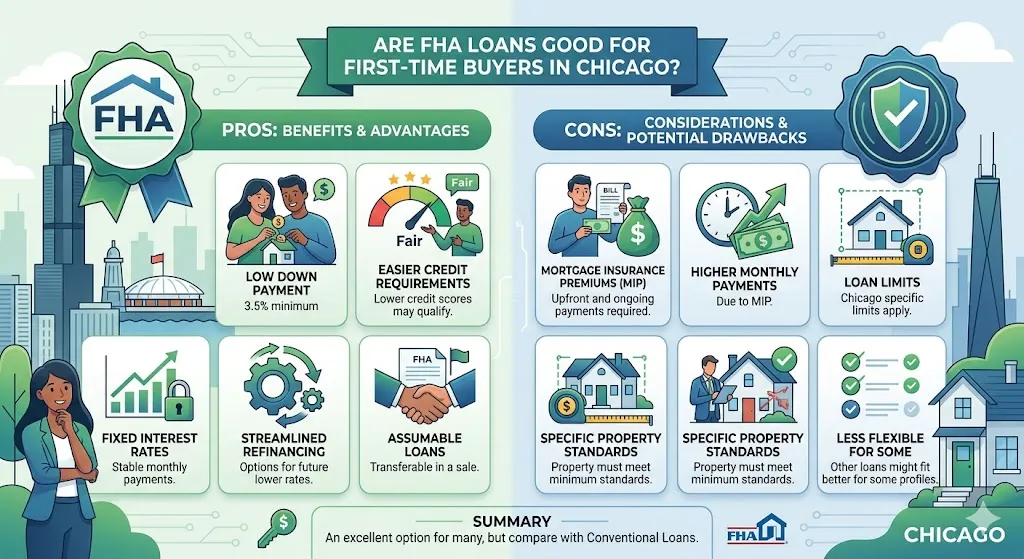
Are FHA Loans Good for First-Time Buyers in Chicago?
The Real Challenge for Chicago Home Buyers
Chicago's median home price sits around $320,000 — and in neighborhoods like Lincoln Park or Wicker Park, that number climbs even higher, fast. If you've been saving but don't have $60,000 sitting around for a 20% down payment, an FHA loan might be the door that actually opens for you.
Quick Answer: Chicago FHA Mortgage Snapshot
Here's a at-a-glance look at what an FHA loan looks like for a typical Chicago first-time buyer in 2026.
| Detail | Chicago Number |
|---|---|
| Median Home Price (Chicago) | ~$320,000 |
| FHA Minimum Down Payment (3.5%) | ~$11,200 |
| Typical FHA Loan Amount | ~$308,800 |
| Est. Monthly Payment (P&I at 6.28% APR) | ~$1,910/mo |
| FHA MIP (Monthly Mortgage Insurance) | ~$142/mo |
| Total Est. Monthly Payment | ~$2,052/mo |
| 2026 FHA Loan Limit – Cook County, IL | $498,257 |
| Conforming Loan Limit 2026 | $806,500 |
| Current Rate (30-yr Fixed, April 2026) | 6.28% APR |
Real Example: Marcus Buys His First Home in Chicago's Bridgeport Neighborhood
Marcus is 29, works as a logistics coordinator on the Near South Side, and earns about $62,000 a year. He's been renting a two-bedroom in Pilsen for four years and wants to buy something in Bridgeport — a neighborhood where homes are still more affordable than the North Side and the community is tight-knit.
He found a two-flat for $298,000. With an FHA loan and 3.5% down, Marcus put $10,430 at closing. His loan amount came to $287,570. At 6.28% APR on a 30-year term, his principal and interest payment is about $1,782 per month. Add FHA mortgage insurance and property taxes, and his total monthly cost is around $2,400 — still less than what many Wicker Park renters pay.
Marcus's credit score was 638. A conventional loan would have hit him with a much higher rate or denied him outright. The FHA program, backed by the Federal Housing Administration, made this deal work. That's exactly the kind of situation where asking "are FHA loans good for first-time buyers in Chicago?" has a clear answer: yes, for buyers like Marcus, they are.
How FHA Loans Actually Work
An FHA loan isn't given out by the government directly. Instead, the Federal Housing Administration insures the loan — meaning if you stop paying, the government covers the lender's loss. That insurance is what allows lenders to approve buyers with lower credit scores and smaller down payments.
Because lenders take less risk, they can offer you a mortgage even if you're just getting started financially. You pay for that protection through mortgage insurance premiums (MIP) — both upfront (1.75% of the loan) and monthly. According to HUD guidelines, MIP stays on your loan for the life of the loan if you put less than 10% down.
That's the one real trade-off. You get in the door faster, but you pay a little extra every month for that privilege.
| FHA Feature | Details |
|---|---|
| Government Backer | Federal Housing Administration (HUD) |
| Down Payment | 3.5% (with 580+ credit score) |
| Down Payment (500–579 credit) | 10% required |
| Upfront MIP | 1.75% of loan amount |
| Annual MIP Rate (30-yr, <10% down) | ~0.55% of loan balance/year |
| MIP Duration (<10% down) | Life of the loan |
What Credit Score Do You Need for an FHA Loan in Chicago?
The Federal Housing Administration sets the floor at 500. But in practice, most Chicago lenders want to see at least a 580 to offer you the 3.5% down payment option. If your score is between 500 and 579, expect to put 10% down instead.
Here's the good news: a 580 credit score is achievable even if you've had a bumpy financial past. According to the Consumer Financial Protection Bureau, about 1 in 5 Americans have a credit score below 600 — and FHA exists precisely for people rebuilding or starting out.
Don't guess at your score. Pull your free report at AnnualCreditReport.com before you talk to any lender. Errors on credit reports are more common than most people think, and fixing one wrong item can boost your score enough to qualify.
FHA vs. Conventional vs. VA vs. USDA: Which Fits Chicago?
Chicago buyers have several loan options, but not all of them fit the same situation. Here's how the main options compare side by side — so you can see where FHA lands.
| Loan Type | Min. Down | Min. Credit | Mortgage Insurance | Best For |
|---|---|---|---|---|
| FHA | 3.5% | 580 | Yes (MIP, life of loan) | Lower credit, first-timers |
| Conventional | 3–5% | 620+ | PMI until 20% equity | Good credit, stable income |
| VA | 0% | No official min. | No PMI | Veterans & active military only |
| USDA | 0% | 640 recommended | Annual fee (lower than FHA) | Rural areas only — not Chicago proper |
USDA loans are not available in Chicago's urban core. VA loans are a better deal if you served — no down payment and no monthly mortgage insurance. But for most Chicago first-time buyers who haven't served, FHA vs. conventional is the real choice.
If your credit score is 700 or above and you can put 5% down, a conventional loan often costs less over time because PMI eventually drops off. If your score is under 680, an FHA loan is almost always the smarter starting point.
More Chicago Mortgage Guides
Step-by-Step: Getting an FHA Loan in Chicago
The process isn't complicated, but order matters. Here's how it goes for a Chicago buyer using FHA financing.
- Step 1 — Check Your Credit: Pull your free report and fix any errors before applying. Even a 10-point score increase can improve your rate.
- Step 2 — Get Pre-Approved: Work with an FHA-approved lender (banks, credit unions, or mortgage companies). Chicago has many — including local options like Inland Bank and Wintrust Mortgage. Pre-approval shows sellers you're serious.
- Step 3 — Set Your Budget: Use the $2,052/month estimate above as a baseline for a $308,800 loan. Factor in Chicago property taxes, which average about 2.08% of assessed value — that can add $400–$600/month on a typical home.
- Step 4 — Find a Home That Meets FHA Standards: FHA requires the home to be your primary residence and in livable condition. Fixer-uppers with major issues may fail the FHA appraisal.
- Step 5 — Make an Offer and Get an Appraisal: Your lender orders an FHA appraisal. This checks both value and condition. Chicago's market is competitive — be prepared to move quickly on offers.
- Step 6 — Underwriting and Closing: The lender reviews your full file. FHA closing in Illinois typically takes 30–45 days. Illinois also requires an attorney at closing, so budget for that fee (~$500–$800).
Common Mistakes Chicago FHA Buyers Make
Chicago's real estate market moves fast — especially on the Northwest Side and in up-and-coming areas like Avondale and Pilsen. First-time buyers using FHA loans sometimes stumble in ways that cost them time or money.
- Skipping pre-approval: In Chicago's competitive neighborhoods, sellers often won't even consider an offer without a pre-approval letter. Don't tour homes before you have it.
- Forgetting Illinois attorney fees: Illinois is an attorney state. You must have a real estate attorney at closing. Budget $500–$800 and find one before you're under contract.
- Choosing a condo that isn't FHA-approved: Not every condo building in Chicago is on HUD's approved list. If you fall in love with a condo, verify FHA approval first at the HUD condo lookup tool before making an offer.
- Ignoring Chicago property tax rates: Cook County has one of the highest effective property tax rates in the country. At roughly 2.08%, a $320,000 home costs about $6,656/year in taxes — always include this in your monthly payment math.
- Taking on new debt before closing: Opening a new credit card or financing a car after pre-approval can tank your debt-to-income ratio and kill the deal at the last minute.
Chicago Down Payment Assistance Programs That Work With FHA
Coming up with that 3.5% can still feel like a stretch. Chicago and Illinois both offer programs that pair directly with FHA loans to help cover your down payment or closing costs.
- Illinois Housing Development Authority (IHDA) Access Forgivable: Up to $6,000 in down payment and closing cost help, forgiven monthly over 10 years. Pairs with FHA loans for eligible buyers.
- City of Chicago Home Buyer Assistance Program: Offers up to $14,999 in closing cost assistance for Chicago residents buying within city limits. Income limits apply.
- Neighborhood Housing Services (NHS) Chicago: Provides pre-purchase counseling (often required for assistance programs) and connects buyers with local down payment resources.
Based on Freddie Mac's research, buyers who receive homebuyer counseling are significantly less likely to default. Many of these programs require a counseling certificate anyway — so it's worth your time even if you don't need the money.
6 Tips to Save Money on Your Chicago FHA Mortgage
- Apply for IHDA down payment assistance: Illinois's forgivable grant programs can cover most of your 3.5% down payment, so you keep your savings intact for moving costs and repairs.
- Get your credit score above 620 before applying: Even within FHA's range, a higher score may help you negotiate a slightly better rate — potentially saving thousands over 30 years.
- Shop at least three lenders: According to the Consumer Financial Protection Bureau, getting just one additional quote saves borrowers an average of $1,500 over the loan's life — getting three quotes saves even more.
- Target neighborhoods with lower property taxes: Chicago's tax burden varies significantly by neighborhood and whether a property has any tax exemptions. The Homeowner Exemption alone can save you $800+ per year.
- Buy in winter: Chicago's housing market slows in November through February — sellers are more motivated, competition drops, and you may negotiate a lower price or seller-paid closing costs.
- Refinance once your equity hits 20%: FHA MIP stays on your loan forever (if you put less than 10% down). Once your equity reaches 20%, plan to refinance into a conventional loan and drop the insurance payment — potentially saving $100–$150/month.
Frequently Asked Questions
Are FHA loans good for first-time buyers in Chicago specifically, or just in general?
They work especially well in Chicago because the median home price ($320,000) is well under the 2026 FHA loan limit for Cook County ($498,257). That means most Chicago homes qualify, and the program's low down payment and flexible credit rules are a great match for buyers entering the city's competitive but still somewhat affordable market compared to coastal cities.
Can I use an FHA loan to buy a two-flat or multi-unit in Chicago?
Yes — and this is one of the best-kept secrets in Chicago homebuying. FHA allows you to purchase a 2-, 3-, or 4-unit property as long as you live in one of the units. You can then rent the other units, and that rental income can help you qualify and offset your mortgage payment. Just know that FHA loan limits increase with unit count — for a 2-unit in Cook County, the 2026 limit is higher than for a single-family home.
How long does it take to close an FHA loan in Illinois?
Typically 30 to 45 days in Illinois. Illinois requires a real estate attorney at closing, which adds a step compared to some other states — budget time and about $500–$800 for that fee. Working with an experienced FHA-approved lender familiar with Illinois can help keep the timeline on track.
What happens to my FHA mortgage insurance over time?
If you put less than 10% down (the most common FHA scenario), mortgage insurance stays on your loan for the full 30 years. It doesn't automatically cancel like PMI does on conventional loans. The smartest move is to refinance into a conventional loan once you've built 20% equity in your Chicago home — at that point, you can remove the insurance and lower your monthly payment significantly.
Your Next Step
If you've been wondering whether an FHA loan is the right path into Chicago homeownership, the best thing you can do right now is pull your credit score and run a few numbers. Use a free mortgage calculator to see what a payment looks like on a Chicago home in your price range — plug in 6.28% APR and a 3.5% down payment to get a realistic starting estimate.
From there, talking to an FHA-approved lender in the Chicago area (or one licensed in Illinois) will give you a real pre-approval based on your actual income and credit. There's no cost to get pre-approved, and it puts you in a much stronger position when you're ready to make an offer. You don't need to have everything figured out first — just take the next small step.