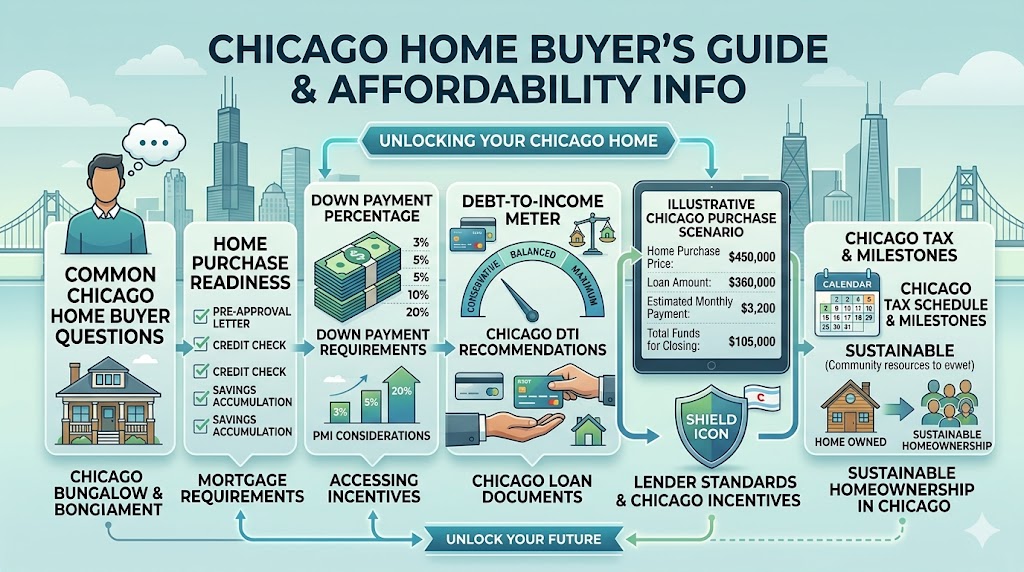
How much down payment do you need in Chicago?
Quick Answer for Chicago
You may need about $9,600 to $16,000 down on a typical $320,000 Chicago home if you use a 3% conventional loan, 3.5% FHA loan, or 5% conventional loan. The answer is MAYBE: Chicago prices are more manageable than coastal cities, but property taxes, insurance, and mortgage insurance can make the monthly payment harder than the down payment itself.
| Factor | Chicago Value | What It Means for You |
|---|---|---|
| Typical home price | About $320,000 | Your 3% to 5% down payment target is roughly $9,600 to $16,000 before closing costs. |
| FHA minimum down | 3.5% with 580+ credit | On a $320,000 home, that is about $11,200 down before FHA upfront mortgage insurance. |
| Conventional low-down option | 3% to 5% down | At 3% down, the loan is about $310,400 and the principal and interest payment is near $1,917 at 6.28% APR. |
| Decision result | MAYBE | The down payment can be reachable, but Chicago taxes and total monthly payment need careful checking. |
Why Down Payment Size Matters for Chicago Buyers
Chicago’s rough $320,000 home price creates a very different problem than Los Angeles or San Jose. The cash needed upfront can be realistic for many first-time buyers, but the full monthly payment can still feel heavy once taxes, insurance, and mortgage insurance are added.
A lower-income buyer may have enough for 3.5% down but struggle with the payment. A mid-income buyer may choose between keeping cash for repairs or putting 5% down. A higher-income buyer may not need the lowest down payment, but still has to decide if 10% or 20% down is worth giving up cash flexibility in a city where older homes, condos, and taxes can change the real cost.
Simple Breakdown with Real Chicago Down Payment Numbers
- FHA allows 3.5% down with a 580+ credit score, so a $320,000 Chicago home needs about $11,200 down.
- A 3% conventional loan lowers the down payment to about $9,600, but credit, income, and mortgage insurance matter.
- A 5% down payment is about $16,000 and may give some buyers a cleaner approval path than the smallest option.
- A 20% down payment is about $64,000, which can reduce the loan size but may be unrealistic for many Chicago renters trying to buy soon.
| Buyer Situation | Typical Chicago Numbers | Likely Outcome |
|---|---|---|
| FHA buyer | $320,000 price, $11,200 down, $308,800 base loan, about $1,907 principal and interest | Useful for buyers with limited savings, but FHA mortgage insurance raises the full payment. |
| 3% conventional buyer | $320,000 price, $9,600 down, $310,400 loan, about $1,917 principal and interest | Lower cash needed, but approval may depend more on credit score and debt ratio. |
| 5% conventional buyer | $320,000 price, $16,000 down, $304,000 loan, about $1,878 principal and interest | More cash upfront, slightly lower payment, and possibly stronger loan file. |
| 20% down buyer | $320,000 price, $64,000 down, $256,000 loan, about $1,581 principal and interest | Lower loan balance and no private mortgage insurance, but much harder savings target. |
How This Looks for Different Chicago Buyers
Maria earns $58,000 a year and has saved $14,000 while renting on the Southwest Side. She looks at a $260,000 starter home and uses FHA with 3.5% down, so her down payment is about $9,100 and her base loan is about $250,900, with principal and interest near $1,550 at 6.28% APR. The deal may work only if taxes, insurance, and debt payments stay controlled. A different property choice or tax bill could move a similar payment by more than $100 a month, which is why the full payment matters more than the down payment alone.
Jordan earns $82,000 and wants a balanced Chicago home near public transit without stretching too far. On a $335,000 property with 5% down, he needs about $16,750 upfront and borrows about $318,250, with principal and interest near $1,966. This gives him a better cushion than chasing the smallest down payment, but he still needs closing costs and reserves. A stronger down payment plan could keep more cash available without pushing him into a weaker monthly payment.
Denise and Malik earn $96,000 together but have a credit card balance and only $12,000 saved. They consider a $360,000 condo with 3% down, which means about $10,800 down and a $349,200 loan, with principal and interest near $2,157 before taxes, insurance, HOA dues, and mortgage insurance. The condo may look affordable from the down payment alone, but the full monthly cost can change the answer quickly. In a similar Chicago deal, comparing lender quotes and timing the rate lock could change the payment by roughly $80 to $140 a month.
Anthony earns $145,000 and is looking at a $500,000 home in a higher-cost Chicago buyer situation. With 10% down, he needs about $50,000 and borrows about $450,000, with principal and interest near $2,780. He could put more down, but that may leave less cash for repairs, moving costs, or furnishing an older property. Two similar Chicago buyers can end up with very different results depending on loan structure, tax comfort, and how much cash they keep after closing.
How Down Payment Needs Change by Buyer Situation in Chicago
In Chicago, the best down payment target often depends more on buyer situation than neighborhood name. A renter with limited savings may need FHA or 3% conventional. A condo buyer has to watch HOA dues. A move-up buyer may care less about the minimum down payment and more about keeping the full payment comfortable.
| Type of Buyer or Area | Typical Numbers | What Changes |
|---|---|---|
| First-time renter with limited savings | $300,000 price, 3.5% FHA down, about $10,500 down | Down payment may be reachable, but cash-to-close and monthly payment need tight planning. |
| Chicago condo buyer | $320,000 price, 3% to 5% down, plus HOA dues | The loan may qualify, but HOA dues can reduce the payment room a lender sees. |
| Move-up buyer | $450,000 price, 10% down, about $45,000 down | More cash lowers risk, but taxes and repair reserves still matter after closing. |
3 Practical Tips for Chicago Buyers
- Test your down payment at $280,000, $320,000, and $360,000 before choosing a target, because Chicago payment comfort can change fast with taxes and insurance.
- Compare FHA, 3% conventional, 5% conventional, and 10% down using the same home price, not different prices, so the tradeoff is clear.
- Before you focus on the smallest down payment, compare property type, tax bill, HOA dues, and repair risk; a cheaper-looking Chicago property can still carry a higher monthly cost.
Your Next Step
Run the numbers with a mortgage calculator using the home price, down payment, taxes, insurance, and mortgage insurance together. Freddie Mac’s April 2026 30-year fixed rate of 6.28% APR is a useful starting point, and the CFPB recommends comparing loan estimates before choosing a lender. If you want help finding someone who understands Chicago pricing and loan options, we can connect you with a local expert.