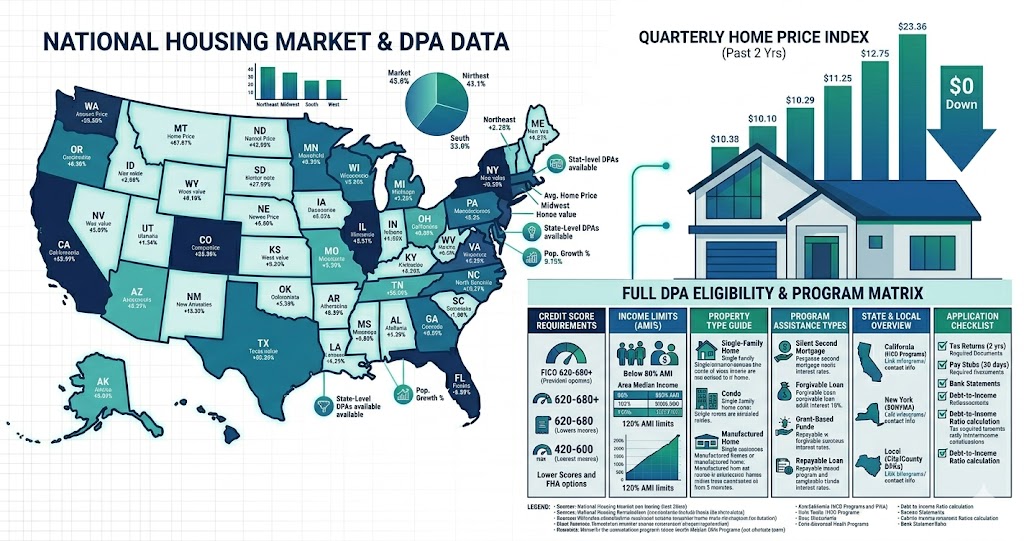
Down Payment Assistance Programs 2026: Complete USA Guide
The Real Challenge for USA Home Buyers
Right now, 2,679 down payment assistance programs exist across the USA — yet most first-time buyers have never heard of a single one. You could be sitting on thousands of dollars in free grant money without even knowing it.
Quick Answer: USA Down Payment Assistance Snapshot
Here is a fast look at the national numbers that matter most for buyers using down payment assistance programs in 2026.
| Detail | USA National Number |
|---|---|
| Median Home Price (2026) | ~$310,000 |
| Average DPA Grant Amount | $10,000–$15,000 |
| Min Down Payment (FHA 3.5%) | $10,850 on a $310,000 home |
| Conforming Loan Limit 2026 | $806,500 (standard); $1,149,825 (high-cost) |
| Number of Active DPA Programs (USA) | 2,073 funded & active (Q1 2026) |
| Current 30-yr Fixed Rate (April 2026) | 6.28% APR (Freddie Mac) |
Real Example: Maria Gets DPA Help Buying Her First Home
Maria is 32, works as a medical billing specialist in Columbus, Ohio, and earns $58,000 a year. She has been renting a two-bedroom apartment in the Clintonville neighborhood for four years and has $6,000 saved — nowhere near what she thought she needed to buy.
A HUD-approved housing counselor told her about Ohio Housing Finance Agency's Your Choice! Down Payment Assistance program. It covered Maria's full 3.5% FHA down payment of $8,750 on a $250,000 home. Combined with her FHA loan, her monthly payment came out to $1,627 — including both her principal/interest at 6.28% APR and her FHA annual mortgage insurance premium of $111 per month. That is less than her old rent.
The DPA came as a 2.5% forgivable second mortgage. Because Maria plans to stay in the home for at least 7 years, she will never pay a cent of it back. The entire deal closed in 34 days. Today Maria has equity in a home she bought for $0 out of pocket for the down payment — using a down payment assistance program that most buyers in her zip code never knew existed.
How Down Payment Assistance Programs Work Across the USA
Down payment assistance programs are funded and administered by a web of federal agencies, state Housing Finance Agencies (HFAs), city governments, and nonprofits. The money flows from sources like the HOME Investment Partnerships Program and the Community Development Block Grant — federal dollars that get distributed to state and local agencies, who then pass them to qualifying buyers at closing.
Most USA DPA programs share a common set of rules. You typically need to be a first-time buyer (meaning you have not owned a home in the past 3 years), your income must fall below the Area Median Income (AMI) limit — often 80% to 120% AMI — and the home must become your primary residence. HUD guidelines require that buyers using most federal-backed DPA programs also complete an approved homebuyer education course before closing.
The DPA does not replace your first mortgage. It layers on top of it. You still get a conventional, FHA, USDA, or VA loan from an approved lender — and the DPA covers some or all of your required down payment. According to the Consumer Financial Protection Bureau, understanding this layered structure is key to comparing the true cost of different DPA offers.
| Program Type | Who Offers It | Repayment Required? |
|---|---|---|
| Grant | State HFAs, nonprofits, local governments | No — free money, no repayment ever |
| Forgivable Second Mortgage | State HFAs, city housing agencies | Forgiven after 5–15 years in the home |
| Deferred-Payment Loan | County and municipal programs | Yes — due when you sell, refi, or move |
| Matched Savings (IDA) | Nonprofits, CDFIs | No — your savings are matched dollar-for-dollar |
Credit Score Requirements for DPA Programs in 2026
Your credit score determines which DPA programs you can access. FHA-paired DPA programs are the most flexible — you can qualify with a score as low as 580 and put just 3.5% down (covered by DPA). If your score falls between 500 and 579, the Federal Housing Administration requires 10% down, which means most DPA grants will not fully cover your down payment at that range.
For conventional loan DPA programs, lenders typically set the floor at 620. Scores above 680 unlock better pricing and more program choices. The good news: 284 DPA programs nationwide in Q1 2026 have no income restrictions at all — meaning even moderate-income buyers with solid credit can qualify. If your score needs work, a 90-day credit repair sprint before applying can move you from 580 to 620 and open dozens of additional programs.
- 580+ score: FHA-backed DPA programs available — 3.5% down requirement can be fully covered by most state grants and forgivable second mortgages.
- 620+ score: Conventional 97 + DPA unlocks — Fannie Mae HomeReady and Freddie Mac Home Possible both layer well with DPA at this floor; scores above 680 get better rate pricing.
- 600–619 score: Some state HFA programs have flexible overlays — states like Ohio, Colorado, and Virginia run programs that accept 600-score borrowers with compensating factors.
- USDA and VA pairings: Neither USDA nor VA loans set a federal minimum score, but individual lenders typically require 620+; DPA is less commonly needed with VA's zero-down benefit, but closing cost assistance programs can still help.
Types of Down Payment Assistance Available to USA Buyers
Not all DPA is created equal. The type you choose affects your total cost over the life of the loan. A grant saves you the most money because you never pay it back. A deferred loan costs you nothing now but must be repaid when you sell. Knowing the difference before you sign can save you thousands of dollars.
According to Down Payment Resource's Q1 2026 data, second-mortgage programs make up 56% of all DPA nationwide — they are the most common type. Grants make up 8% and are growing. You can find which types are active in your state using the free lookup tools at HUD.gov or NCSHA.org. Both are updated regularly and searchable by zip code.
| DPA Type | Min Down OOP | Min Credit | Repayment | Best For |
|---|---|---|---|---|
| Grant | $0 | 620 (most programs) | Never | Buyers who want the lowest lifetime cost |
| Forgivable Second Mortgage | $0 | 580–620 | Forgiven after 5–15 yrs in the home | Buyers planning to stay 7+ years |
| Deferred-Payment Loan | $0 | 580+ | Due at sale, refi, or move-out | Buyers who may sell within 5–7 years |
| Matched Savings / IDA | Varies (you save first) | None required | No — your savings are matched | Buyers with 12–24 months to plan |
For most USA first-time buyers in 2026, grants and forgivable second mortgages deliver the best net savings. A $10,850 grant on a $310,000 home is effectively $10,850 extra in your pocket. Compare that to a deferred loan where the same $10,850 must be repaid when you sell — potentially with years of appreciation built in.
Step-by-Step: How to Apply for DPA Programs in the USA
Most buyers make one critical mistake: they find a house first, then look for help. The right order is the opposite. Follow these six steps and you will not leave money on the table.
- Research programs before house-hunting. Visit HUD.gov's state-by-state assistance page or DownPaymentResource.com. Filter by your state, income, and credit score. Make a short list of 2–3 programs you likely qualify for before you even talk to a real estate agent.
- Complete a HUD-approved homebuyer education course. This step is required by most DPA programs — and it is not optional. You can complete it online in about 6–8 hours at frameworks.org or eHomeAmerica.org for around $75. Without the certificate, many programs will not process your application.
- Get pre-qualified with a DPA-approved lender. Not all lenders participate in every DPA program. Ask specifically: "Are you approved for [program name]?" Your state HFA's website publishes a list of participating lenders. Using a non-participating lender means losing the DPA entirely.
- Confirm income and purchase price eligibility. DPA programs have both income caps and maximum purchase prices. Run your numbers before you fall in love with a home. A household income of $65,000 may qualify for a $300,000 purchase in Ohio but not in California's higher-cost markets.
- Submit your DPA application alongside your first mortgage application. Your lender handles both at the same time — DPA is not a separate process you manage alone. Provide all required documents (tax returns, pay stubs, homebuyer education certificate) in one clean package to avoid delays.
- Close on your home — DPA funds arrive at the closing table. The DPA money is wired directly to the title company and applied as a credit toward your down payment and sometimes closing costs. Your cash-to-close drops by the full DPA amount.
5 Costly Mistakes USA Buyers Make With DPA Programs
These are the five mistakes that cost buyers their DPA money — or saddle them with a surprise repayment bill years later.
- Assuming only low-income buyers qualify. Many down payment assistance programs reach households earning up to 120% of the Area Median Income. In most US metro areas that means a single buyer earning $75,000–$90,000 may still qualify. Do not self-screen yourself out without checking the actual income limit for your county.
- Working with a lender who is not DPA-approved. Your mortgage broker may genuinely not know which DPA programs exist in your state. Always cross-reference your lender against your state HFA's approved lender list. Finding out after you are under contract that your lender cannot process the DPA will cost you the program and possibly the deal.
- Skipping the homebuyer education course. Buyers skip it because they think it is optional or a waste of time. It is neither. HUD guidelines require it for most federal-backed DPA programs, and skipping it disqualifies your application automatically — no exceptions.
- Not comparing the APR on DPA-paired mortgages. Some DPA second mortgages come attached to a first mortgage with a slightly higher interest rate. Based on Freddie Mac's weekly survey, the national average 30-year fixed is 6.28% in April 2026 — but some DPA-tied first mortgages price at 6.50% or higher. Run the total 5-year cost of the DPA offer vs. a standard mortgage before you commit.
- Selling or refinancing before the forgiveness period ends. A forgivable second mortgage is only forgiven if you stay. Most programs forgive on a sliding scale — leave in year 3 of a 7-year forgiveness period and you repay a prorated portion. Read your DPA agreement carefully and mark your forgiveness date on a calendar.
Comparing DPA Options Side-by-Side With Real USA Numbers
Using the USA national median home price of $310,000 and today's rate of 6.28% APR on a 30-year fixed, here is what each DPA type actually costs you month to month. The FHA option includes the 1.75% upfront MIP financed into the loan and the 0.55% annual MIP added monthly.
| Scenario | Down Payment (OOP) | Loan Amount | Monthly Payment | Best For |
|---|---|---|---|---|
| No DPA — Conventional 20% Down (baseline) | $62,000 | $248,000 | $1,532/mo | Buyers with large savings, no MIP |
| DPA Grant (covers full 3.5% FHA down) | $0 out of pocket | $304,385 (MIP financed) | $2,017/mo (incl. $137 MIP) | Buyers with $0 saved for down payment |
| Forgivable Second Mortgage — 5% DPA | $0 out of pocket | $294,500 | $1,819/mo | Buyers staying 7+ years, best long-term value |
| Deferred-Payment Loan — 10% DPA | $0 out of pocket | $279,000 | $1,723/mo | Buyers who want lower payments but may move |
The forgivable second mortgage at 5% DPA wins for most USA buyers in 2026. Your monthly payment of $1,819 is $485 less than the 20%-down baseline requires in upfront savings — and you never repay the assistance if you stay in the home. The grant option is best if you have truly $0 saved. Just note that the FHA MIP adds $137 every month — over 5 years that is $8,220 in insurance costs that you would not pay with a 20% conventional loan.
6 Tips to Save Money on Your USA Down Payment
- Stack programs when your state allows it. Many states let you layer a city or county grant on top of a state HFA forgivable second mortgage — for example, a California buyer in a targeted zip code can combine a CalHFA MyHome second mortgage with a local city grant, potentially stacking $25,000+ in total assistance.
- Check your employer's homebuyer benefits. Over 200 major USA employers — including hospital systems, universities, and school districts — offer down payment assistance as a 2026 employee benefit. Ask your HR department directly; these programs rarely get advertised.
- Target USDA-eligible zip codes in your metro area. USDA Rural Development loans require zero down payment, and many suburbs and small cities qualify. Pairing USDA zero-down with a closing cost DPA program can eliminate every dollar of upfront cost. Use the USDA's eligibility map at eligibility.sc.egov.usda.gov to check your target area.
- Time your application to state program refunding cycles. DPA programs often run out of funding mid-year and reopen in October when new fiscal year funds arrive. If you are buying in summer and programs show "temporarily suspended," waiting 60–90 days can save you $10,000 or more.
- Compare APR — not just the interest rate — on DPA-paired offers. A lender quoting 6.50% with a $12,000 DPA grant may cost you more over 5 years than a lender at 6.28% with a $7,500 grant. Run the total-cost math, not just the rate number.
- Get a free HUD-approved housing counselor on your side. Call 800-569-4287 (HUD's hotline) to connect with a counselor who knows every local DPA program in your county. This service is free, and counselors routinely find money that buyers miss on their own.
Frequently Asked Questions
How much down payment assistance can I get in 2026?
It depends on your state, income, and the program you qualify for. Nationally, the average DPA recipient receives $10,000–$15,000. Grants typically range from $2,500 to $25,000. In high-cost areas like California and New York, some deferred-payment programs provide up to $50,000. According to Down Payment Resource's Q1 2026 data, there are currently 2,073 active and funded programs across the USA — so your options are broader than most buyers assume.
Do I have to be a first-time buyer to qualify for DPA programs?
The federal definition of "first-time buyer" is broader than most people think. You qualify if you have not owned a home in the past three years — even if you owned a home before that. Some programs are open to repeat buyers in targeted geographic areas designated by HUD as economically distressed. Veterans and active military members are often exempt from the first-time buyer requirement entirely under state HFA rules.
Can I combine a down payment assistance program with an FHA loan?
Yes — FHA plus DPA is the most common combination in the USA. Your FHA loan covers the purchase with a minimum 3.5% down (if your score is 580+), and the DPA covers that 3.5% so your out-of-pocket cash is $0. The DPA comes as a second mortgage recorded after the FHA first mortgage. The Federal Housing Administration permits this structure — just note that the upfront MIP of 1.75% and annual MIP of ~0.55% still apply to your FHA loan regardless of how your down payment is funded.
What happens to my DPA if I sell or refinance before the forgiveness period ends?
If your DPA is a forgivable second mortgage, selling or refinancing early triggers a repayment. Most programs forgive on a pro-rated schedule — for example, a 7-year program may forgive 1/7th per year, so leaving in year 4 means repaying 3/7ths of the original amount. Grants have no repayment trigger. Deferred-payment loans are always due at sale or refinance. Read your DPA agreement before closing and note your forgiveness maturity date — it is one of the most important numbers in your loan documents.
Your Next Step
The best move you can make today is a quick search on HUD.gov or DownPaymentResource.com — both have free lookup tools that show every down payment assistance program active in your state right now. Punch in your zip code, income, and estimated purchase price, and you will have a real list in under five minutes. If numbers are your thing, run a few scenarios through a mortgage calculator using today's 6.28% APR to see exactly what your monthly payment looks like with and without DPA — the difference is often hundreds of dollars a month.