How To Invest In Section 8 Housing With $0 (Step-By-Step)
I own 153 Section 8 rental properties that generate me over $200,000 a month in guaranteed income. And when I say guaranteed, that means that the US government quite literally deposits that money into my bank account on the first of every month. I started this business with almost zero dollars down. And I'm going to show you how to get started with your first Section 8 rental with almost no money down out of your own pocket. This is a step-by-step process that's going to show you exactly how I went from working for Section 8 to now building a real estate portfolio that's worth over $10 million by the age of 23 years old. I'm going to break down every single thing through the entire process from finding the properties, setting up the management, setting up the financing, delegating everything through the entire process. That way, you become an investor in the background rather than the day-to-day landlord through the process.
How I Built a $10M+ Section 8 Empire by Age 23 – Starting with $0 Down
From zero down to 153 properties generating over $200,000 guaranteed every month
For starters, government housing has been around since 1937, but for Section 8 specifically, it came around in 1974, which is over 50 years ago at this point. It helps low-income tenants who cannot afford a property to get their rent subsidized directly by the government, paid for by your tax dollars. The government will subsidize anywhere from 70 to 100% of a tenant's rent, and the tenant will be responsible from zero all the way to 30% every month.
The great thing about this program is that the payments are guaranteed on the first of every month, which means you do not have to wait for late payments from cash tenants and it allows you to scale with predictability. To become a Section 8 tenant, it takes about 10 to 15 years to actually get your voucher. The crazy part is that less than 10% of landlords accept Section 8 tenants, which creates a massive opportunity for me and multiple other landlords.
Your average Section 8 tenant stays in a house for 7 and 1/2 years, and your average market cash tenant stays in a house for right around 2 years. And what the government has done to incentivize landlords to accept Section 8 is that they pay 10 to 30% above market rents, which has allowed me to cash flow more than any other investor that works with market tenants and helped me build a recession-proof business model that's feasible in any financial climate. Section 8 tenants do get paid during government shutdowns and they did get paid during COVID. So, it is completely recession-proof.
Let's get into step one, which is going to be setting up the right business structure to get you started with this business model and to protect yourself from having any potential lawsuits while owning these rental properties. The structure that I recommend is a two LLC structure setup. It's a holding company in Wyoming, which allows you to have anonymity and asset protection. What anonymity means is that nobody knows that you own the property. And then under that holding LLC in Wyoming, you would have an operating LLC that holds the properties.
Many investors will say that you should own one property per LLC. But considering these are $70,000 houses and you do not have much equity, what I do personally is generally going to be three to five properties per LLC. And you can go on bizzy.com, biz.com, and set this all up for under $200 and get started right now. This investment to set up your LLC will be well worth it because it has significant legal protection and potentially even some tax benefits that you didn't know about.
Step two is where we're going to get into market selection. And the two primary locations that I generally look at are going to be the Midwest and the Southeast. When it comes to Section 8 investing, where you're mainly focused on cash flow, you want to look for locations with low purchase price and high rent potentials. And you could check the rents directly on huduser.gov. It's called the rent to purchase price ratio, and that's going to be a big factor when it comes to choosing a location. My top markets to find properties sub $100,000 in the Midwest would be Ohio, including Cleveland, Toledo, and Akron. Additionally, you could also look at Indiana, where you can find properties sub $100,000 in Indianapolis.
Guaranteed Section 8 Rent – Deposited by the U.S. Government Every 1st of the Month
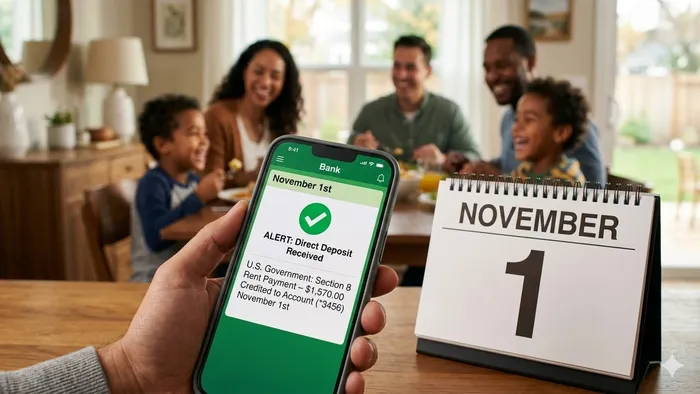
100% recession-proof: Section 8 payments arrive even during shutdowns and COVID
Generally in Ohio, you could end up cash flowing anywhere from $400 to $800 every month after all of your expenses with $8 to $15,000 down using traditional financing. There are ways to be able to get these properties under contract for $0 down, which we will shortly get into. If you're focused on looking at the Southeast, you could look at Jackson, Mississippi, Birmingham, Alabama, Montgomery, Alabama, and even Shreveport or Lafayette, Louisiana. These are all locations where you could find properties under $100,000 that rent all the way from $1,200 to $1,500 every month.
Please make sure to avoid locations that are not landlord friendly, like California, Oregon, or potentially even Washington. Keep in mind with a landlord friendly state, I'm able to evict a tenant under a couple weeks, and there's 5-day eviction notices. If you think about a location like California, it might take you 6, 12, 18 months and tens of thousands of dollars to even get the process started. You want to find a location with a good price to rent ratio where you could have high cash flow, a minimum of $400 to $800 every month. And you want to check huduser.gov to see exactly what Section 8 pays in every specific zip code.
One of the most important steps when actually choosing a location with Section 8 is to call the local housing authority and ask them how many outstanding vouchers they have. This is going to tell you how many Section 8 tenants are waiting to be housed, which is extremely crucial when choosing a location to buy in right now and focusing on Section 8 investing. Once choosing a location, you need to ensure that there's supply on the market. This is extremely important to have supply because this whole business model is made for scalability.
At this point, I have five main websites that I utilize to find on and off-market deals under $100,000. The first one would be investorlift.com. This is where you can find completely off-market deals sub $100,000 that are under contract with wholesalers. Number two would be fsbo.com. This is forsalebyowner.com. This essentially allows you to find properties that are listed by the owner directly where there's no agent involved. This is probably one of my top ones to find properties that are completely seller financed just because you can directly approach the owner. Number three would be roofstock.com. They have a section where you could find turnkey on and off-market deals sub $100,000. And for me personally, I've probably closed on over 10 deals just from this website alone.
Top Section 8 Cash-Flow Markets in the Midwest & Southeast
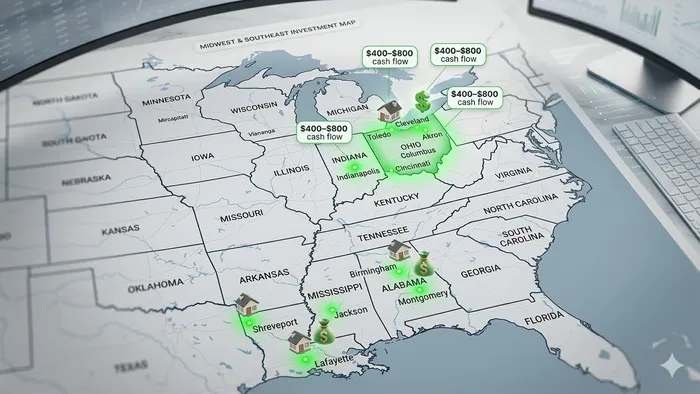
Prime locations with low purchase prices and high government-subsidized rents
Number four would be directly from the MLS. Zillow, Realtor, Redfin.com are all feasible options. This is where you could find on-market deals for seller financing, traditional financing, and this is pretty much where everybody looks for properties, but I still managed to close an additional 10 to 20 deals a year just from the MLS. Number five is going to be my personal favorite, which is a Section 8 software that I created 6 months ago that has allowed me to find deals significantly faster than any other method.
When it comes to evaluating a property and a potential tenant, there are four things I look at. Number one, you want to drive by the property and check the condition of the exterior, the neighborhood, and the surrounding properties. Number two, you want to check how the current tenant is maintaining the outside of the property. If you pull up to a property and their car is all busted up, they have a flat tire, the inside is wrecked, well, that just shows you how that current tenant is living and how they're potentially going to treat your property as well.
Number three would be do an at-home interview to see exactly how that current tenant is living. Because this is probably one of the most important steps. And this goes into exactly how they're going to treat your current property. If the current tenant has busted up walls, all the doors are broken, nothing is working in the household, all the lights are not functional, whatever the case may be, it's flooded, well, assume that's how they're going to treat your current property. But on the other hand, if you have a tenant that's completely taken care of, everything looks nice, clean, in order, well, that would probably make sense to move forward with that specific tenant.
And number four, which is very important as well, is check their eviction history. Generally, we do not accept Section 8 tenants with an eviction history just because we do not want to run into that process with a Section 8 tenant and have to waste time. I'm looking for a tenant that wants to spend 7, 10, 15 years potentially in a property. Just remember, there's going to be a lot of stigma surrounded by Section 8 tenants, but your average Section 8 tenant waits 10 to 15 years to actually get approved for the program and become a Section 8 tenant.
Real Deal Example: $71,000 Property Cash-Flowing $750/Month
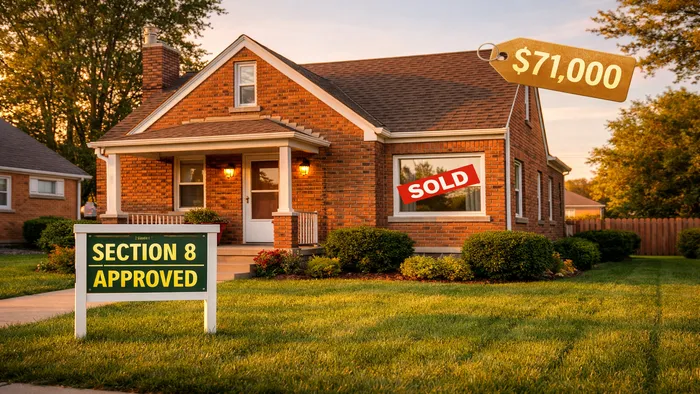
My recent Louisiana deal: $1,570/month government rent – only $10,650 down
A lot of them do treat the property pretty well because they don't want to risk getting kicked off of the free rent. And if they do damage your property and they are a Section 8 tenant, they could actually get kicked off of the property if I do report it to Section 8, which a lot of people do not even know. And lastly, once you found the perfect Section 8 tenant, you want to utilize my bulletproof lease to protect yourself. And there's three major clauses that I have in this lease that separate it from all the other landlords.
Number one is going to be the repair clause. This requires tenants to become responsible for the first $150 of any repairs that they've caused within the property. Number two is going to be the lockout clause. This requires the tenant to pay for any locksmith charges if they get locked out of the property. And number three is going to be the maintenance clause. This requires a tenant to handle lawn care and snow removal.
Let's get into the management portion. I own over 46 properties in Ohio, and I've never even been there. And this is because I have successfully delegated this process to property managers that take care of the renting, the leases, the Section 8 process while I live completely out of state. To find a property manager, you want to go on a website called thumbtack.com. This is where I find the vast majority of my property managers. And on average, each one is going to end up charging anywhere from 8 to 10%. They handle the tenant placement, the rent collection, the Section 8 paperwork, and even the maintenance coordination and monthly checkups to ensure the properties are in good condition.
If you're only planning on getting a couple properties and you are doing this in-state, it may make sense to just self-manage. But if you're trying to build a business out of this that is scalable and you want to have 10, 15, 20, 30 properties, it definitely makes sense to find a management company or a local property manager to do this just so you turn into an investor rather than the day-to-day landlord, which is what I preach.
The Section 8 Snowball: Scale from 1 Property to 153+ with Cash Flow Alone

Use monthly cash flow to buy more properties – true passive income snowball effect
I understand a lot of landlords are scared of doing this out of state, but I just want you to consider this one example. If a plumbing issue pops up in a property and it's 5 minutes away from you versus 5 hours away from you, what is your game plan? Instead of you actually going under the property to fix the issue, you're going to call a plumber. So, I want you to ask yourself this one specific question. If you're going to call a plumber and the property is 5 minutes away from you or 5 hours away from you, why does it matter whether or not you're located in the same state as the property? Well, the answer is it doesn't. And once I realized that, that's essentially allowed me to take this business model to whole new levels without ever having to see my properties in Ohio. And for me personally, I probably spend right around an hour a day managing my properties. And that only consists of me speaking to my property manager to ensure everything is in order.
Let's get into scaling your portfolio. The first property is going to be the most difficult for you. But once the first one is completed, it just becomes a process and a system that you need to follow to close on your fifth, 10th, 20th, 50th, and even potentially your 100 plus. There are multiple different ways you could scale this. Whether this is seller financing, raising capital, using the existing cash flow from these properties, or even potentially using the BRRRR method to buy, rehab, rent, and then refinance these houses.
But I want you to consider this. Section 8 becomes a snowball effect once you have enough properties. Each property on average is going to cost you right around 8 to potentially up to $15,000 down with traditional financing. So, for example, if you've built a portfolio with right around 10, potentially even 20 properties, let's assume each one is generating $500 a month on average. That is $10,000 a month in guaranteed passive income. So, with $10,000 a month in passive income, you're essentially able to buy an additional property every month. So, you're using the existing cash flow from these properties to buy more and more without having to come any more out of pocket than you were before.
And let's also remember with real estate, you're making money four to five different ways depending on your scenario. Number one, you're generating guaranteed passive income every month. Number two, these properties are appreciating every year from anywhere from 4 to 10% just depending on the market. Number three, there are rent increases with Section 8 that are above market rent increases. Some of my properties that I've purchased in 2020, 2021, 2022 now have rents that are $500 to $600 a month above what I initially rented them out for. Number four, you are paying down your principal payments every month with these specific properties. So, you have more equity in these houses month over month. And number five, you have massive tax benefits when buying real estate, whether you have W2 income or if you're 1099. Either way, you could still benefit from owning some type of real estate in your portfolio. And with Donald Trump bringing back bonus depreciation, that is a huge plus for real estate investors in 2025.