Most Buyers Cancel For The WRONG Reasons
If you're expecting a perfect home inspection report, you're setting yourself up to fail. That's the truth that no one wants to tell you. You're not buying a flawless property. You're buying a used home in most cases. And even new construction isn't perfect in my experience. And here's the problem. Too many buyers panic the moment they see a report that says something like there's a GFI missing, that the eaves have wood rot, or the roof has discoloration, or an outlet doesn't work, and then they walk away. But here's the reality. You'll find the same issues in the next house and the one after that. Walking away doesn't solve anything unless the home has real problems. What you need is perspective, a strategy, and the confidence to negotiate when it actually matters.
What to Expect in a Home Inspection Report as a Buyer
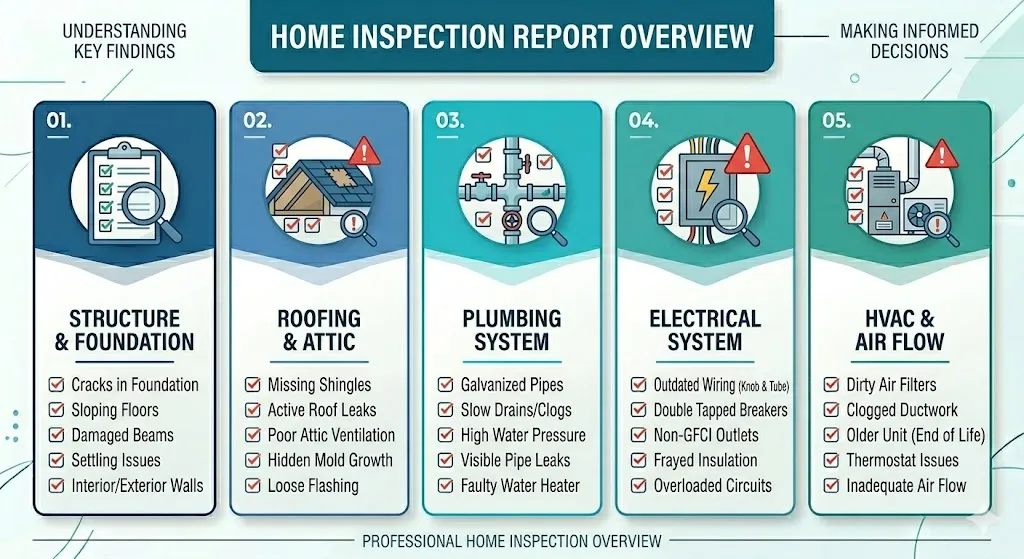
Inspection reports highlight everything—not just major problems
Today, I'm going to walk you through what to expect in every home inspection report. What's normal versus what's concerning, how to negotiate like a pro, and when it actually makes sense to walk away. I've been doing this for over 20 years. I've seen hundreds of inspections and some of the best deals I've ever negotiated happen after the inspection. So, if your instinct is to freak out when that 40, 50, 60, 100page PDF shows up in your inbox, breathe, read this article and let's talk through it.
First, let's set some expectations. That home inspection report, it's going to look scary. In many cases, you're probably a first-time home buyer. You've never been through this process before and you're not really sure what to expect. So, I'm going to try to help that a little bit. You're likely to get a big PDF. It's going to have pages and pages of photos, arrows, notes, and it's going to be pointing to things like cracks in concrete, missing GFIs, maybe even a gas leak. And if I'm being completely honest, it's going to feel overwhelming. But remember this, that's exactly what you paid for. You hired someone to call out everything they see, not just the big stuff. So, let's actually break it down. What's normal? What should you negotiate? And what's a dealbreaker?
Normal is one of those relative terms. It's going to be different for each person, but I want to start with some common stuff that you're likely to see. These are the things I see almost every single week, and in my opinion, they're totally normal. Let's start with the hairline cracks in driveways or patios. Remember, these are poured at a different concrete depth than the actual slab of the home. And they also settle. And many times you have heavy objects on them like your cars. And over time, these things are likely to crack. On top of that, you might see things like minor drywall cracks along ceiling seams or sometimes in the walls. Many times these cracks are very straight lines, which basically means it's two drywall pieces coming together and it's taped at the crack line. This isn't something you should be worrying about because it does happen as the home settles. On top of that, things like paint patches or texture inconsistencies. This happens when there's holes in the wall and somebody goes and puts a little putty on it and scrapes it down but never retextures. Or in some cases, maybe there's bigger holes in the wall. A similar thing happens there. It typically happens when you have some DIY projects that are done by somebody that didn't really know what they were doing but didn't require an actual contractor to do the work.
Normal vs Serious Home Inspection Issues: Know the Difference
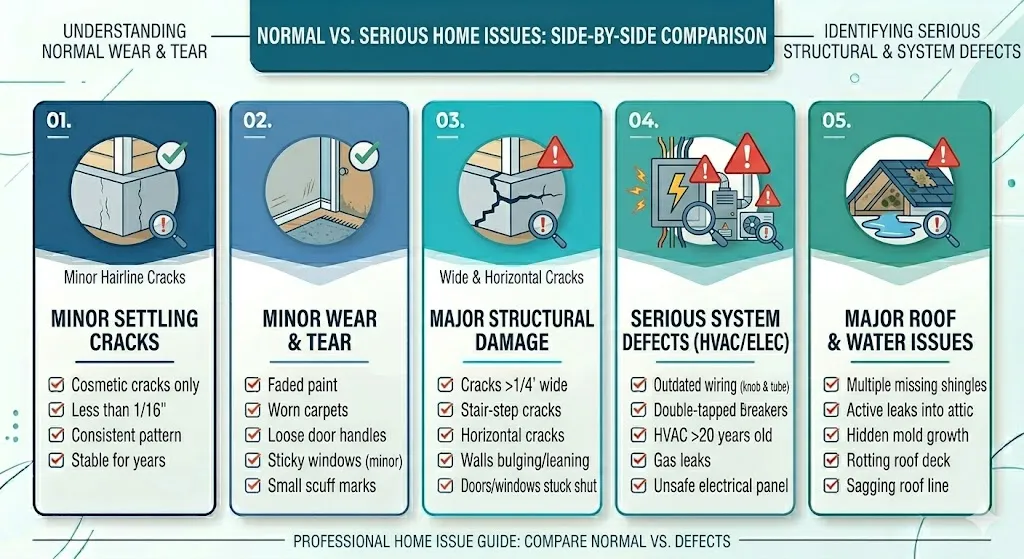
Not all inspection issues are deal breakers—focus on severity
In some cases, you've seen code changes over time. The codes to build or remodel a house back in the '60s are different from when they were in the '7s, then the '8s, the '90s were different from the 80s and 2000s, and so on. Things like missing GFI protection in older homes. This is a code change over time, and it's something you probably want to update when you do move in the house. But because these things change so often, there's a really good chance things like this are going to show up. On top of that, you're likely to see things like water stains under sinks, or in some cases in the attic, wood rot on the fascia or the eaves, in some cases, loose toilets, squeaky doors, chip grout.
In my opinion, these aren't deal breakers. They're just the result of a home being lived in. Even brand new homes will show some of this. And that's why I think it's important if you are buying new construction that you do get your own home inspection on that property because chances are there are things that are going to show up in that inspection report that you would like addressed before ever closing on that home.
Here's the thing. When I bring things up, that doesn't mean you have to be okay with them. I'm just pointing out what's normal and typical versus what's something that you should really be concerned with. So, don't let the little things derail you. These are typically just cosmetic and easily fixable.
So, what actually matters? Here's where you shift focus. Start looking at the big ticket items. In my opinion, I always want to focus on the items that cost the most money to replace. Because if you're a first-time home buyer and you just put all of your savings into the down payment and the closing cost and you have no money left aside, the last thing you want is a big ticket item showing up that's ultimately going to break the bank. I want you to focus on the following items. The first being the roof. You want to see if there's any signs of leaks. Ideally, you'd like to know the age, but you also want to pay attention to missing shingles, cracked tiles, that sort of thing. In addition to making sure that anything comes out of the roof is properly sealed.
With that, there's something I want to add on the roof. Just because the roof is old doesn't mean you need to ask for it to be replaced. What I like to do is that if something shows up in the home inspection report that says the roof is older or it might need to be replaced or whatever is I'd like to have a qualified roofer come out and actually inspect that roof to give us an idea of how much time is likely left on it. And that's because some roofs can actually show like they're older than they actually are, which means the lifespan is likely longer than you expect it to be. If the roof is an issue, I'm going to talk about how to negotiate that as we move through this article.
The next thing I like to pay attention to is the plumbing. Has the plumbing been redone at any period of time? Have they ever had a slab leak? Did they replace the plumbing? Is it copper? Is it galvanized? Is it some sort of PEX plumbing? On top of that, are there any active leaks or root issues in the main line? In my opinion, the plumbing is probably one of the bigger things in the property that I like addressed because if you ever have to redo that plumbing, that likely means drilling into the slab of that home. In some cases, pulling the drywall out, repatching the home. There's a lot that goes into plumbing a home. And that's the last thing you want to take on as a first-time home buyer.
The next thing I want to talk about is the electrical. How old is that panel? Is it a Federal Pacific panel? These are panels that were put in place back in the '60s and '70s. These are panels that are known to have issues. In addition to that, are there any safety concerns? Are there any wiring issues? Are there any signs of DIY work? These are all things that can cost a significant amount of money to repair. On top of that, the HVAC. How old is it? Is it working properly? Has it been serviced? These are things that can cost you anywhere from a couple of thousand dollars up to $15,000 or more to actually replace. So, these are things that I like to focus on.
Focus on Big-Ticket Repairs That Impact Your Budget
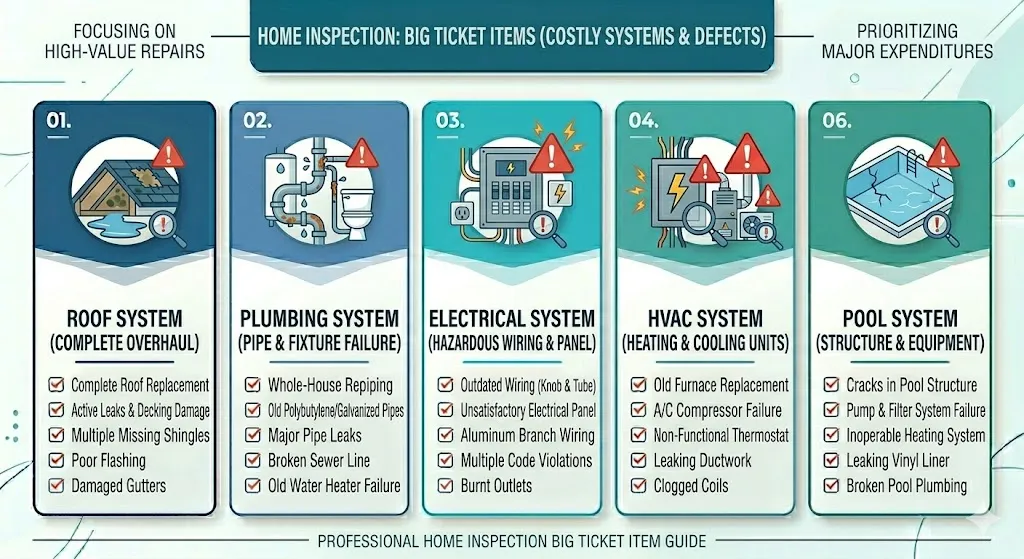
Prioritize expensive repairs when evaluating a home
In addition to that, the foundation. Are there any signs of movement? Are there any cracks that are concerning? In some cases you might have a structural engineer come out to evaluate some of those issues. And last but not least is the drainage. How does the water flow around and away from that property? Because water that sits next to your foundation can absolutely cause issues over time.
So instead, as a real estate agent, what I'd like you to do is focus on the one to three major items that you want addressed in that home. And don't sweat the loose door handle or the fogged window. Lead with what's expensive or urgent in many cases because that's your leverage. If there's a health and safety issue going on, you should absolutely ask the seller to address that. But if the majority of the items in the home are just cosmetic or they're working but not working to 100%, those should go on your fix it later and rather focus on the big ticket stuff with the seller.
If you want to do something crazy, I once had a mentor that told me about a tactic that I've never used, but it's something that I've always kept in my back pocket, and that is throw in a crazy ask. Something like, "We want you to paint the exterior of the house." When in fact, you don't really want it. And the reason you want to do that is because the seller will say no to that, but they'll feel good saying yes to the roof repair or the other credit that you're asking for. And you're probably wondering why. It's because now they feel like they're compromising and not just giving in. Remember, when it comes to negotiation, it's all psychological. I often talk about buying a home. It's emotional. People justify logical. When it comes to negotiating, it's all in the head. So, give them something to say no to so they'll say yes to what you really want.
When it comes to asking for things to be fixed, you actually have a couple of different options. You can ask for those items to actually be addressed, or you can ask for a credit for repairs to actually do the items yourself. The seller can respond in a couple of different ways. They can say yes to your repairs. They can say yes to your credits, or in some cases, they could say no entirely and not do anything. Or they might be willing to compromise. They might be willing to fix some things, give you a credit for others. So, just understand it's not always a straightforward answer.
But with that said, personally, I like credits over repairs. And the reason for that is because you get to hire your own contractor. You control the quality. You decide when and how it's done. And you avoid lastminute seller fixes just to get the deal closed. With that said, there are a couple of exceptions. For things like roof leaks or active water intrusion, you want that fixed before closing. And in that case, ask for a licensed contractor and make sure you get the receipts.
How to Negotiate After a Home Inspection Like a Pro
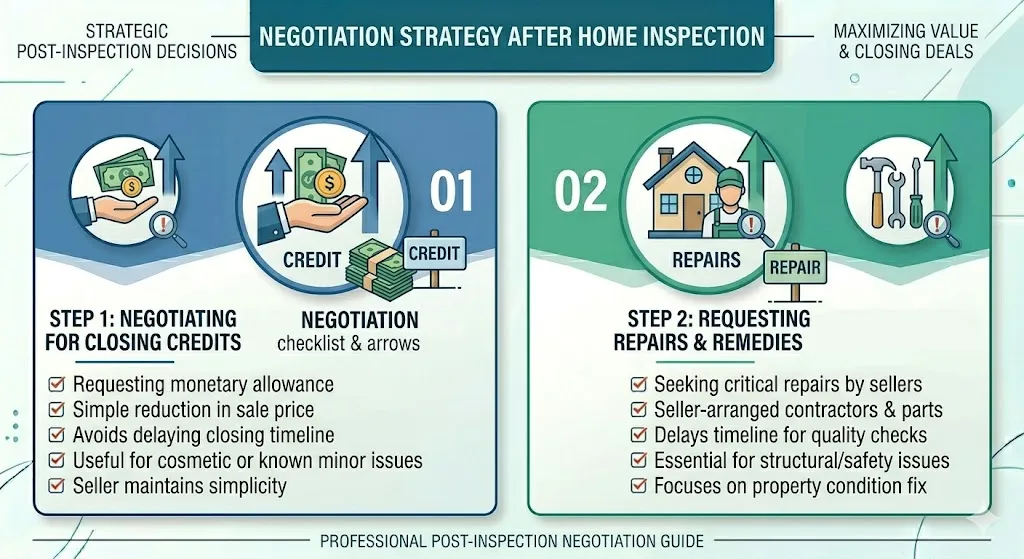
Smart negotiation can save you thousands after inspection
Remember, as a buyer, you also need to think like a seller. I tell sellers all the time, you also need to think like a buyer. And that's because it's all about perspective. I think it's important to understand once you're actually in contract, you go through the inspection phase, you actually have a little bit of leverage on that seller when you're a buyer in that property. And the reason for that is because if you walk away from a deal because of a major issue, that seller now has to disclose that to the next buyer. So, it's in their best interest to work with you if you're being fair and reasonable. When your repair request is fair and reasonable, most sellers will meet you in the middle. They know the next buyer will likely find the same stuff.
But even then, I do know that sometimes walking away is the right move. So, in my opinion, here is when I recommend it. If the property has major foundation problems, things like serious cracking, any sort of visible movement, on top of that, active mold or moisture intrusion that's not being addressed or hasn't been addressed over a long period of time. In addition to that, another one for me is unreasonable sellers. People that won't negotiate at all. I often tell my buyers, you need to have your line in the sand when it comes to the negotiation. Not only when you're putting in a price for that home, but also what you're willing to settle for in that negotiation. And if the seller is not willing to negotiate up to that line in the sand, then you have to be willing to walk away. But understand, if you start by walking away and not negotiating, you'll never see how far the seller was actually willing to go. I've negotiated a repair request from a couple of hundred up to as high as $87,000 on a $1.2 million property. So, understand if you don't ask, you'll never know the answer.
On top of that, another one for me is unpermitted work that's clearly done wrong. Understand, you're going to see unpermitted work all day long. People that have removed walls, people that have done bathroom and kitchen remodels without ever pulling a permit. But understand, just because it's normal doesn't mean it's right. So, in these cases, I like to see how the work was done. Was it done by a qualified contractor and you just didn't get the permits or was it done by somebody that you just picked up at Home Depot and you can clearly see there's issues with the work without ever digging in. In that case, you should absolutely walk away. On top of that, structural red flags like sagging ceilings or framing issues. If the house is a money pit or the seller is a nightmare, don't fight it. Make sure you walk away.
Before we end today, I want to leave you with a quick story about a buyer that I worked with last year that found a home that they absolutely loved, and the inspection report showed a lot of what we talked about today. There were things that had changed over time. There were older items in the house. There were missing GFIs. There were cracks in patios and all of that stuff. In fact, a lot of what I've discussed today was in that home inspection report. But the biggest concern for my client was an 18-year-old HVAC on that property that did not work at all. The air conditioning didn't come on. The furnace barely blew any air at all. On top of that, there were some electrical issues along with evidence of multiple roof patches.
Here's the thing. The buyers were ready to walk away. But I told them, "You're going to see this on almost every single house in this price range." So, what we did is we went back and asked the seller for a $20,000 credit to repair these items. Before we did that, we talked to my HVAC guy and got a bid on what we thought it was going to cost to replace that HVAC, which ended up being about $11,000. We also discussed with my electrician what it was going to cost to repair that panel, which was about 2500 bucks. And we also discussed with the roofer on how the roof patches were actually done and whether or not it made sense to move forward. The roofer said the roof was completely fine and that the lifespan on that roof was about another 15 years. So, my client was completely happy with that. So, all in the cost to repair the items that were the biggest concern for my client was about $13,500. So, let's say $14,000. We asked for 20 because we thought the seller would negotiate. And here's the best part. The seller actually agreed to our full $20,000 credit.
When to Walk Away vs Move Forward After Inspection
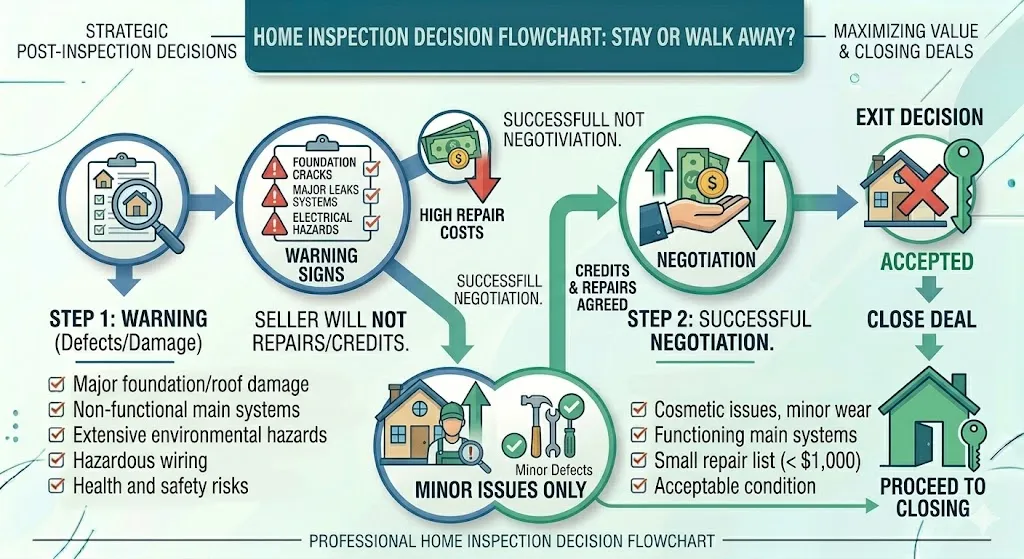
Walk away only when serious issues or poor negotiations arise
Had my client walked away, chances are they were going to find a similar issue on other homes. But here's the thing, my clients absolutely love this home. They love the location. Their family actually lived down the street from this property. So, all in all, this was the right property. They just weren't happy with some of the issues on this property. And fortunately, we were able to address it. They've been in the home almost 6 months, and they absolutely love it. And realize they almost walked for nothing.
So, if we had to wrap this up, remember the inspection reports aren't deal killers. They're tools. They help you understand the home, and they give you the info you need to negotiate smart. So, focus on the big stuff. Let go of the cosmetic stuff. Be clear and reasonable in your request, and don't walk away unless it actually makes sense. Remember, you're not looking for perfect, you're looking for the right fit. So, don't walk away. Negotiate.