How much down payment do you need in New York City?
Quick Answer for New York City
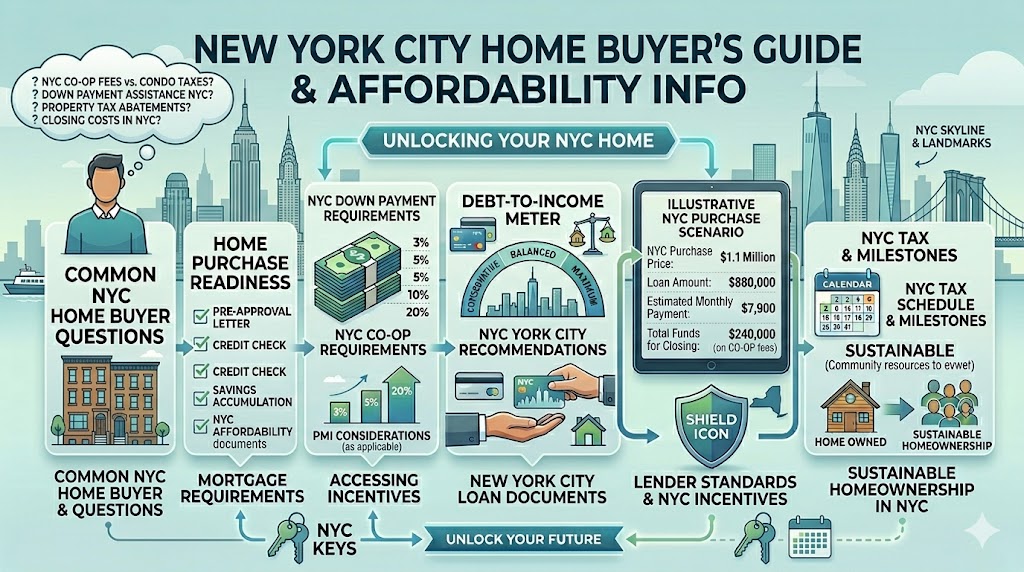
You may need as little as 3% to 3.5% down to buy in New York City, but the cash amount is still large because a realistic NYC home price is around $750,000. The answer is MAYBE: low-down-payment loans can work here, but condo, co-op, closing cost, reserve, and monthly payment pressure make NYC harder than many cheaper cities.
| Factor | New York City Value | What It Means for You |
|---|---|---|
| FHA minimum down payment | 3.5% down, about $26,250 on a $750,000 home | Useful for buyers with 580+ credit, but FHA loan size, building approval, and monthly mortgage insurance still matter. |
| Conventional low-down-payment option | 3% down, about $22,500 on a $750,000 condo or starter property | The cash entry point can be lower, but strong income and manageable debt are still needed. |
| 20% down payment example | $150,000 down on a $750,000 purchase | This lowers the loan to $600,000 and may help avoid PMI, but it is a major savings hurdle. |
| Extra cash pressure | Roughly $25,000–$45,000 for closing costs and reserves | Your real cash target may be much higher than the down payment alone. |
Why Down Payment Size Matters More in New York City
New York City is not just expensive because of the home price. A buyer looking near $750,000 may also face condo fees, co-op board expectations, property taxes, building rules, and closing costs that make the cash plan more complicated than a simple 3% or 3.5% calculation.
A lower-income buyer may have enough monthly rent history but not enough savings for the full cash-to-close amount. A mid-income buyer may qualify on paper but feel squeezed by the payment. A higher-income buyer may not struggle with the down payment itself, but may need a cleaner loan structure because NYC prices can push the loan near high-cost conforming or jumbo territory.
Simple Breakdown with Real New York City Numbers
- FHA allows 3.5% down with a 580+ credit score, so a $750,000 NYC purchase would need about $26,250 down before closing costs.
- A 3% conventional option would need about $22,500 down, but the buyer may need stronger credit, income, and debt numbers.
- At 6.28% APR on a 30-year fixed loan, a $727,500 loan is roughly $4,490 a month before taxes, insurance, HOA, or mortgage insurance.
- Low down payment helps buyers enter the market, but NYC buyers with co-op rules, high fees, or jumbo-size loans may need more cash.
| Buyer Situation | Typical New York City Numbers | Likely Outcome |
|---|---|---|
| First-time buyer using FHA | $750,000 price, $26,250 down, about $723,750 loan before FHA upfront MIP | Possible if the property and loan fit FHA rules, but payment and MIP may be heavy. |
| Mid-income condo buyer | $700,000 price, 5% down, $35,000 down, about $665,000 loan | More realistic monthly payment than $750,000, but still needs strong income after condo fees. |
| Buyer with 20% down | $750,000 price, $150,000 down, $600,000 loan, about $3,710 principal and interest | Lower payment and no PMI possibility, but the savings requirement is large. |
| Higher-income buyer | $950,000 price, 15% down, $142,500 down, about $807,500 loan | May sit near high-cost conforming limits and needs careful lender comparison. |
How This Looks for Different New York City Buyers
Maria earns $82,000 and rents in Queens while trying to buy a smaller co-op-style starter home near $525,000. With 3.5% down, she needs about $18,375 down and a loan near $506,625, with principal and interest around $3,130 at 6.28% APR before taxes, insurance, maintenance, and FHA costs. The deal may work only if the total monthly payment stays below her comfort limit and the building fits the loan type. A cleaner down payment plan could reduce upfront stress without forcing her into a payment she cannot handle.
Andre earns $135,000 and is looking at a $700,000 condo in Brooklyn or a similar first-time buyer setup. With 5% down, he brings $35,000 and borrows about $665,000, making the principal and interest close to $4,110 a month before condo fees and taxes. He may qualify, but his real test is whether the full monthly cost still leaves room for savings and normal city expenses. In a similar deal, comparing lender quotes and timing the rate lock could shift the payment by about $90–$150 a month.
Nisha and Omar earn $165,000 together but have limited cash because daycare and rent have slowed their savings. On a $750,000 purchase with 3% down, they would need about $22,500 down and a loan near $727,500, with principal and interest around $4,490 a month before PMI, taxes, insurance, and fees. Their challenge is not only the down payment; it is the total cash-to-close and monthly comfort after the purchase. Two NYC buyers with the same income can land in very different places depending on loan structure and building choice.
David earns $260,000 and is comparing higher-cost condo options near $950,000. If he puts 15% down, he brings about $142,500 and borrows about $807,500, with principal and interest near $4,990 a month before building costs and taxes. He has more income, but his loan size, reserves, and property type still matter because NYC purchases can get complex fast. A slightly larger down payment or different property target could move the deal from stretched to more stable without changing his whole budget.
How Down Payment Needs Change by Buyer Situation in New York City
The down payment answer changes a lot by property type in New York City. A first-time condo buyer may focus on the smallest legal down payment, while a co-op buyer may need stronger reserves or a larger cash cushion. A higher-income buyer may care less about the down payment percentage and more about keeping the loan inside a better pricing range.
| Type of Buyer or Area | Typical Numbers | What Changes |
|---|---|---|
| First-time low-down-payment buyer | $650,000 price, 3% down, $19,500 down, about $630,500 loan | Lower entry cash, but higher monthly payment and possible PMI pressure. |
| Co-op or stricter building buyer | $600,000 price, 10% down, $60,000 down, plus possible reserve expectations | The building may expect stronger cash even when the loan program allows less. |
| Higher-price condo buyer | $950,000 price, 15% down, $142,500 down, about $807,500 loan | The buyer may need to compare high-cost conforming and jumbo pricing carefully. |
3 Practical Tips for New York City Buyers
- Compare the down payment on at least three NYC price targets, such as $600,000, $750,000, and $900,000, before choosing your search range.
- Check FHA, 3% conventional, 5% conventional, 10% down, and 20% down side by side, because the lowest cash option may not create the safest monthly payment.
- Ask early whether the property is a condo, co-op, or house, because NYC building rules and reserve expectations can change the cash you need.
Your Next Step
Use a mortgage calculator to test several New York City price points with 3%, 3.5%, 5%, 10%, and 20% down. Then compare lender estimates before you shop seriously, because the CFPB recommends checking loan offers before choosing one. If you want help finding someone who understands New York City pricing and loan options, we can connect you with a local expert.
How much down payment do you need in New York City?
Quick Answer for New York City
You may need as little as 3% to 3.5% down to buy in New York City, but the cash amount is still large because a realistic NYC home price is around $750,000. The answer is MAYBE: low-down-payment loans can work here, but condo, co-op, closing cost, reserve, and monthly payment pressure make NYC harder than many cheaper cities.
| Factor | New York City Value | What It Means for You |
|---|---|---|
| FHA minimum down payment | 3.5% down, about $26,250 on a $750,000 home | Useful for buyers with 580+ credit, but FHA loan size, building approval, and monthly mortgage insurance still matter. |
| Conventional low-down-payment option | 3% down, about $22,500 on a $750,000 condo or starter property | The cash entry point can be lower, but strong income and manageable debt are still needed. |
| 20% down payment example | $150,000 down on a $750,000 purchase | This lowers the loan to $600,000 and may help avoid PMI, but it is a major savings hurdle. |
| Extra cash pressure | Roughly $25,000–$45,000 for closing costs and reserves | Your real cash target may be much higher than the down payment alone. |
Why Down Payment Size Matters More in New York City
New York City is not just expensive because of the home price. A buyer looking near $750,000 may also face condo fees, co-op board expectations, property taxes, building rules, and closing costs that make the cash plan more complicated than a simple 3% or 3.5% calculation.
A lower-income buyer may have enough monthly rent history but not enough savings for the full cash-to-close amount. A mid-income buyer may qualify on paper but feel squeezed by the payment. A higher-income buyer may not struggle with the down payment itself, but may need a cleaner loan structure because NYC prices can push the loan near high-cost conforming or jumbo territory.
Simple Breakdown with Real New York City Numbers
- FHA allows 3.5% down with a 580+ credit score, so a $750,000 NYC purchase would need about $26,250 down before closing costs.
- A 3% conventional option would need about $22,500 down, but the buyer may need stronger credit, income, and debt numbers.
- At 6.28% APR on a 30-year fixed loan, a $727,500 loan is roughly $4,490 a month before taxes, insurance, HOA, or mortgage insurance.
- Low down payment helps buyers enter the market, but NYC buyers with co-op rules, high fees, or jumbo-size loans may need more cash.
| Buyer Situation | Typical New York City Numbers | Likely Outcome |
|---|---|---|
| First-time buyer using FHA | $750,000 price, $26,250 down, about $723,750 loan before FHA upfront MIP | Possible if the property and loan fit FHA rules, but payment and MIP may be heavy. |
| Mid-income condo buyer | $700,000 price, 5% down, $35,000 down, about $665,000 loan | More realistic monthly payment than $750,000, but still needs strong income after condo fees. |
| Buyer with 20% down | $750,000 price, $150,000 down, $600,000 loan, about $3,710 principal and interest | Lower payment and no PMI possibility, but the savings requirement is large. |
| Higher-income buyer | $950,000 price, 15% down, $142,500 down, about $807,500 loan | May sit near high-cost conforming limits and needs careful lender comparison. |
How This Looks for Different New York City Buyers
Maria earns $82,000 and rents in Queens while trying to buy a smaller co-op-style starter home near $525,000. With 3.5% down, she needs about $18,375 down and a loan near $506,625, with principal and interest around $3,130 at 6.28% APR before taxes, insurance, maintenance, and FHA costs. The deal may work only if the total monthly payment stays below her comfort limit and the building fits the loan type. A cleaner down payment plan could reduce upfront stress without forcing her into a payment she cannot handle.
Andre earns $135,000 and is looking at a $700,000 condo in Brooklyn or a similar first-time buyer setup. With 5% down, he brings $35,000 and borrows about $665,000, making the principal and interest close to $4,110 a month before condo fees and taxes. He may qualify, but his real test is whether the full monthly cost still leaves room for savings and normal city expenses. In a similar deal, comparing lender quotes and timing the rate lock could shift the payment by about $90–$150 a month.
Nisha and Omar earn $165,000 together but have limited cash because daycare and rent have slowed their savings. On a $750,000 purchase with 3% down, they would need about $22,500 down and a loan near $727,500, with principal and interest around $4,490 a month before PMI, taxes, insurance, and fees. Their challenge is not only the down payment; it is the total cash-to-close and monthly comfort after the purchase. Two NYC buyers with the same income can land in very different places depending on loan structure and building choice.
David earns $260,000 and is comparing higher-cost condo options near $950,000. If he puts 15% down, he brings about $142,500 and borrows about $807,500, with principal and interest near $4,990 a month before building costs and taxes. He has more income, but his loan size, reserves, and property type still matter because NYC purchases can get complex fast. A slightly larger down payment or different property target could move the deal from stretched to more stable without changing his whole budget.
How Down Payment Needs Change by Buyer Situation in New York City
The down payment answer changes a lot by property type in New York City. A first-time condo buyer may focus on the smallest legal down payment, while a co-op buyer may need stronger reserves or a larger cash cushion. A higher-income buyer may care less about the down payment percentage and more about keeping the loan inside a better pricing range.
| Type of Buyer or Area | Typical Numbers | What Changes |
|---|---|---|
| First-time low-down-payment buyer | $650,000 price, 3% down, $19,500 down, about $630,500 loan | Lower entry cash, but higher monthly payment and possible PMI pressure. |
| Co-op or stricter building buyer | $600,000 price, 10% down, $60,000 down, plus possible reserve expectations | The building may expect stronger cash even when the loan program allows less. |
| Higher-price condo buyer | $950,000 price, 15% down, $142,500 down, about $807,500 loan | The buyer may need to compare high-cost conforming and jumbo pricing carefully. |
3 Practical Tips for New York City Buyers
- Compare the down payment on at least three NYC price targets, such as $600,000, $750,000, and $900,000, before choosing your search range.
- Check FHA, 3% conventional, 5% conventional, 10% down, and 20% down side by side, because the lowest cash option may not create the safest monthly payment.
- Ask early whether the property is a condo, co-op, or house, because NYC building rules and reserve expectations can change the cash you need.
Your Next Step
Use a mortgage calculator to test several New York City price points with 3%, 3.5%, 5%, 10%, and 20% down. Then compare lender estimates before you shop seriously, because the CFPB recommends checking loan offers before choosing one. If you want help finding someone who understands New York City pricing and loan options, we can connect you with a local expert.