Why Everyone is Suddenly Buying Gold
Gold is having its moment this year alone. As of recording right now, the spot price of gold has gone from 2639 per ounce at the start of the year, peaking to about 4,300 to 4,400 in mid-occtober and has now settled around the $4,000 range. It's up 53% year to date, which means that gold has performed better than Bitcoin, Apple stock, and even outperforming Nvidia stock. I know that's hard to imagine. Since this is gold's biggest year since 1979, I wanted to examine the several reasons why I think gold is performing the way it has been this year and explain where I think the price of gold is going for the near-term future.
Why Gold Prices Are Rising Rapidly in 2026
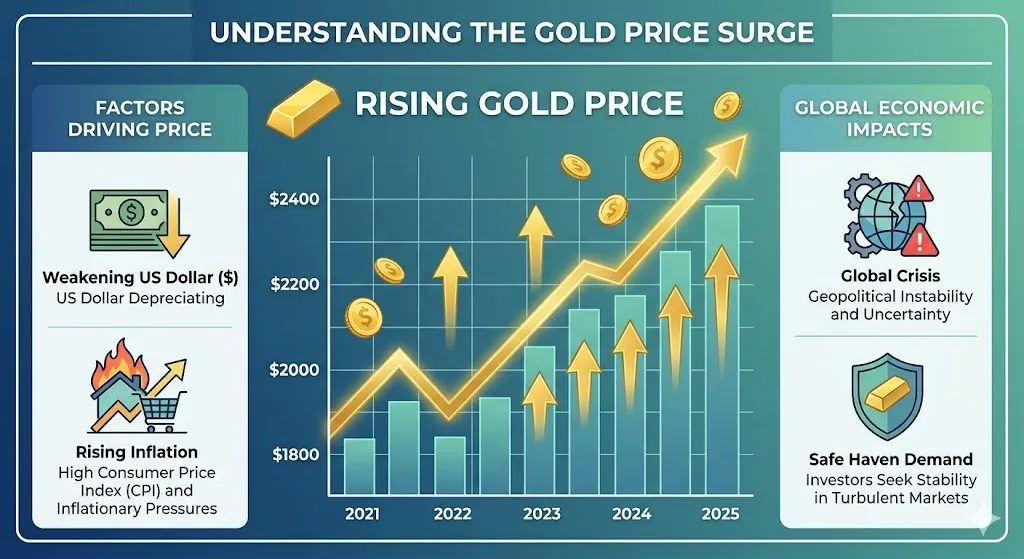
A breakdown of the major forces driving gold’s historic price surge in 2026
There's also a little investigative journalism in today's article. I'm heading over to my local coin and precious metals shop, Wintercoin, to talk to the owner, Seth, because I believe when gold is up 53% in just one year, the retail market can tell us a lot about whether or not this is a sustainable trend or just a speculative bubble. Are people buying physical gold to hold or are they just flipping it for quick profits? Wittercoin is one of the largest coin shops in the country which puts Seth at the intersection of spot prices and real world demand. His insights will help us understand if this rally actually has legs.
Let's first get into a little bit of background. What happened in gold's previous breakout year, which was 46 years ago in 1979. Back then, gold rose from $230 an ounce in January of 1979 to a staggering $855 an ounce just merely 12 months later. That's a $271% increase in just one year, which shatters how well it's doing this year. According to Douglas Trender, a precious metals analyst at Jack Hunt, he writes that the gold price spike of 1979 to 1980 is thought by many to be a classic reaction to high interest rate, high inflation rate during the latter stages of the Jimmy Carter presidential tenure. When it became apparent that Ronald Reagan and his conservative fiscal policies would assume the presidency in 1981, inflation fears eased, resulting in gold's price regression.
That definitely explains some of the runup. And according to the gold charts, the price of gold was trading back below $300 by mid1982, which was just 2 years later, even though inflation still at that time remained relatively high. That makes me think that the 1979 spike was largely driven by speculation and panic rather than fundamental values. If it were purely because of inflation related reasons, the price of gold, you would think, would just decline more gradually as inflation eases.
There was a lot to panic about back in 1979. There seemed to be a loss of faith in the Carter administration, and there were fears that the economic system was breaking down. The crazy high inflation numbers of around 13% and high unemployment around 7.5% really contributed to that fact. Adding to all of this was geopolitical instability with the Iranian hostage crisis and the Soviet invasion of Afghanistan.
From what I just told you, history might be repeating itself. The same forces that drove gold's 271% surge in 1979, which was economic uncertainty, geopolitical chaos, and loss of confidence. These are all showing up again in 2026.
Gold vs US Dollar: Understanding the Inverse Relationship
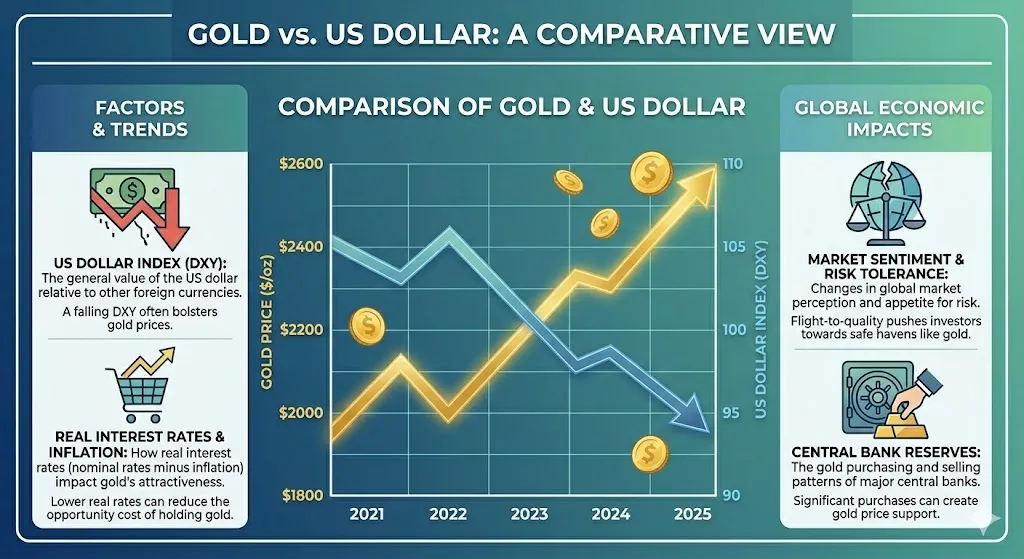
Gold typically rises when the US dollar weakens, making it a key hedge asset
So, let's break down some of the reasons why I think gold is surging right now. Starting with number one is gold's relationship to the US dollar. These two typically have what's called an inverse relationship. That means when the US dollar goes up, typically gold prices go down and vice versa. That's because gold is priced in dollars globally. So let's say that the value of the US dollar actually goes down relative to other currencies. Gold's price will tend to go up.
Now, this Morgan Stanley article sums it up pretty well, and I read quote that the value of the US dollar against other currencies dropped about 11% in the first half of this year, the biggest decline in more than 50 years, ending a 15-year bull cycle of the US dollar. You can see this occur on the US dollar index graph. This is the benchmark for the dollar's international value, and you can see it is falling this year. Morgan Stanley Research estimates that the US currency could lose another 10% by the end of 2026. And because of these items, Morgan Stanley notes that quote, "Foreign investors have been adding hedges to their exposure to US assets, which will likely weaken the US dollar."
And so this kind of makes sense when the US dollar starts to lose its value, investors like to look for alternative investment sources. And typically one that they like is gold. While this may not be the exact main contributing reason why gold is surging, it's definitely one of the factors.
Another key factor that complicates things is reason number two today, which is inflation. Back in 1979, one of the assumed reasons why gold spiked was because inflation was running so hot, upwards of 13 to 15%. Gold is conventionally seen as an inflation hedge because it has a limited supply. So, as the dollar loses value to inflation, it will take more dollars to buy the same amount of gold, or that's at least what a lot of people tend to think.
But what's more fascinating is that if inflation is simply just moderate, gold prices actually stagnate or they fall. The decade of the '90s is a perfect demonstration of this. The price of gold found a comfortable range of around $300 to $375. It fluctuated at this level for basically the entire decade and inflation rates in the '90s. They started at around 5.5% and by the end of the decade it was around 3.5%. Also between 2000 and 2009 when inflation was quite moderate at 2.5% per year, gold prices actually performed better.
So what that means is that while inflation is going up and gold is marketed as an inflation hedge, it doesn't always mean that just gold will go up in value because there is inflation. So what that leads me to believe is that inflation is definitely a factor, but it's not the exact factor that's driving up the price of gold. Instead, there are other factors such as what we expect the Federal Reserve to do with interest rates as well as geopolitical uncertainty and central bank policies that could have a stronger weight when it comes to the price of gold.
How Inflation Really Affects Gold Prices
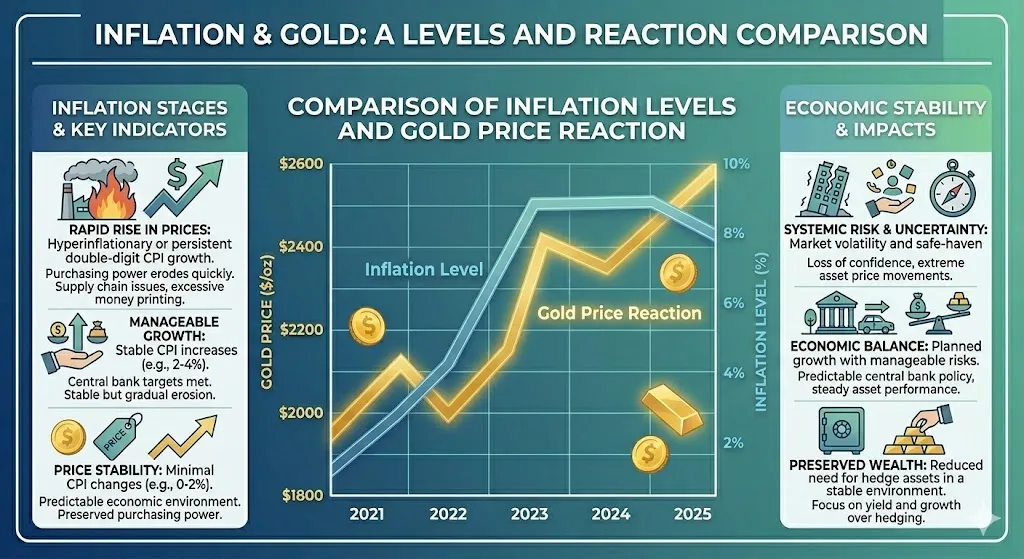
Gold reacts differently depending on inflation levels and economic expectations
So let's actually talk about central bank policies. This is reason number three why gold prices could be surging this year. Central bank demand. According to a European Central Bank study, central banks now hold 36,000 tons of gold, hoovering up huge volumes since the post-pandemic inflation spike and Russia's invasion of Ukraine in 2022. They have increased their holdings by more than 1,000 metric tonses in each of the last 3 years, which is a record pace.
So this following chart right here illustrates that foreign banks for the first time since 1996 are holding more of a percentage of gold than treasuries as a percentage of their international reserves. Currently central banks own 20% of all the gold ever mined and gold purchases have increased a lot since 2022. China is a huge reason for this as well. Their central bank recently had extended its gold buying streak for 11 consecutive months now fifth in the world of the top 15 gold reserves.
According to Apollo global management's chief economist Torston Sllock, he says that quote, "The gold stock level in China has soared throughout 2026 and Bloomberg data shows that household demand for gold ETFs is also surging." This indicates that far beyond whatever the People's Bank of China is doing, Chinese households are also driving significant activity.
You can see this demand for physical gold both on the central bank side as well as the retail side in these countries like China, India, and other Asia. But the demand there is higher than the Americas and the rest of the world. Central banks want gold because they want to diversify away from the US dollar. In 2015, the US dollar made up 66% of foreign central bank reserves. But as of 2026, that is now 58%. So the trend is clearly showing that many of these banks, while they still carry US dollars as the dominant reserve currency, they might be hedging a little bit by buying gold.
Gold also doesn't really add any default risks. It's not like a government can default on the debt of gold. They just have the asset itself. It kind of just sits there. It doesn't really do that much, but at least it gives them a little bit more economic stability in case of a global financial collapse. I personally don't think that the US dollar is going anywhere anytime soon or is going to be dethroned as the world reserve currency, but that could still change in let's say the next 10 or 20 or 30 years.
The fourth reason why gold prices are surging this year can be attributed to geopolitical risk and also global uncertainty. This is one of the main factors I think that actually drives up the price of gold because panic and fear generally bring up the price of gold because institutional investors get scared of what's going to happen to the markets and then they want a hard asset to own. Right now in 2026, there's no shortage of things to worry about. We've got ongoing conflicts in the Middle East and Ukraine. There are rising tensions between the US and China over trade as well as Taiwan. And we're seeing political instability in major economies. On top of that, we've had a government shutdown, debt levels reaching record highs, money being printed, and just uncertainty all around the global economy.
A Fortune article notes that quote, "Gold's 50% jump in 2026 marked a seminal moment. It crossed the $4,000 an ounce threshold after President Donald Trump enacted a 100% tariff on China. As the dollar depreciates and US stocks slump, gold shines brighter as a safe asset. When fear and instability hits, a lot of investors, institutions, and retail like to turn to gold.
And according to Warren Buffett, with an asset like gold for example, basically gold is a way of going long, which means that you are buying something with the expectation it will increase going long on fear. It's been a pretty good way of going long on fear from time to time, but you really have to hope people become more afraid in the year or 2 years than they are right now. Historical analysis shows that during periods of heightened geopolitical uncertainty, gold has delivered average weekly returns of approximately 1.6% while equity markets often experience simultaneous declines.
Now, those are several macro reasons why gold is up this year, but I wanted to actually answer a critical question, which is that are everyday people actually buying physical gold or is this just all institutional money and speculation?
So, let's go over to my local coin shop, Wittercoin.
Central Bank Gold Buying and Global Demand Trends
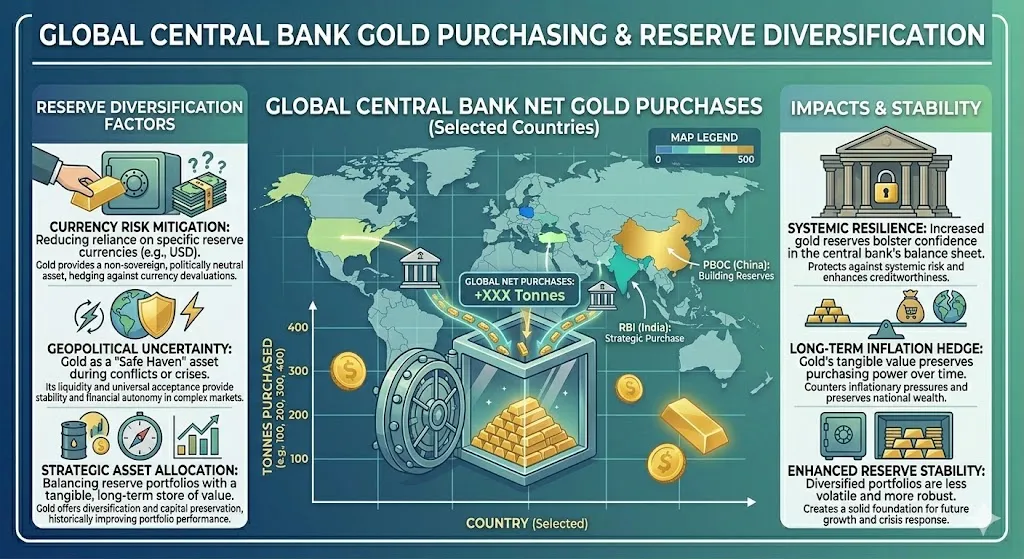
Central banks are driving massive gold demand to diversify reserves and reduce risk
What's up, Humphrey? Good to see you, man. Nice to see you. I just had one question for you. Go ahead. Which is we've seen the price of gold this year go from $2,600 an ounce to over $4,000 an ounce. How much do you think retail buying is driving this? Oh, my answer is going to be controversial. I think you're going to get a lot of comments like he's absolutely wrong or he's right. Listen, right here, what I'm seeing in our showroom, and we're probably one of the largest gold and silver bullion dealers in the country. I would say for every 25 ounces of gold that we buy from the public, we sell one ounce of gold to the public. Everyone is selling, which is unusual because historically retail is the dumb money or whatever, they're slow. They kind of when gold jumps up is when they come and buy it. Retail is being very smart. They're selling it to strength. So that's why I think it's unusual.
Okay. So that is very unusual because usually, back in 1979, I felt like a lot of the panic buying was actually causing the price of gold to run up. Yes. So what you're actually seeing is the opposite. We're actually not seeing that retail is a reason for the price of gold running up. Perhaps it's just institutions and governments.
Well, here's the thing. I nobody ultimately knows. There's all kind China, India. And I've been in this business a long time. Look at the chart. Look at the graph. No. It's very simple. It's very simple. There are clearly more buyers than sellers. But what we're seeing in here, it's not the retail. Retail is being very smart. They're selling into strength. So, I have no idea what it is, but it sounds cool to say it's the Chinese Federal Reserve Bank or it's a bunch of Brazilian billionaires. We don't know.
Nobody really knows. In years past, would retail buying activity be correlated to the price of gold in your opinion? Sure. Yeah. There's been many, many times where it's the opposite, like for every 20 ounces that we're selling to the public, we're buying an ounce in the public, but it's completely flip-flopped this way. So, it's certainly not the people that's coming into our showroom that's pushing up the price of the stock because they're selling into the strength, which I think is very smart.
And are you seeing that across your peers that also own coin shops? Same thing. Yeah. And it's like there's 15,000 coin shops all over the United States. The majority of them do a lot of gold and silver bullion business. And we're all kind of seeing the same thing. Of course, there's some days where they get a lot more gold buyers than sellers, but overall, that's what I'm seeing. And we handle a lot of this. This isn't speculation or rumor or what I read or what article that I watch. That's what I'm seeing on a daily basis.
Dang, this is going to be tough for my article guys because now I don't know. Yeah, we don't know what's bringing up the price besides the factors that we've already listed in. It's got to be I kind of would suspect and I don't want to speculate too much but I would suspect it's probably concentrated to a few bigger buyers that just need a lot of gold, because ultimately, governments or we talking people? I would say governments, but I've heard crazy stories about billionaires building bunkers and just hoarding a lot of American gold eagles and gold bars from Switzerland. It's always something. But again, we ultimately don't know. There's a lot of rumors and this and that, but the facts are for anything to go up in price, there has to be more buyers and sellers. And I think with, as you pointed out, up 53% this year, that's a lot more buying than selling. So something's happening and I'm in this business and I see what I see out here. It's not the retail public. Thank you, Seth. Yeah, of course. Anytime. All right. All right. Right on. Thanks.
Wow. Okay. So, there you have it. So, while Seth could not confirm that it was retail buying that was causing the surge, he did point out that perhaps central banks, institutions, and billionaires could be the reason for the runup of demand. Here's what we do know, though. We've got the weakening dollar. There are central banks buying at record levels. And there's geopolitical instability across the world in many different regions. If retail isn't causing the runup, then perhaps it's just more macro related. And this rally may be completely separate from the 1979 rally. That rally was built on speculation and panic more than fundamentals. And once fear subsided, a new president came in and the Fed raised rates, gold just went right back down in price.
So what could happen in the next few months and into 2026, what we should really look for are the following four things. First is the Fed policy. If they start to cut rates aggressively due to recession fears, gold could keep going higher because rate cuts are generally bullish for gold. Second is the dollar index. We want to keep an eye on that. If the dollar all of a sudden strengthens, gold might not continue its run because banks and investors are more confident with the dollar. Third, we should keep an eye on the geopolitical landscape that we are in. If we see trade wars cool down or if we see tensions in the Middle East or Ukraine deescalate, then that could be a good thing for the world in general, but also probably bad for gold prices. And lastly, this one's kind of hard to keep track of, but I'm going to continue to talk to Seth over at Wittercoin. If retail demand starts to go up more than his 25 to1 ratio, that could be a sign that gold surges further. Otherwise, I think we could be in for some gold prices to consolidate and move downwards.
Geopolitical Risks Driving Safe Haven Gold Demand
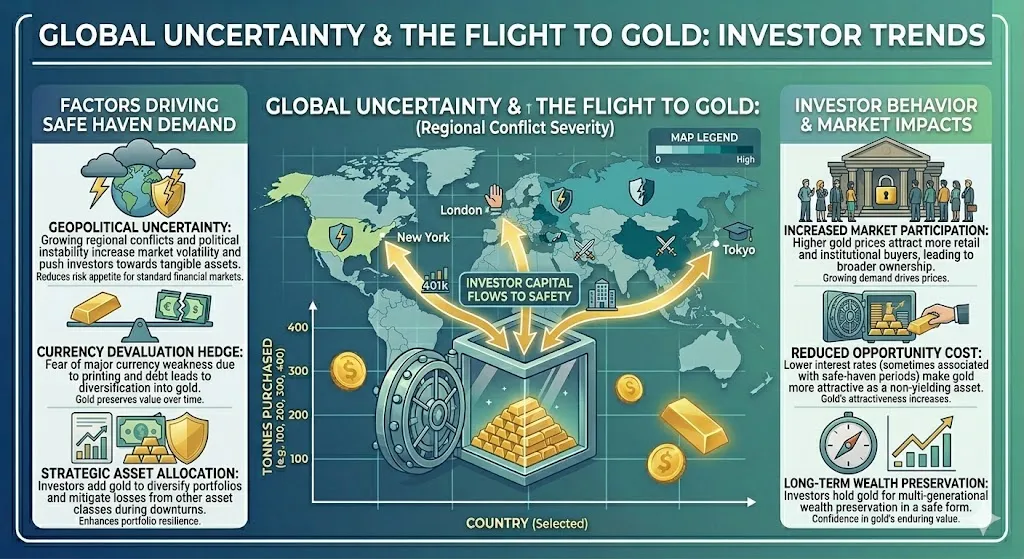
Investors turn to gold during global uncertainty, boosting demand and prices
So, Seth actually had a really good take on this off camera. He said he thought prices of gold would either go to $9,000 an ounce or go right back down to $2,500 an ounce, and there was really nothing in between. I really appreciated his candidness and how open he was about how he didn't really know. And I think that is a very safe thing to do, which is when it comes to an asset price, you really don't know what's going to happen.
If you are going to invest in some gold, I think holding some gold as part of a diversified portfolio makes sense. Perhaps you can have 3%, 5% or maybe even a 10% allocation to commodities or alternatives. I think that's a healthy kind of place to be at. But you also have to remember if you look at the gold charts, there were periods of time when basically gold returned flat or returned negatively over a period of 10 to 20 years. For example, you could have bought an ounce of gold for $1,788 in February of 2012 and it wouldn't have even seen a return until June of 2020.
All right, so what do you think? Let me know if you are buying gold and if you think we're in a sustainable bull market or if this is just a repeat of 1979 all over again.