15-Year Mortgage vs. 15 Year or Investing Which One Is Smarter for Yo
Paying off your home faster sounds like the obvious win. But depending on where you're at financially, putting that extra money to work elsewhere might actually make more sense. It's not a one-size-fits-all answer.
Are you choosing between a 30-year mortgage and a 15-year mortgage and you just don't know what to do? You could save several hundred 1000 potentially choosing a 15-year, but that's only part of the story. I'm going to get in the details and help you make the best decision that fits your particular circumstances. I'm also going to share some common mistakes that people make when choosing between a 15-year and a 30-year mortgage. on what's thebest decision for you, 30-year mortgage versus 15-year mortgage.
What's the difference between a 30-year mortgage and a 15-year mortgage? The easy answer, it is 15 years, right? There's a lot more to it than that, and I want to break down some things that you should consider when you're thinking about a 30-year mortgage or a 15-year mortgage. before I break this all down, I want to talk about how you should be thinking about this. It's easy to get dialed in on an interest rate and a term.
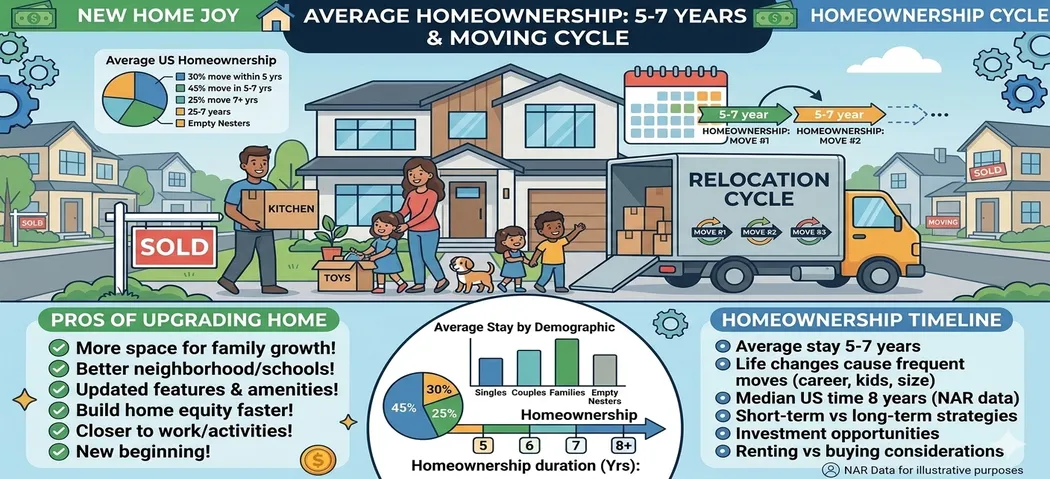
Maybe that excitement of having that loan paid off quicker. Maybe just some quick math numbers on if I pay this mortgage for 30 years, I pay this. And if I pay this mortgage for 15 years, I pay this. But there's a lot to it more than just that payment and that interest rate. From personal experience, I have lived in my forever house eight times in my 30 years of marriage. We've been eight times in our forever house. So, to say, "Hey, I'm going to pay this off in 15 years." We never got to a house and being there 15 years.
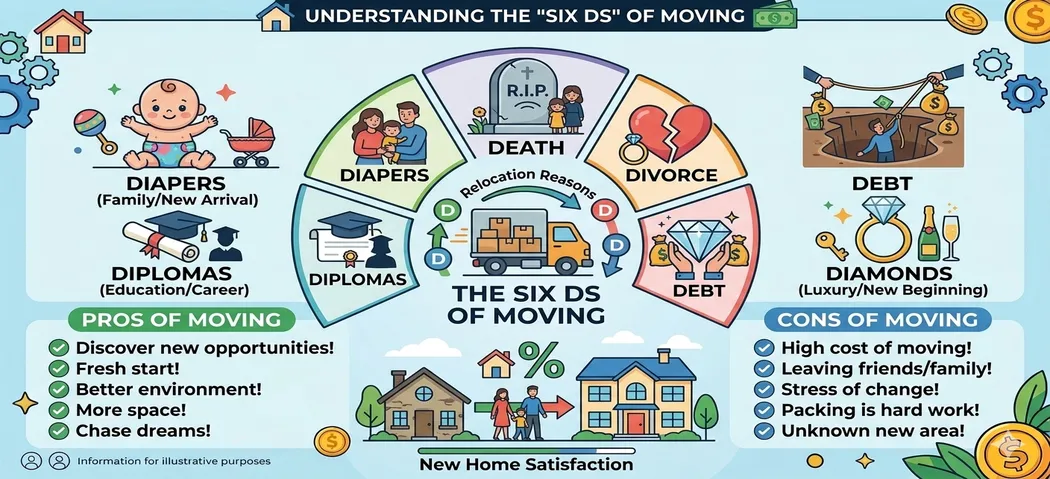
The national average is closer to 5 to seven years. are you really going to pay that house off in 15 years? are you really going to be there more than 5 to seven years? Statistically speaking, you won't. to put a little context behind that five to seven years, we talk about the six Ds in mortgage, in home finance, and things that make moves happen, make sales happen, make you move to a different house, a different place to live. The six Ds, death, divorce, debt, diamonds, diplomas, and diapers.
Those are those six Ds we talked about in the mortgage business that drive change to your housing situation. Those six Ds weren't the reason why my wife and I moved eight times in that period of time. those are just the six that come up. We just wanted a different place. We wanted a change of scenery. We felt that we had reached the maximum equity that we could grow in that house and it was time to do something different.
But there's other reasons as well that will cause you to look at moving and changing your environment a lot shorter than 30 years or even 15 years. that you know this, let's talk about the pros and cons and advantages and different aspects relating to a 15-year or a 30-year mortgage. Generally speaking, you get a lower interest rate with a 15-year mortgage versus a 30-year mortgage. That's cool. Give you some perspective. I've had a mortgage career for over 20 years.
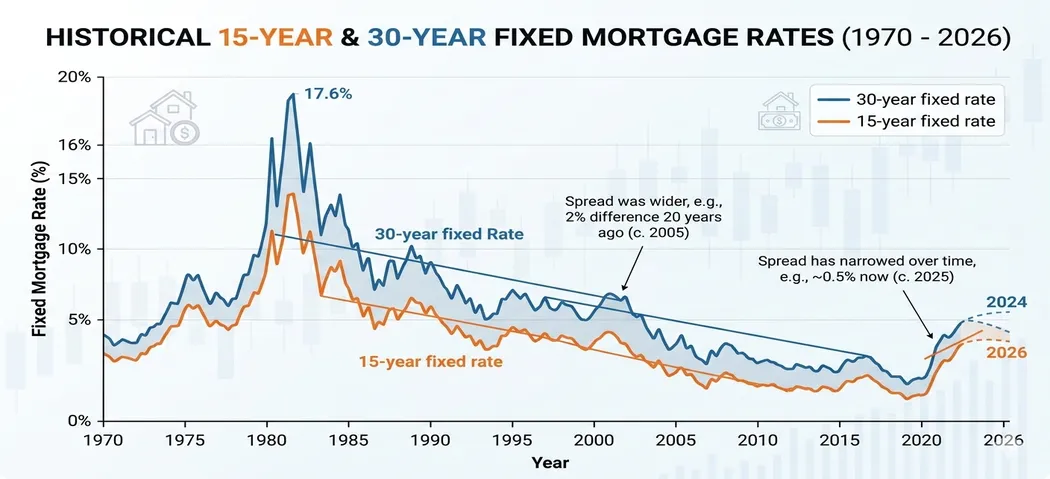
And 20 years ago, give you some sample interest rates and what those were 20 years ago. A 7 and 12% interest rate on a 30-year mortgage. Didn't even talk about 20-year mortgages, but 20 years or somewhere in between. 6 - 12% interest rate on a 20-year mortgage. And a 15-year mortgage might be 5 12%. a full 2 percentage point difference between the two. There was big incentive to pull the belt tight and pay those extra payments because you were saving two percentage points. As of the time in 2026,
that spread isn't there between 15-year and 30 years. It's a lot more compressed. Some days it might be as less as a half an interest point different. you're stuck paying this larger payment without that giant reward of a lower mortgage interest rate. There still is a reward for paying it off in 15 years, even if the rates were exactly the same. let's put that into context. 30-year mortgage, if you're going to buck the trend and you're going to live there the full 30 years,
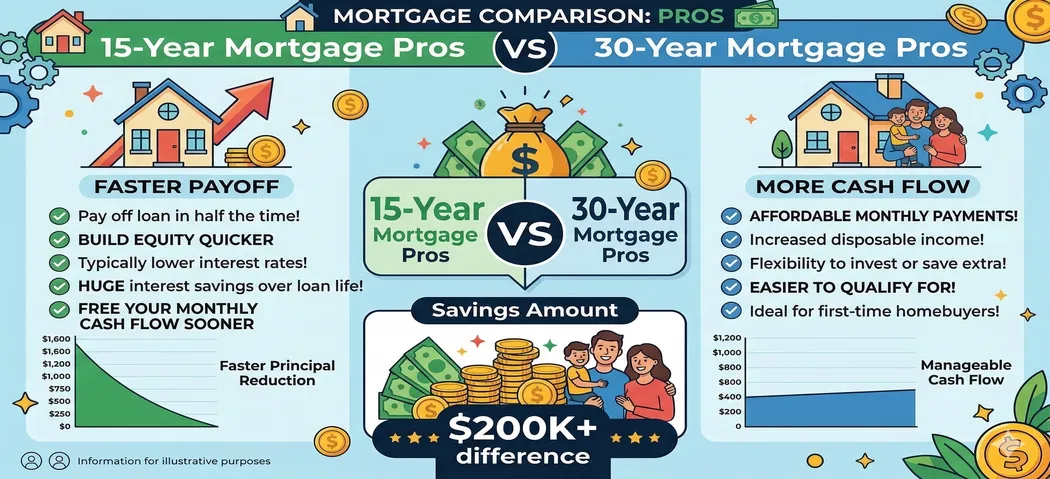
30 years times 12 months in a year equals 360. take 2330 multiplied by 360. You end up paying back approximately $838,000 over the life of that loan if you live there for 30 years. let's take that same interest rate for a 15-year. That mortgage payment jumps up about $600 to $3,150. again, we're going to buck the trend. we're going to pay that for 15 years times 12 is 180. So 3,150 multiplied by 180 equals $567,000. Exact same interest rate, exact same everything difference between 15 and 30.
You would save $270,000 in that comparison. at a high level, someone who is buying their first house and thought they were going to be in it forever looks at this and says, "Wow, I'm going to save $270,000. Obviously, I want to go to the 15-year. And if their rate was even lower, the savings would be higher." There's flaws in that whole piece, but we'll talk about that later. we talked about a lot of the pros of a 15-year mortgage.
Let's talk about the cons of a 15-year mortgage and the pros of potentially a 30-year mortgage. at a really high level, think about the life of your career and where you're at professionally. Most people will continue to earn more money throughout their professional career. When you strap yourself with extra debt early on, it impedes your lifestyle. And it might be lifestyle and things you want to do and things you want to enjoy while you're young and you're healthy and you can do those things.
But it can also impede your ability to put money away long-term for long-term financial success. When I talk about long-term financial success, it might be something as easy as putting more money into your 401k every single month. Are you maxing out your 401k? What if that extra $500 a month was fully funding your 401k and that money was growing tax-free or tax deferred and also had a company match.
I want to drill down a little further on this and those of you who watched my videos in the past are going to know one of the things I go to all the time is investor.gov. let's take that $500 per month and let's assume you're 30 years old and let's assume there's no other money in your retirement account. let's put $500 in there per month and let's do that over 15 years and let's use a 10% compounding interest rate because that's what the market has returned historically over 20, 30, 40 years.
$500 per month putting away into your 401k as an example, not including your employer match, but might even be higher, but just just use $500. $500 per month, 15 years compounding interest over those 15 years. What a huge number. That's a big piece. in my career, I sold and recommended a lot more 15-year mortgages when there was a bigger spread. there's a reward for going to the quicker term with a better interest rate.
As these rates have compressed, the reward isn't there. It's not a one-sizefits-all, and it's really something that needs to be customized for your financial situation. an example. 401k is fully funded. Money is in the bank. Great down payment on this house. It is okay to look at a 15-year and accelerate that and get that paid off, but not if you don't have those other boxes checked. Again, each case is different and each person is different and each scenario is different.
that's why you need to talk to a mortgage professional to really help you figure out these nuances. Even if you can pay the 15-year, maybe it isn't the best financial advice for a couple of the things that we laid out earlier. talking a little bit about 15. let's dive into some more of the pros and cons of a 30-year mortgage. The first piece is going to be a lower payment and a lower monthly payment, which frees up additional cash flow to do what you need to do or what you want to do.
The really fascinating thing is this. If we go back to the trend that a typical homeowner is there between 5 years and 7 years in a house, in their early years, most of your mortgage payment, especially on a 30-year, goes to interest. Fast forward 5 years from now, you typically didn't pay a bunch off on that principal. you go to sell that house. probably what's going to happen in the foreseeable future in most markets in most homes, you should see some appreciation.
So that $350,000 house that may see a 5% appreciation, a 10%, a 7% year, we put five years out, maybe your house has appreciated 30% in that period of time. You suddenly have $100,000 of equity. That equity can be deployed when you go buy your next house. whether your balance was 335,000 or 315,000, whether you did a 30-year or 15-year or whatever those numbers are that you were in for a short period of time, it really didn't make a big difference because where the real magic was was that equity.
The other big thing on a 30-year mortgage is you can look at taking the 30 and choosing to make additional payments. With a conventional mortgage, you can pay it off tomorrow. You can pay an extra $10,000 a month. You can make an extra $100 a month. You can pay whatever you want and as long as your account is in good standing, you've got money set aside for taxes and insurance, you can put on your mortgage statement that you want additional money to go towards principal.
you have the ease and the comfort of a lower minimum obligation being the 30-year fixed rate mortgage, but you can turn up the dial and set yourself on a 15-year payback. you can set yourself up on a 5year payback. Whatever it is, simple amortization schedule you can run and say if I paid this much more every single month, I'll pay my loan off at what date.
What I really want to convey, it's not one sizefits-all. It's not 30-year and 15 year. And it's not you should always do this and you should always do this. We didn't even get into 30-year, 20 year, 15year, 10 year. There are other options.
I tell you what's consistent is good sound financial advice from a true professional is the consistency that you need to see what is best for you. With my clients, we go further and we talk about things like retirement, how much money is being put away, not just how quick we can pay your mortgage off. What else do you have out there? Do you have a good professional that's advising you? I highly recommend that.
So, knowing this, here are some questions you should be asking your professional or asking yourself on a 30-year versus a 15-year. What's more important to you right now? Lower monthly payment or paying your loan off quicker? What is your particular situation in your finances?
The second question is, how is your income? Is it stable? Is it increasing? How's your reserve contingency? What happens if the unexpected happens? Do you have that nest egg? Is your income rising? Is this a house that you can easily afford on a 30-year and a 15-year? If that's the case, maybe it is a 15-year.
Now, the opposite of that is maybe you're early in your career. Maybe you don't love the job that you're in. And you don't want to get stuck to something because you've got a mortgage payment that's keeping you at a job that you just don't like and you're debt stuck and you're burdened by that and you can't make a move because you bit off this bigger payment.
Maybe a 30-year payment gets you into a spot that adding a roommate and going through a little bit of savings that you could jump to a new option in a new career if you chose that 30-year option with the lower payment.
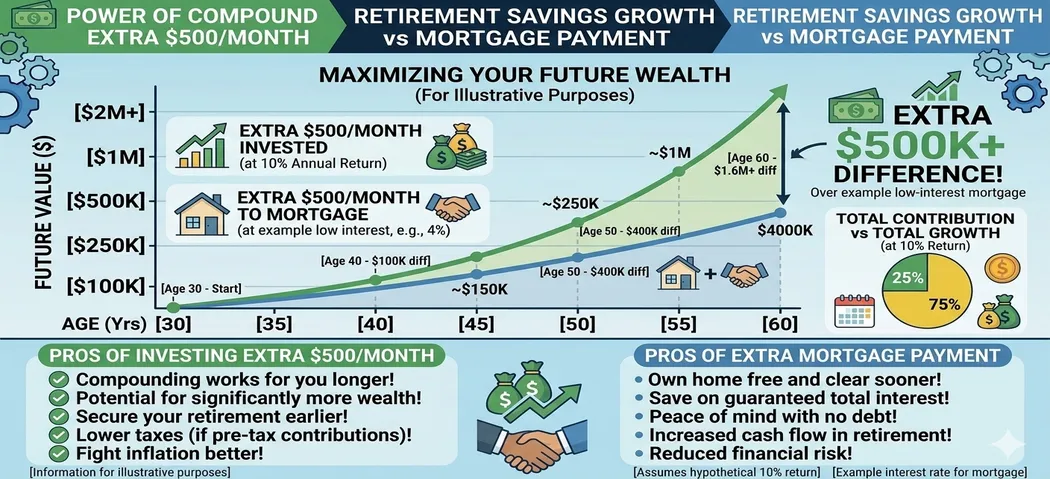
The next question to ask yourself is paying that house off really the best ROI, the best return on investment? If you look at your life and your family as a business, is this the best spot to allocate an extra $500 a month to paying this debt off that you're not going to see rewards for it for years to come? Or is that better to put that money into investments so you're diversified?
Not only do you have a free and clear house someday, but you also have money in savings and retirement so you can retire in a great position. This isn't a right or wrong conversation. It's an option conversation and understanding your options and what fits you best. taking the time to understand that is critical so you make a good decision that fits you not just right now but long term.
Neither option is wrong — it really comes down to your situation, your risk tolerance, and honestly, what helps you sleep at night.