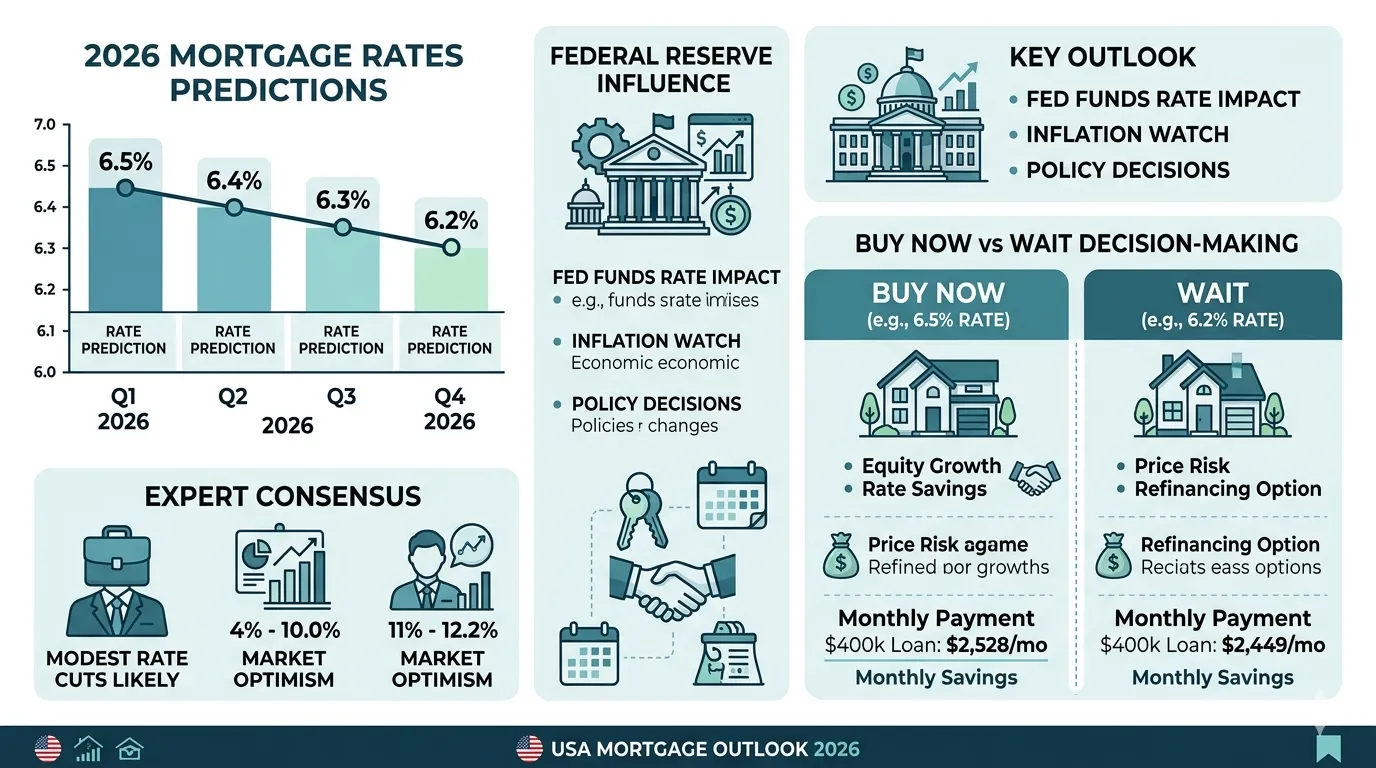
2026 Mortgage Rates Predictions
The Real Problem With Predicting Mortgage Rates
You've been watching rates for months, and every time you think they're about to drop, something changes and your plans get pushed back again. It feels like the goalposts keep moving — and you just want a straight answer about where rates are actually headed.
The truth is, no one can predict mortgage rates with 100% accuracy. But experts track the right signals — and right now, those signals are pointing in a clearer direction than they have in years.
Quick Answer: What You Need to Know
The 2026 mortgage rates predictions from major housing economists agree on a slow decline — most expect 30-year fixed rates to settle between 5.9% and 6.4% by the end of the year, down from the current 6.28% average in April 2026.
| Quarter | Predicted Rate Range | Monthly Payment ($380k Loan) | Change vs. April 2026 |
|---|---|---|---|
| Q1 2026 (actual) | 6.28% | $2,347 | Baseline |
| Q2 2026 | 6.10%–6.25% | ~$2,308 | -$39/mo |
| Q3 2026 | 5.95%–6.15% | ~$2,271 | -$76/mo |
| Q4 2026 | 5.90%–6.10% | ~$2,257 | -$90/mo |
Real Example: Priya + a $360,000 Loan Decision
Priya is a 31-year-old nurse in Texas earning $85,000 a year. She found a home she loves for $420,000 and can put $60,000 down — leaving her with a $360,000 mortgage. She's torn: buy now at 6.28%, or wait for rates to drop?
At 6.28%, Priya's monthly payment (principal + interest) is $2,224. If she waits until Q4 2026 and gets 6.0%, her payment drops to $2,158 — saving $66 per month. That's $792 a year, or about $23,760 over 30 years.
But here's the catch: while Priya waits, the home's price could rise. If it goes up just 3% — to $432,600 — her loan jumps to $372,600 even at the lower rate, pushing her payment back to $2,231. The rate drop gets erased. That's why timing the market is harder than it sounds.
| Priya's Option | Rate | Loan Amount | Monthly Payment |
|---|---|---|---|
| Buy now (April 2026) | 6.28% | $360,000 | $2,224 |
| Wait — same price | 6.0% | $360,000 | $2,158 |
| Wait — price rises 3% | 6.0% | $372,600 | $2,231 |
| Wait — price rises 5% | 6.0% | $381,000 | $2,282 |
What the Top Experts Are Saying for 2026
The biggest names in housing economics have weighed in on 2026 mortgage rates predictions — and for once, they mostly agree. A gradual, modest decline is the base case. No crash in rates, but no spike either.
Fannie Mae, the Mortgage Bankers Association (MBA), and the National Association of Realtors (NAR) all put their Q4 2026 forecasts within a tight 0.3% band of each other. That kind of consensus is rare — and it should give you a bit more confidence in your planning.
| Institution | Q2 2026 Forecast | Q4 2026 Forecast | Tone |
|---|---|---|---|
| Fannie Mae | 6.2% | 6.0% | Cautiously optimistic |
| Mortgage Bankers Assoc. | 6.3% | 6.1% | Steady decline expected |
| Nat'l Assoc. of Realtors | 6.1% | 5.9% | Most bullish on cuts |
| Wells Fargo Economics | 6.25% | 6.05% | Conservative, data-driven |
The Federal Reserve's Role in 2026 Rate Predictions
The Federal Reserve doesn't set mortgage rates directly — but its decisions send powerful signals to the bond market, which does. When the Fed cuts its benchmark rate, investors expect lower returns on bonds, which pulls mortgage rates down too.
In 2026, the Fed is expected to make one or two more cuts — but only if inflation keeps cooling. The Fed's target is 2% inflation. As of early 2026, inflation is hovering around 2.8%, which means the Fed is cautious. They don't want to cut too fast and reignite prices.
For you as a homebuyer, this means: don't expect dramatic drops. Each Fed cut might shave 0.10%–0.20% off mortgage rates — not a 1% swing overnight. Progress will be slow but real.
- Fed cuts rates: Bond yields fall → mortgage rates ease down gradually
- Fed holds rates: Mortgage rates stay flat or drift slightly lower on their own
- Inflation spikes: Fed may pause or reverse — rates could climb again unexpectedly
- Strong jobs data: A healthy economy can push rates up even when the Fed is on hold
The Upside Scenario and the Downside Risk
Most forecasts assume things go more or less as planned — inflation cools, the Fed cuts once or twice, and rates drift lower. But two other scenarios are worth knowing about so you're not caught off guard.
In the upside scenario, inflation drops faster than expected. The Fed cuts rates aggressively. Mortgage rates could hit 5.5% or even lower by late 2026. That would be a huge win for buyers who are waiting.
In the downside scenario, a surprise economic shock — rising oil prices, trade disruptions, or a jobs surge — forces the Fed to hold or even hike. Rates could climb back toward 7%. It has happened before, and it can happen again. Plan for the base case, but don't ignore the risks.
- Base case (most likely): Rates land at 5.9%–6.1% by December 2026
- Upside case: Rates drop to 5.4%–5.6% if inflation cools fast
- Downside case: Rates climb to 6.7%–7.0% if inflation reaccelerates
How Each Rate Move Actually Affects Your Payment
It helps to see the numbers in black and white. A 0.25% rate change sounds tiny — but on a $400,000 loan, it adds or removes about $60 from your monthly payment. Over 30 years, that's $21,600.
The table below shows what your monthly payment looks like at different rate levels across common loan sizes. Use it to pressure-test your budget at each possible scenario.
| Interest Rate | $250k Loan | $350k Loan | $450k Loan | $550k Loan |
|---|---|---|---|---|
| 5.5% | $1,419 | $1,987 | $2,555 | $3,123 |
| 5.75% | $1,460 | $2,044 | $2,627 | $3,211 |
| 6.0% | $1,499 | $2,098 | $2,698 | $3,297 |
| 6.28% (now) | $1,543 | $2,160 | $2,777 | $3,393 |
| 6.75% | $1,622 | $2,271 | $2,920 | $3,568 |
| 7.0% | $1,663 | $2,329 | $2,994 | $3,659 |
If You Already Have a Mortgage: The Refinance Opportunity
If you bought a home in 2023 or 2024 at a rate above 7%, the 2026 mortgage rates predictions are good news for you too. A refinance opportunity could be coming — and being ready for it can save you hundreds per month.
The general rule is: refinancing makes sense when your new rate is at least 0.75%–1.0% lower than your current rate, and you plan to stay in the home long enough to break even on the closing costs. Closing costs typically run $3,000–$6,000.
- Calculate your break-even: divide closing costs by monthly savings to find your payoff month
- If you bought at 7.5% and rates hit 6.0%, that's a 1.5% drop — almost always worth refinancing
- Start the refinance process as soon as rates hit your target — don't wait for the absolute bottom
- Ask your lender about a no-closing-cost refinance if you plan to move within 5 years
What You Can Actually Control Right Now
You can't control what the Fed does or where the bond market goes. But you can control the factors that determine your personal mortgage rate — and those often matter more than national rate trends.
Your credit score, debt-to-income ratio (DTI), down payment size, and the lender you choose all affect the rate you're actually offered. A borrower with a 760 credit score can get a rate 0.5%–1.0% lower than someone with a 680 score — on the exact same house.
- Credit score: Aim for 740+ to unlock the best rate tiers
- DTI ratio: Keep total debt payments below 43% of your gross monthly income
- Down payment: 20%+ eliminates PMI and often earns a better rate
- Lender comparison: Shopping 3–5 lenders can save 0.25%–0.5% on your rate — that's thousands over 30 years
6 Tips to Save Money Using 2026 Rate Predictions
- Get pre-approved now, even if you're not ready to buy: Pre-approval is free and shows you your real rate — so you know exactly what you're working with before rates shift.
- Watch the 10-Year Treasury yield weekly: This single number predicts mortgage rate direction better than any news headline — when it drops, mortgage rates usually follow within days.
- Ask about a float-down option when you lock: Some lenders let you lock a rate but drop it if rates fall before closing — this gives you protection in both directions.
- Improve your credit score before you apply: Pay down revolving debt below 30% utilization — 60 days of this can raise your score by 20–40 points and save you thousands over the life of your loan.
- Consider mortgage points if you're staying long-term: Buying one point (1% of the loan) typically lowers your rate by 0.25% — worth it if you stay in the home more than 7–8 years.
- Set a rate alert with your lender or a mortgage app: Rather than checking daily, set a target rate (e.g., 5.9%) and get notified automatically — so you can act fast when your number hits.
Frequently Asked Questions
Are 2026 mortgage rates predictions reliable?
No forecast is guaranteed — but predictions from institutions like Fannie Mae and the MBA are based on deep economic modeling and historical patterns. They're the best tool we have. Treat them as a range and a direction, not an exact number.
What would make mortgage rates rise unexpectedly in 2026?
A sudden jump in inflation, a strong jobs report that spooks the Fed, or a global financial shock could all push rates higher fast. These events are hard to predict — which is why locking your rate when it works for your budget is always a smart move.
Should I wait for a 5% mortgage rate before buying?
Most forecasts don't see 5% rates until 2027 at the earliest — and only if the economy cooperates. Waiting for 5% while prices rise could cost you more than just accepting today's 6.28% and refinancing later when rates drop.
How can I get a rate lower than what's predicted nationally?
Your personal rate depends on your credit score, down payment, and which lender you use. A strong credit profile (760+), a 20% down payment, and shopping at least 3 lenders can get you a rate 0.5% or more below the national average.
Your Next Step
The 2026 mortgage rates predictions are pointing in a good direction — but the best rate you'll ever get is the one you actually secure for yourself. Don't wait for the perfect moment. Talk to a lender today, get your pre-approval numbers, and find out what rate you personally qualify for right now. Even a 15-minute call could change your whole home-buying timeline.