2026 is shaping up to be the most balanced, predictable housing market we've had in years. And if you're planning to buy a home, that predictability can be your biggest advantage. But here's the question. Are you actually prepared to buy a home in a normal market? Because 2026 isn't 2021. It isn't the affordability shock of 2022, and it isn't the low inventory freeze we've dealt with the last few years. This is a different environment. And if you understand how it works, you can put yourself in one of the best buying positions we've seen since 2019.
Today, I'm walking you through exactly how to buy a home in 2026. Your timing, your financing, your strategy, how to evaluate homes, how to negotiate, and how to avoid the biggest mistakes that buyers make. This is a blueprint for buying a home in a more normal market.
2026 Housing Market Trends: Inventory, Prices, and Buyer Advantage
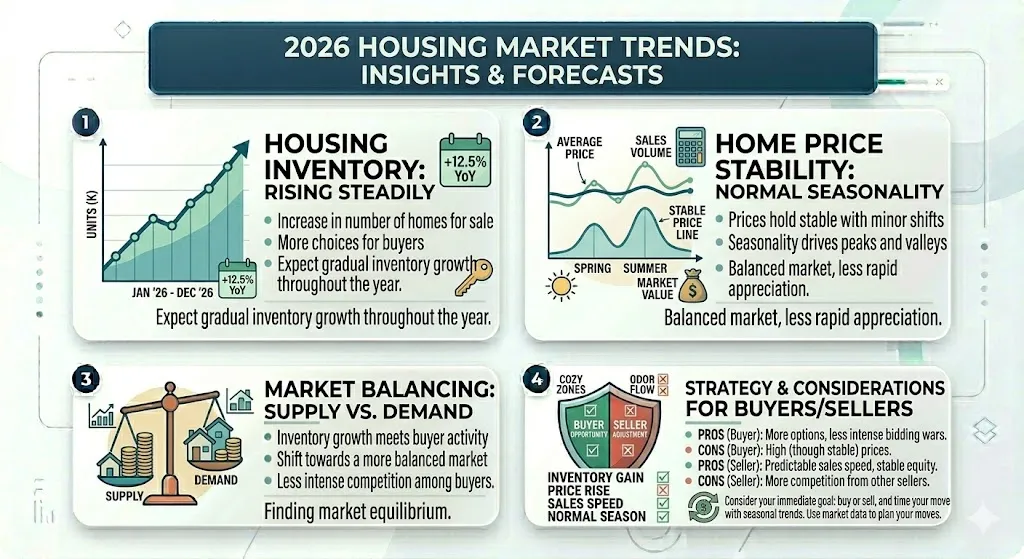
A balanced market gives buyers more control and better decision-making power
So, let's jump in because 2026 might finally be the year the market gives buyers a real opportunity, if you're ready for it.
So, if there's an overarching theme of this article, this is what I want you to take in. That we are returning to a more normal market. For the first time since 2019, the housing market is lining up with long-term historical patterns. Inventory is rising, days on market are normalizing, prices are flattening, and buyer activity is aligning with actual seasonality. In a normal market, buyers who prepare early understand the process and make decisions based on facts, not emotion, come out ahead. That's the entire advantage you have in 2026. You finally get to make decisions the way the home buying process is supposed to work.
Now, with that, you're going to see inventory rise, and that's going to give you leverage. Inventory is climbing back towards preandemic levels, and that's one of the biggest advantages you have as a home buyer in 2026. More homes on the market means more choices and less pressure. During one of the recent home buyer webinars we did, we talked about how low inventory forces buyers into reactive emotional decisions. But with higher inventory, you get to compare homes. You get to walk away from homes and you get to take your time without the fear that you'll never find another option.
Now, this is the first time in years where buyers aren't backed into corners. At the same time, homes are likely going to take longer to sell, and that's going to help you. Homes at the moment are taking around 30 days or more to sell. And as I said a moment ago, that's completely normal. It benefits you because you're not racing the clock anymore. You can see a home twice. You can think about it. You can talk strategy with your lender, with your realtor, with your family. You can also look at alternatives if there's other homes in that neighborhood that are maybe priced similarly or have similar upgrades. A normal pace leads to better decisions and fewer regrets. It gives you room to be thoughtful instead of reactive.
Now, as I've been saying on this channel since before the pandemic, house prices are not going to crash. In fact, home prices are stable. They're not falling, but at the same time, they're not surging. Home prices have leveled off nationally. Now, that's not a downturn, and it's also not a run up. It's stability. And stability is exactly what buyers need. You're no longer watching prices jump 5, 10, 15% in a year. But at the same time, you're no longer wondering if the bottom will fall out. You're navigating a market where pricing is reasonable and predictable. That matters for planning. It matters for budgeting. And it also matters for confidence.
Now, as we know, interest rates have been the key driver of the housing market since the beginning of the pandemic. And with that, we saw artificially low interest rates for a good part of 2 years. But since then, the Fed jacked interest rates and the entire housing market slowed. Now, with that, to add some additional context, in 2024, interest rates averaged about 6.9% for that entire year. In this year, 2025, interest rates have averaged about 6.7%. Now, in 2026, most projections have them in the low 6% range with the possibility of breaking into the high fives if inflation continues to cooperate. Every 1% drop in rates adds millions of new eligible buyers to the market. When rates get below roughly 5.8%, 8% affordability improves and competition increases quickly. That's why your preparation matters because if rates dip, you want to already be positioned to act, not scrambling to catch up.
Best Time to Buy a House in 2026: Seasonal Market Strategy
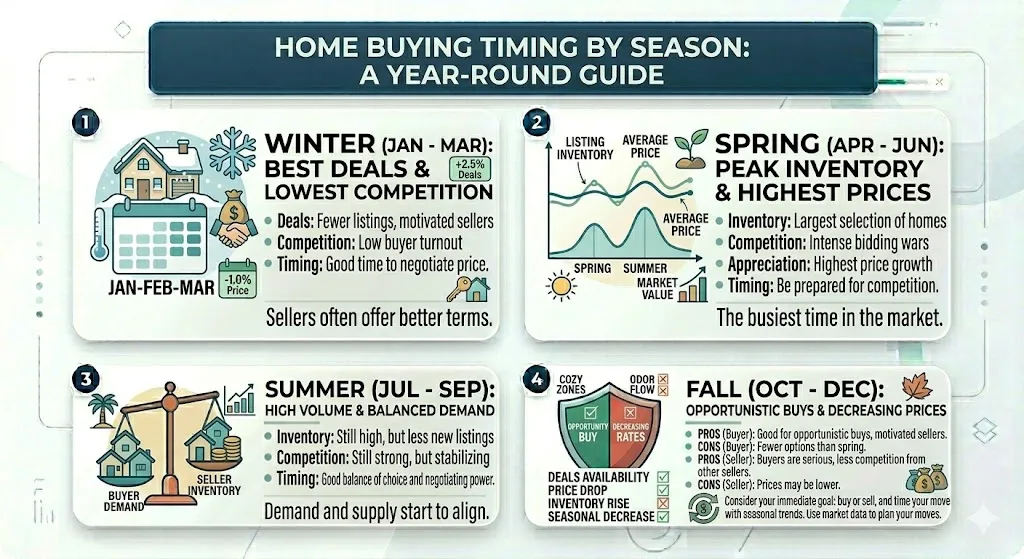
Understanding seasonality helps you time your home purchase smarter
Now, when I say that 2026 is going to be a more normal housing market, that also means that seasonality is back and understanding it gives you a huge advantage. understand that between January and February, you're likely to see low inventory on the market, but motivated sellers, which is really good for negotiation. At the same time, between March and June, that's when the peak activity happens for the year. That's usually when you have the best selection, but you also have more competition because there's a higher number of listings on the market. But the other thing to understand is that this is also when the most appreciation happens for the entire year. So, if you're able to get in early, chances are you're going to reap those rewards.
Now, when it comes to summer, buyers are distracted, but motivated sellers remain. So, it can be a good time to find deals. Now, as we move into the fall, understand that homes sit longer. But at the same time, sellers become more flexible, which means if you're a buyer out there, that can be a strong opportunity window. But, as I mentioned earlier, the most appreciation happens earlier in the year. So, if you're buying later in 2026, chances are the appreciation for that year has already happened.
Now, as I say that, I want you to understand that you don't need perfect timing. You just need to understand the rhythm so that you can align your search with what matters most to you.
The biggest opportunity buyers have in 2026, in my opinion, is balance. You're no longer buying in a market controlled entirely by sellers, and you're not buying in a distressed market either. In fact, you're going to get more inventory. You're going to get more normal negotiation. You're going to get more reasonable pricing, or at least you should. You should get a slower pace of the market. You also should get better preparation windows, more leverage on still listings, and improving affordability. This combination hasn't existed since before 2019.
So, one of the core lessons I want you to take away from this article is that readiness is everything. Buyers who prepare early win. Period. So, if you're asking yourself what that means, the first thing is you need to know your payment comfort zone. Shop the payment, not the approval amount. Also, build your savings foundation. That means down payment, closing costs, emergency reserve. A strong financial cushion makes buying and owning far less stressful. And at the same time, you need to understand your credit picture. You don't need perfect credit. You need prepared credit. Small improvements create real savings.
And with that said, you should be getting a full preapproval, not a pre-quall. You should be having a conversation with a professional on the phone and providing documentation. That means W2s, that means payubs, that means bank statements. You should be doing a loan application. And from that, you should be walking away with a full preapproval. That means you should know exactly how much home you qualify for, how much down payment you need, how much closing cost you need, so that when the right opportunity presents itself, you're ready to go.
How to Prepare to Buy a Home in 2026: Financial Checklist
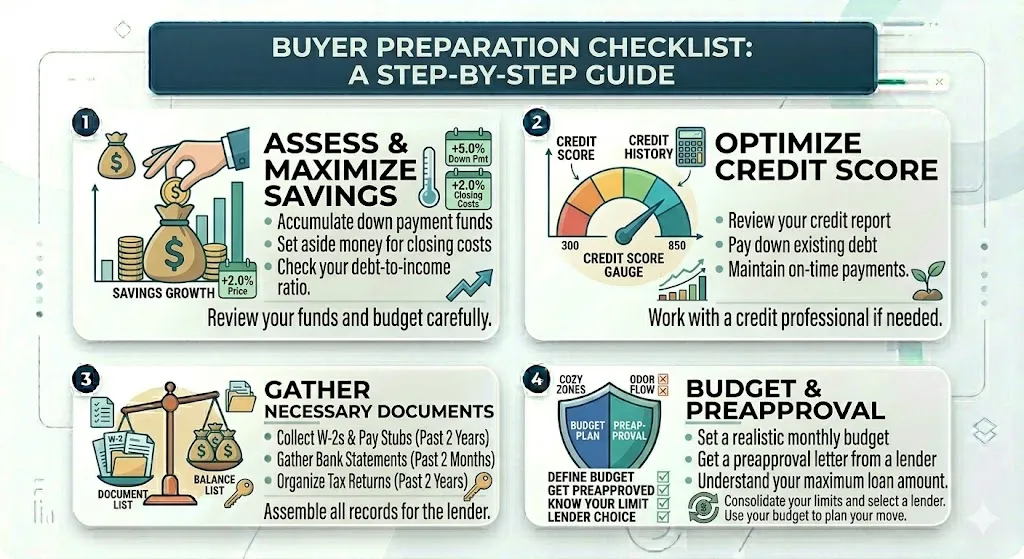
Preparation is the key advantage for buyers in a balanced market
Now, if you're watching this, you're not sure where to start. My team and I help a lot of people here on YouTube. We'd love to help you, too. You can get directly in touch with us using that link in the description.
Now, the key with preparation is that it gives you more strength when it's time to make an offer. Now, if you've been watching my articles for any period of time, you've often hear me say that people buy emotionally and they justify logically. And understand that buying a home is emotional. So, that's why it's super important that you get really clear on why you're doing what you're doing. Your why keeps you grounded. When decisions feel overwhelming, you need to ask yourself, why am I buying now? Why this area? Why this price point? Why this lifestyle? When your why is clear, your decisions become easier.
Now, with longer days on market and more inventory, negotiation is going to come back to the market. This is one of the strongest advantages that buyers have heading into 2026. Now, with that, here are some things that you can negotiate. We're talking price, closing costs, repairs, credits, rate buyowns, even timelines. If a home has been sitting on the market for, say, longer than 60, 90 days, there's leverage in that home.
But you need to have the right team on your side. So, before you start shopping or going to open houses or falling in love with homes online, you need to make sure you have the right team. That means the right real estate agent and the right mortgage professional. In 2026, this matters more than it has in years. A good team protects you. They educate you. They prepare you. And they put you in a position to win. A weak team cost you opportunities. They cost you money and peace of mind.
So, if you're watching this going, "Well, how do you choose the right real estate agent?" Well, experience matters. Again, this isn't 2021 where anyone with a license can get an offer accepted. You need someone who understands pricing, negotiation, contracts, and local trends. You need to choose an adviser, not a salesperson. Ask yourself, do they educate you or push you? Do they listen to your goals? Do they explain the process clearly? Your agent should slow things down, not speed them up.
Your agent must also understand financing. They don't need to be a lender, but they should know how loan types, down payment strategies, credits, and appraisal terms impact your offer strength. Your agent and lender should operate as a unified team. When your lender and agent are aligned, your offer is stronger and communication is way smoother. When they're not aligned, you feel it immediately.
So, with that, there's some red flags to avoid. The first one is pressure. No one should be pressuring you to make decisions in any market out there. Also, a lack of communication. I can't tell you how big of a red flag this is. As a real estate agent, I have to make a lot of phone calls, a lot of text messages, reaching out on other people's behalf. And most of the time, that's to agents on the other end. And what I can tell you is that 90% of the time, these people don't respond without multiple points of contact. In fact, as we're filming this article, I've reached out to one agent five times in the last, say, 48 hours or so with zero response, which means I can't find out the information my buyer wants on this property because they won't return my call.
On top of that, another red flag to avoid is somebody with minimal local knowledge. You need somebody that understands the local market that you're in. They also need to have strategy. In addition, they should be talking to you about your budget, about your goals, about what you're trying to accomplish. If you feel like you're the one doing all the work and you're not getting a response from your agent, then you probably have the wrong agent.
Home Buying Negotiation Tips 2026: How to Get the Best Deal
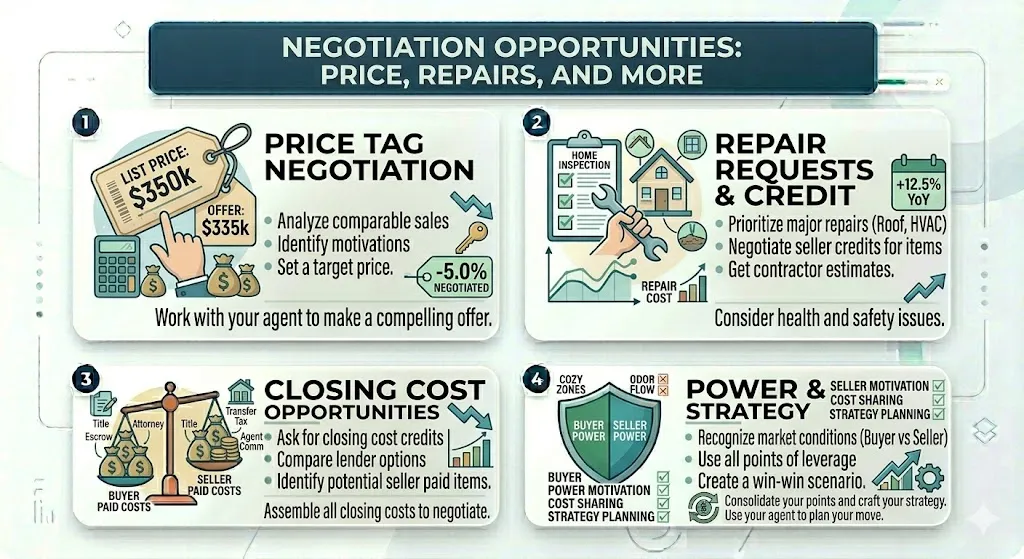
More inventory and time on market create strong negotiation opportunities
At the same time, how do you choose the right lender? Well, you want somebody that has good terms. At the same time, you want somebody that has clarity. They have communication. They have options. They have transparency. They also have realistic numbers. As I mentioned earlier, you don't necessarily need the lender with the lowest rate. You need a lender with a competitive interest rate that can ultimately get you to the finish line. A lot of lenders out there can overpromise and underdel. They can tell you they have the best rates in the world, but if they can't actually get you to the finish line, it really doesn't matter. A great lender helps you understand what you can comfortably afford, not what you can technically qualify for.
The right team makes you competitive. Your team isn't just your support. They are part of your strategy. And that's because a strong team not only helps you find the right home, they help you evaluate the condition. They help you price the market accurately, you know, based on comps to figure out exactly what that home's worth. They also help you negotiate effectively. They don't get in the middle of the transaction just trying to get it closed. They want the best deal for you. While at the same time, they're structuring your offer for success. They're giving you guidance in how to make that offer so that it actually stands out. Understand that in 2026, your competition isn't other buyers. Your competition is buyers with better preparation and better teams.
Now, as a real estate agent that's been doing this over 20 years, I've seen a lot of home buyer mistakes. And one of the very first ones I want to talk about today is waiting for the perfect interest rate. By the time rates drop enough to excite you, they've excited everyone else, too. So, understand that waiting for the interest rate isn't the right move. Also, expecting pandemic level deals. In my opinion, these aren't returning. So you need to aim for fair and reasonable, not some fantasy you have in your head. At the same time, as we mentioned earlier, you should not be shopping without preparation. Preparation always beats timing.
Another thing you should avoid is letting your emotion override your logic. You can actually take your time now. Use that wisely. Prepare earlier. Even if you're not planning on buying a home until summer, start doing the process now to know exactly where you stand and exactly how much you qualify for. And if there's things that you need to work on, you have time to do it.
And lastly, not aligning your team early. The earlier your team is in place, the smoother everything becomes.
So here's the bottom line. 2026 is going to be a more normal market, more inventory, more negotiation, stable prices, and a pace that lets you make smart, informed decisions if you prepare financially, mentally, and strategically. And if you choose the right team, buying in 2026 can be one of the best opportunities that buyers have had in years.
Top Home Buyer Mistakes to Avoid in the 2026 Housing Market
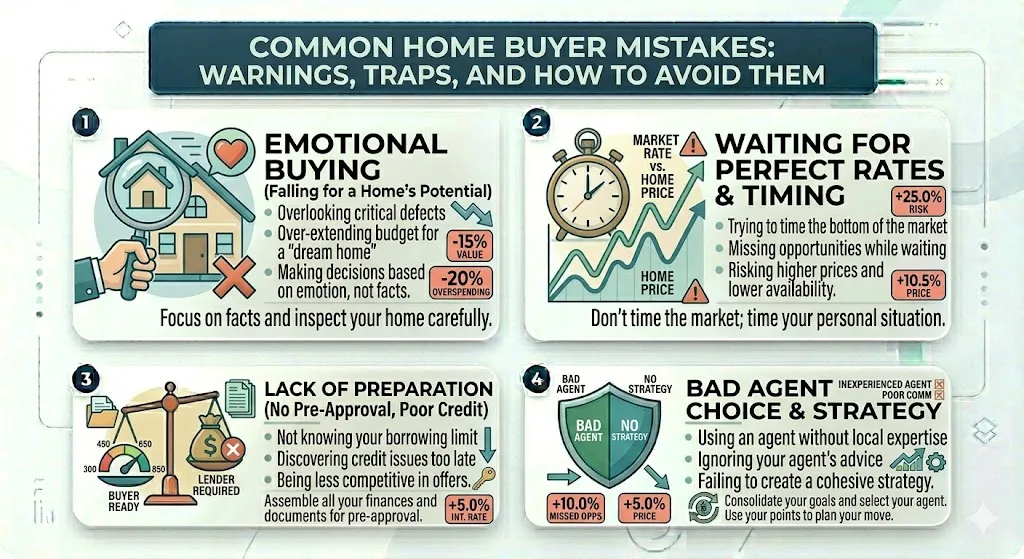
Avoid these mistakes to stay competitive and make smarter buying decisions
Now, if you want help building a plan or want to understand what home buying looks like in your specific market, make sure you reach out. There's a link in the description of the article. Whether you're going through the pre-approval process or you're just looking for a real estate agent, we can help guide you to the finish line. Just make sure you check that link below. Remember, real estate is local and your strategy should be, too.
Now, do me a favor. If you found any value in this article at all, make sure you hit that thumbs up and please consider subscribing to the channel. See you next time.