Buying A House with a 6% Interest Rate Is SMART
A lot of people think buying a home at a 6% mortgage rate is absolutely crazy. But what if I told you it could be one of the smartest decisions you'll ever make? At the moment, there's a lot of people that hit the pause button ever since interest rates started going up, thinking, "I'm just going to wait. I'm going to wait for interest rates to come down. I'm going to wait for home prices to come down before I jump back in the market." But what if that strategy ends up costing you more money in the long run?
Why Buying a Home at 6% Interest Rate Can Be a Smart Move
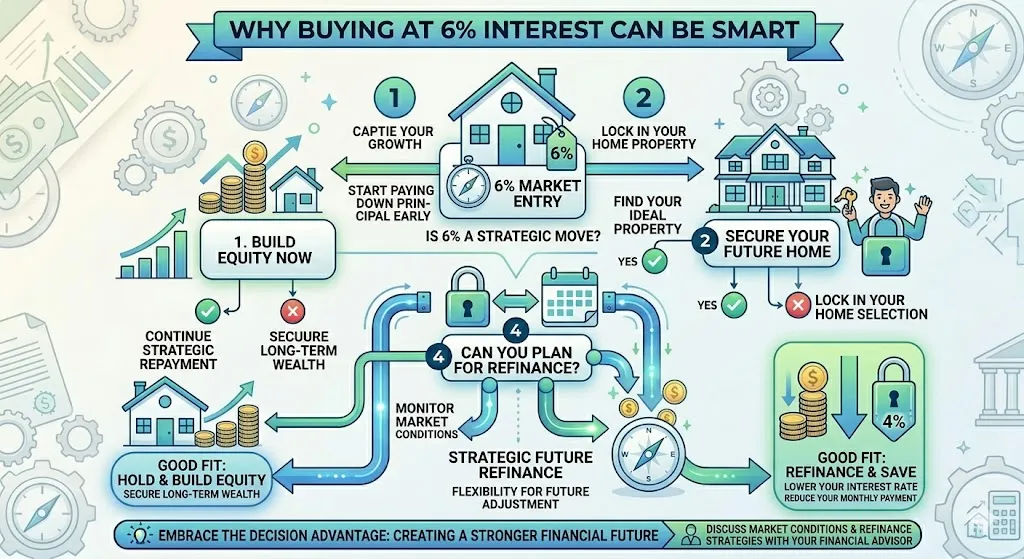
Lock in today’s price and refinance later when rates drop
The goal with this article is to help you understand why locking in your interest rate right now could be a financially sound decision and why waiting might end up costing you more money than you think.
At the moment, what we have is a comparison problem. If you've been reading my articles before, you often hear me say that people have very short memories. They only remember a couple of years ago. And when it comes to home prices and when it comes to interest rates, that's exactly the mindset. People are thinking about where house prices were prior to the pandemic. They're thinking about where interest rates were at the bottom of the pandemic. But what people don't understand is how we got there.
With interest rates sitting at those lows of 2 1/2, 3, 3 1/2%. That's not normal. That was an anomaly. The only reason interest rates got there is essentially we had this black swan event in the economy. We had this pandemic that spread across the world, and it essentially shut down the global economy. And because of that, what we had is we had the Fed take the Fed funds rate to 0%. Which made borrowing money really, really cheap. On top of that, we had the Fed stimulating the economy with all of this money. And with people locked at home, getting money put into their bank account, not really being able to go out and spend it, they were able to save not only for down payments, but they were able to put money away, maybe in some cases pay off debt that they weren't able to pay off before. So, a lot of people during that pandemic time ended up in a way better financial position than they would have otherwise.
So when we take a step back, with a 50,000 foot view and look at that period of time versus where we are now, it's a very small blip on the radar. What you have to understand is that from about 1982 to say 2002, we were essentially in a 40-year bull run in mortgage rates, which essentially means interest rates were coming down during that entire period of time. Yes, some years they went up, but the overall trend of interest rates during that period of time was down. And that was broken in 2022 as the Fed started to raise the federal funds rate. And during that time, interest rates shot up, which I think we saw the peak sometime in October of 2023, which is ironically when I bought a house.
I bought a house in November of 2023. Actually closed in November, and I closed on that property with a 7% interest rate. Now, at the time, 30-year fix rates were about 7 1/2%. I closed on my property on a 7-year ARM at 7%. Now, I bought the house at that time for $1.5 million. And a lot of people online, a lot of people on my articles were telling me, you're absolutely crazy. You're essentially buying at the top of the market with price. You're buying at a super high interest rate. Why would you do that?
Well, for me, it was the right time in my life. I have three boys, my wife, there's five of us living in 1,700 square foot property with not really a big yard to play in. My kids are growing. We need more space. We needed additional bedrooms. There was a property in my neighborhood that a friend of mine owned that I had been wanting to buy for years. And unfortunately, he never came to me with that opportunity until this time, when interest rates were high, home prices were high. So for me, it was the right time in my life to make that move.
The Hidden Cost of Waiting for Lower Mortgage Rates
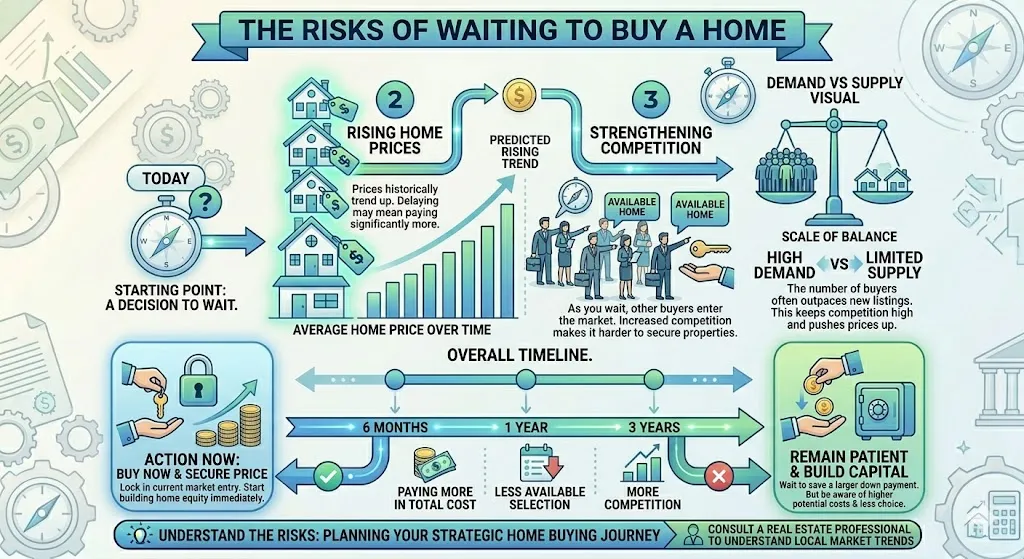
Waiting can cost more due to rising prices and competition
But here's what's happened since then. Before I ever closed on that property in October, interest rates actually had gone down. And I was able to secure a refinance, a no cost refinance during that period of time where I had to come up with no money out of pocket and actually was able to get a half a percent lower on my interest rate which saved me about $400 per month. So I was able to take my interest rate from 7% down to 6.5%. I saved $400 per month. I came up with essentially no money out of pocket. So it was a no-brainer to do it.
And then again about 6 months later I was able to do the exact same thing. I was able to take it from 6 1/2% down to 6% to save another $400. So now I'm in a total savings of about $800 on my property from where I originally purchased it. At the same time, values were creeping up.
Now, here's the crazy part. Just recently, this past week, I was able to refinance my 6% down to a 5.12% on a 7-year fix. So, the same amount of loan, same type of loan, and I was able to break my payment down another $630 something bucks. So, all in, I've been able to save $1,430 something. Now, this last time, I did have to pay a little bit of money out of pocket in order to refinance because I wasn't able to raise the interest rate and get any sort of rebate back to pay those closing costs. So, I had to pay about $5,000–$6,000 in closing costs in order to get this last loan. But when you take the amount of money I'm saving and you divide it into the cost of the loan, it's going to take me about eight or so months in order to recoup the cost of that loan. So in 8 months, I'm going to be at a break even point. And from every point forward, I'll be saving $637 on that loan.
Now, a lot of you ask the question, how are you able to refinance your loan with no cost? Well, just in really simple terms, every day there's the best interest rate in the market. So say today the best interest rate in the market is 6%. If you take a slightly higher interest rate than the best rate in the market, a lot of times the lender offers a credit back to you that you can use towards closing cost. And that's essentially what I did. So each time I didn't take the absolute best rate in the market. I took a slightly higher rate so that I could use those costs in order to cover the cost of my loan. And the reason I did that is because I'm one of those people that believes interest rates are going to trend down in the future, so that I'm taking advantage of those opportunities as they present themselves.
So, you're reading this going, you're telling me to buy a home at 6%. Why would I do that if you think interest rates are going to move down in the future? And that's because I don't know when they're going to move down in the future. If you use my example that I just gave you of me personally, I bought my house at $1.5 million. My payment was based off a 7% interest rate. My payment is now $1,400 lower while at the same time my house price is up about $100 to $150,000 during that same period of time. So had I waited for interest rates to get down to what I'm at today if I was able to lock that in today. Yes, I would have that interest rate, but I would be paying a lot more for the home today.
How Refinancing Can Lower Your Mortgage Payments Over Time
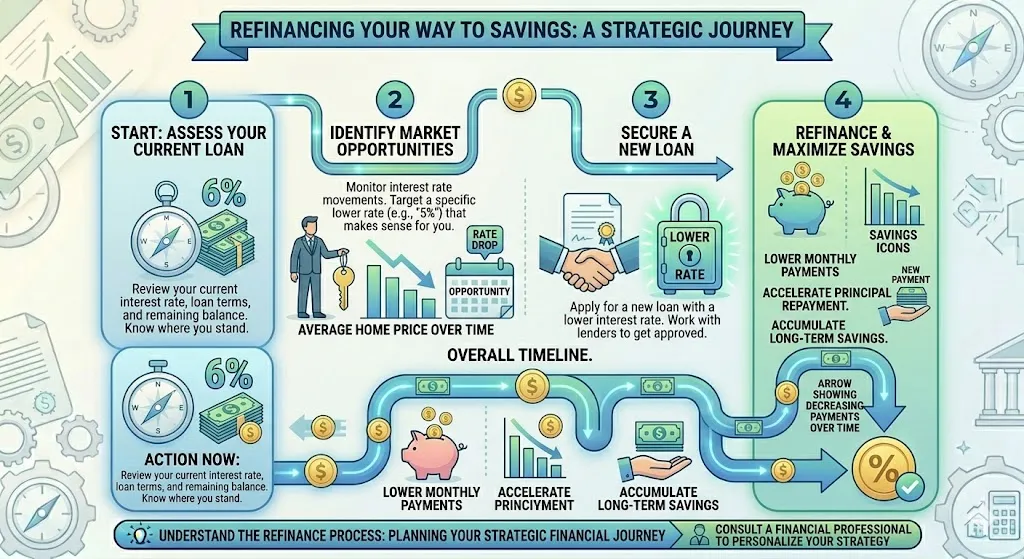
Take advantage of falling rates to reduce monthly costs
And so that's the whole idea here — by purchasing today, you're essentially fixing that housing price. You can never refinance the price of your house, but you can refinance your payment on that house if and when interest rates go lower in the future. So, if you're like me and you believe there's an opportunity for interest rates to move down in the future and you're able to qualify because you still have your job, you still have equity in your property, then you're able to take advantage of those at that time.
Now, if interest rates drop to 3% tomorrow and you're able to lock that in, then you absolutely lock it in with the expectation that it's probably not going to ever get there again. But the reality is, as we sit here today around 6%, the chances of seeing a 3–3 1/2% interest rate again are very, very low.
So, the thing to understand is that when you buy a house at 6% today, you're not necessarily stuck at that 6%. And at the same time, you have the market working in your favor. And that's because if interest rates move higher, then you've already locked in that interest rate and you've locked in your housing price. If interest rates move lower, then you take advantage of them by refinancing. Or let's just say interest rates move sideways and they don't go up or down. Well, guess what? Chances are home prices are going to keep pace with the rate of inflation, which means they're going to gradually continue to creep up. But by buying that house, what you've done is now you've secured your housing payment. You've locked in the ability to have force savings. You're gaining that appreciation on that property as it continues to appreciate over that period of time and you've taken out the risk of the market going against you because now you've locked in that payment.
And the reason I can say everything that I'm saying confidently is because everything comes down to supply and demand. Basic economics. When you have more demand than you have supply, then prices tend to go up. And the opposite is true. When you have more supply than you have demand, then that means softer prices. Prices continue to come down. Well, at the moment, what we have is we still have a supply shortage nationwide in most housing markets out there.
Now, if you're reading this and you're in parts of Florida, Louisiana, Texas, some of these markets, you're probably going, you're absolutely crazy. Where I am, you can just put an offer in and get your offer accepted immediately. You can get concessions. Yes, there are some markets out there like that, but the majority of the United States still has less inventory than it did prior to the pandemic. And even then, inventory was low. So, you're in an environment right now in most markets where supply is constrained. You still have a lot of buyers sitting on the sidelines waiting to buy homes. And as those properties become available, you have competition out there not only from those people sitting on the sidelines but you also have more and more people every single year turning prime buying age. So you have multiple generations of people that start to hit that age between 33 and say 38 years old where they decide that they want to become homeowners. And as that happens, you get more competition coming into the market.
And if you were to sit there and wait, there's a risk to waiting as well. The risk is higher prices. The risk is higher interest rates. Risk is also higher competition. You got more people going after the thing that you want. In addition to that, you also have the risk of the Fed, inflation, all of those other factors that we talk about that could send not only prices higher, interest rates higher, just impact you in a negative way.
How Supply and Demand Drive Home Prices Higher
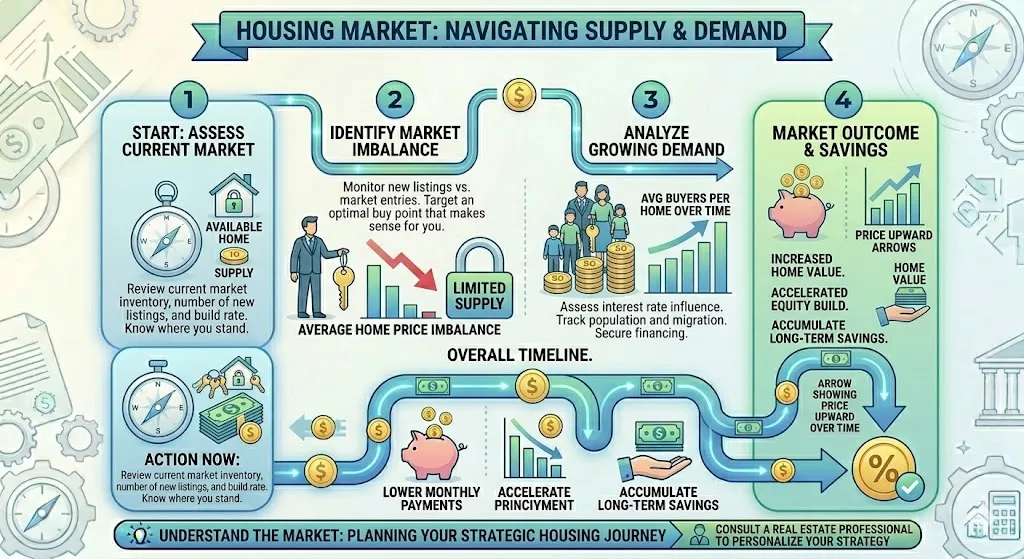
Low inventory and strong demand keep prices rising
So, what you want to do is take advantage of the market when it presents itself. But that doesn't mean you should run out and buy a home. There's a right time in your life. And what I say for everyone is, for me it was a family move. Why I bought that property, I had already owned the previous property, but the reason I bought the most recent was because the right time for me and my family. We needed more rooms. We wanted a different location. All of these things were driving that move. And I went from a 2.99% interest rate to a 7% interest rate at that time. But for me, it was the right move. And I'll tell you, I questioned it. Had a lot of conversations with different people asking the same things that you're probably asking right now. Am I making the right move?
And now I look back and go, it was 100% the right move because had I sat on the sidelines, which I had done several times before, I watched home prices go up, I watched payments come down and I go, I could have done that, but I didn't. I sat on my hands and I waited and I missed that opportunity. And there were many times where I had regrets because those same homes that I could have bought back then are now considerably higher than where I would have purchased them.
So, what I want to stress is you have to buy when it's the right time in your life. But at the same time, you need money in the bank. You need to be able to comfortably make that payment even if interest rates don't move down. I don't want you to buy a house with the expectation that the only way you can afford it is if and when interest rates go down. That's the wrong move. You need to buy with the expectation that, hey, listen, if this is where rates are forever, I can do it. I might not like it, but I can comfortably make this payment because that's the right mindset. And then if and when interest rates go down, you take advantage of it and you sit back and you smile because you're like, "Hey, listen. I made the right decision at that time based on where I was in my life." And now I've been awarded with a lower interest rate.
But if I were giving you advice right now, don't try to time the market. It's a fool's game. I've been lucky multiple times in doing what I'm doing. It's not because I can pick the bottoms and the tops and all of this stuff because I've also bought at the wrong time. I bought in 2006. I went through the whole craziness of prices dropping and being the highest purchase in the neighborhood and the whole thing. And that was a different environment. Those were different loans. That was a different time. There was way more inventory. So many different factors.
Smart Home Buying Strategy: When Is the Right Time to Buy?
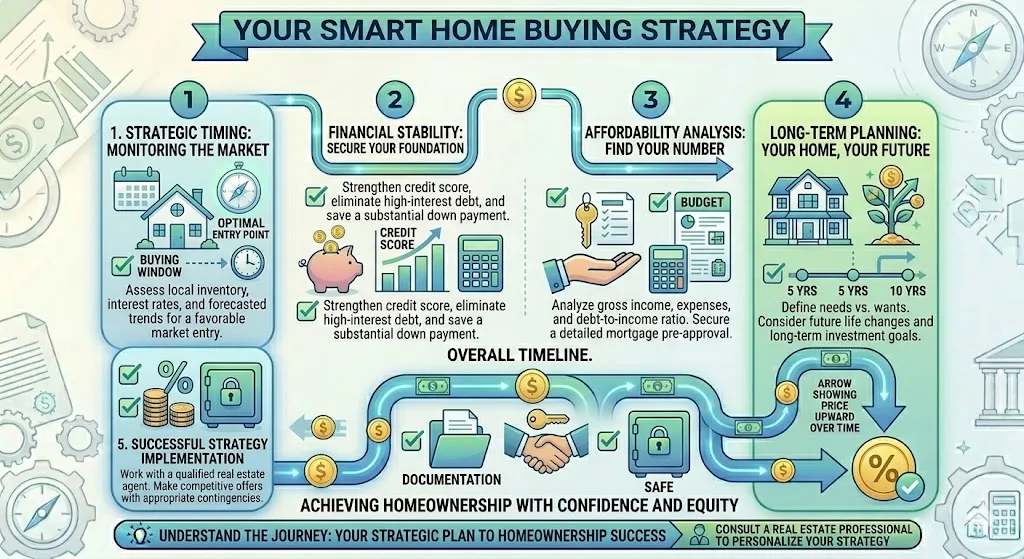
Focus on personal readiness rather than timing the market
But I would suggest just buying when it's the right time in your life, having stability, relationship stability, work stability, location stability, knowing that you're going to be in that area for a longer period of time, and having a longer term time horizon. I would say 5, 7, 10 years minimum on anything you're buying at the moment. And that's because there's a chance that home prices do just move with the rate of inflation. No real growth in home prices when you're comparing it to inflation, but home prices getting more expensive over time because of how inflation actually works.
So, if I were to sum this up in a couple of words, what I would say is — if you're buying now, you know exactly what you're getting. You know the payment, you know the price, you know the interest rate, you know exactly where everything is. By waiting, you don't know. You don't know where prices are going to be. You don't know where interest rates are going to be. You don't know where your job stability is going to be. You don't know where any of that stuff is going to be. So, the earlier you can do that, the better off you're going to be long term.