Cash Out Refinance Explained Should You Do One in 2026
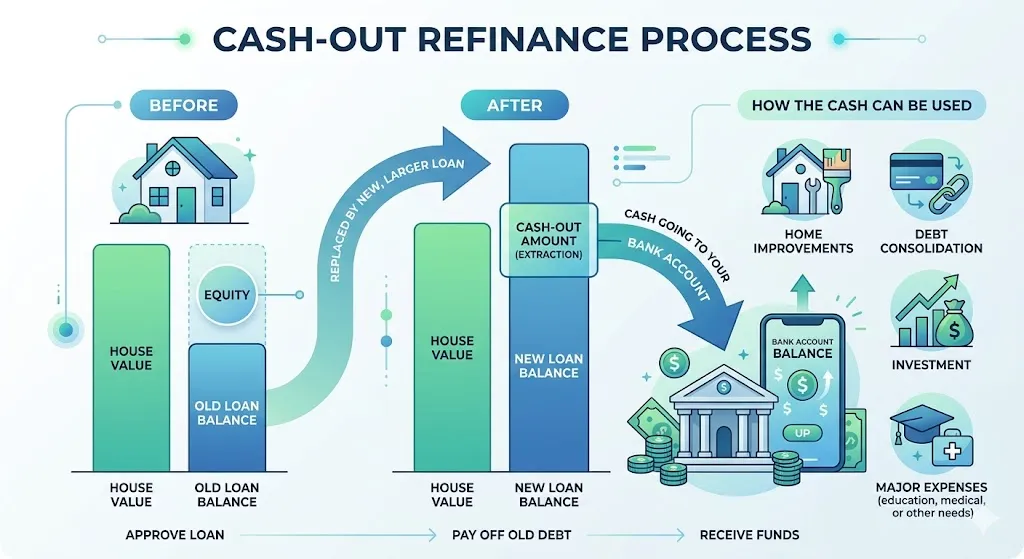
A simple breakdown of how homeowners convert home equity into usable cash
Cash out refinance gets a bad rap. Some people think it's irresponsible. Some think it's only for people in trouble. And some think it's the smartest financial move they'll ever make. Today, I'm going to break down the top five legit reasons a cash out refinance can make sense and the big mistake people make when they do it. If you're a homeowner sitting on equity, this article might save you or make you a lot of money.
Okay, first quick definition. A cash out refinance means you replace your current mortgage or in some cases you have a paid-off home with a new one and you pull cash out of your home equity. I know people love examples. So, your house is worth 500,000, you only owe 200,000 on it. You need $100,000 of that 300,000 in equity. The difference between what you owe and what it's worth, that's considered home equity. So, you get a new loan for $300,000. You pay off the old $200,000 loan. You put $100,000 in your bank account. And now you have a bigger loan with a bigger payment, but you've got cash to deploy for a ton of things. You're not creating debt necessarily. You're repositioning existing equity. So, the question isn't can you do it, it's should you and why.
So, let's talk about reason number one why people are doing cash out refinance, especially in 2026. They are paying off high-interest debt. This is the most common and honestly the most misunderstood. You're taking on more debt to pay off debt. Well, if you got credit cards at 18 to 28%, you got personal loans at 10 to 15% and $1,100 car payments, it might make sense to roll that debt into a mortgage at a much lower rate. Your cash flow can change immediately. I've done scenarios and examples where somebody had $7,700 in monthly payments and that was accounting for the minimums on the credit cards. They paid off everything, consolidated it into a mortgage payment that was $4,300. Now your monthly outlay is $4,300 versus $7,700. The smart way to do it is take that difference of $3,400 and start paying it down in the new mortgage and get it paid off in record time. Probably you'd cut the term in half on the mortgage.
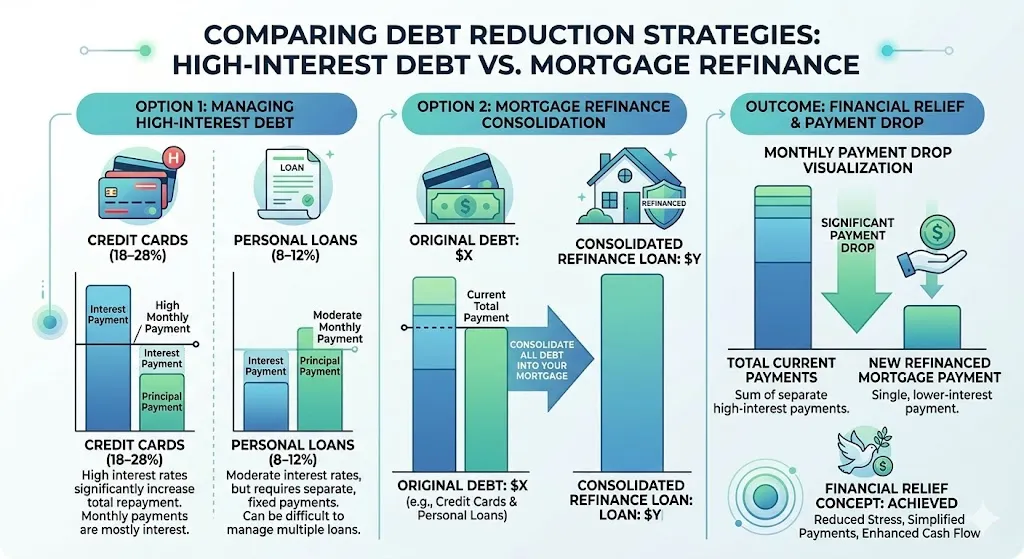
See how consolidating debt into a mortgage can dramatically reduce monthly expenses
So, one thing to emphasize here, this only works if you don't run the credit cards back up and reintroduce all this new spending power to some new things you can buy and create new debt. I've seen people free up thousands a month overnight, the $3,400 I talked about. And I've seen people wreck themselves doing the same move by doing that and then just running up 50, 60, 80,000 in credit card debt over the next couple years. So, if the cash out reduces stress and improves discipline, it's powerful. If it enables bad habits, it's poison. And that's the thing, too. Debt is a powerful tool. It's a sword. It can be used to do great. And it can also inflict quite a bit of harm. So, that's number one. Cash out refinance to pay off high interest debt, to consolidate debt. It's a great one, but just do it wisely.
All right. Reason number two, and I'm seeing this one a lot in 2026 as well, is to invest in real estate. And this is where wealthy homeowners and investors think differently. They think about doing a cash out on existing stuff for down payment on the next rental property. They think about cash out on existing stuff to build an ADU to create more rental income. They think of doing cash out to redeploy equity to new assets because they know that holding on to as much assets as possible is turning this debt equity into income producing assets. So, your house isn't a piggy bank, but it can be a business partner.
And in this sense, where you're taking the money out to invest in real estate, you got to keep a couple things in mind. I'm doing cash out refinance for an investor who is reminding me, listen, I'm going to take some of the cash out, so I want to invest it. I've got opportunity, but I don't want to turn my current cash flowing properties into properties that are bleeding me out and negative on a monthly basis. So, we're only taking a certain portion, and we're keeping his loan to value at 60% or less. And by doing that, he's going to be able to deploy more capital, buy more assets, have more cash flow, not less. And there's a lot of different reasons for this, but by controlling more assets, you're going to have more appreciation. If you own one million in real estate, it goes up 5% a year, that's $50,000 a year in appreciation. If you own 2 million in real estate, that same 5% in appreciation is $100,000 a year in net worth, in equity. There may be some tax advantages. Talk to your CPA about that. But this is how a lot of people buy their second, third, fourth, and in some cases investors are buying their 32nd property.
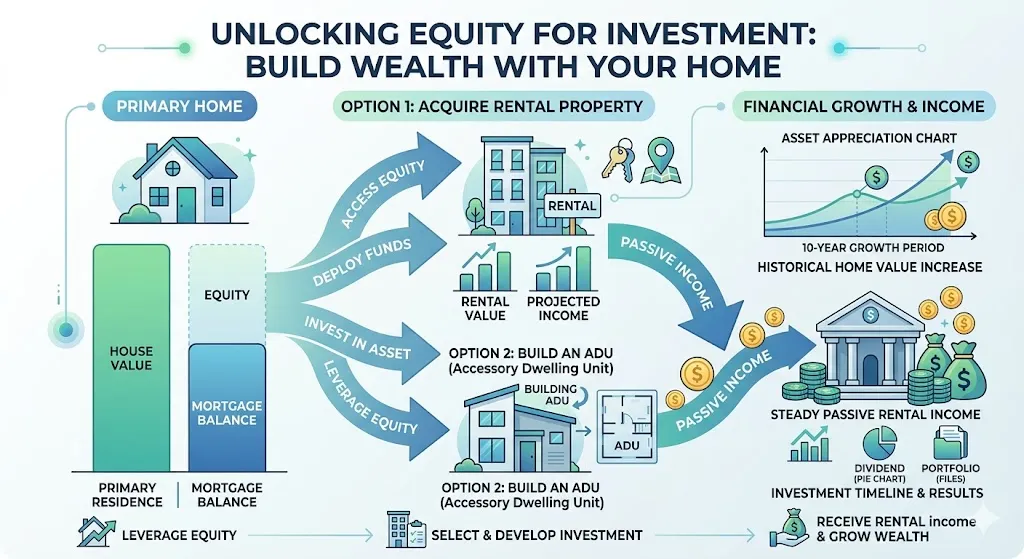
Turn your home equity into income-producing assets and long-term wealth
All right, so that's that. Reason number three, home improvements that actually pay you back. This is so common in California. Besides what people would call good upgrades like kitchens, bathrooms, more square footage, energy efficiency, that's actually adding a lot of value to your home. What I want to talk about is ADU specifically because I'm having people run the numbers where they're pulling out $200,000, building a nice ADU. This ADU is renting for $2,200, $2,400. And so immediately they're seeing not only the increase in value to their home because the home plus ADU is now worth $300 or $400,000 more if and when they want to sell it, but also a payment of $1,600 or $1,700 being added is netting them $2,200 to $2,400 in California where you're not always able to get a cash on cash return by buying a property.
So, good upgrades: kitchens, bathrooms, square footage, energy efficiency, and save the best for last, ADUs. What you want to avoid are what some people would call bad upgrades. You're over-customizing it. Where it's something you love, but maybe not the buyer 10 or 20 years from now is going to love. Luxury that doesn't fit the neighborhood. You don't want to be the nicest house in the neighborhood. So, if you're over-improving your house, it could be every $100,000 you put in only nets you an extra $25,000 in true value that is going to translate to an increased sales price. In some cases, you might do an improvement that doesn't add any value to a future buyer. So, if the improvement increases value, usability, or rent in the case of ADU, it's an investment, not just a remodel. Borrowing against your home to improve the home is one of the cleanest uses of equity. A lot cleaner than blowing it in Vegas.
Reason number four, and I'm seeing this one as well quite a bit in 2026, and I want more people to be careful in advance. Entrepreneurs love doing cash out refinance for business growth. Banks don't advertise this and you don't see it talked about a lot, but I certainly get it where I've got somebody who's got real estate and if they can pull money out and pay 6% interest on the $100,000 or $150,000 they take out of home equity and use that for hiring or marketing or equipment or buying a partner or expanding a proven business where every dollar in gets a 30–40% return, you're going to win. You're using long-term low-cost money, 6%, 6 and a half%, to fund something designed to produce returns. And what I would say would be the best case scenario is you use all this business growth and this added income to plow it back into the mortgage where sure you added whatever you added, $700, $800, $1,000 a month to the mortgage payment, but now you've got an extra $5,000 a month of cash flow from a business. Throw that back at the mortgage and get this mortgage paid off in five years.
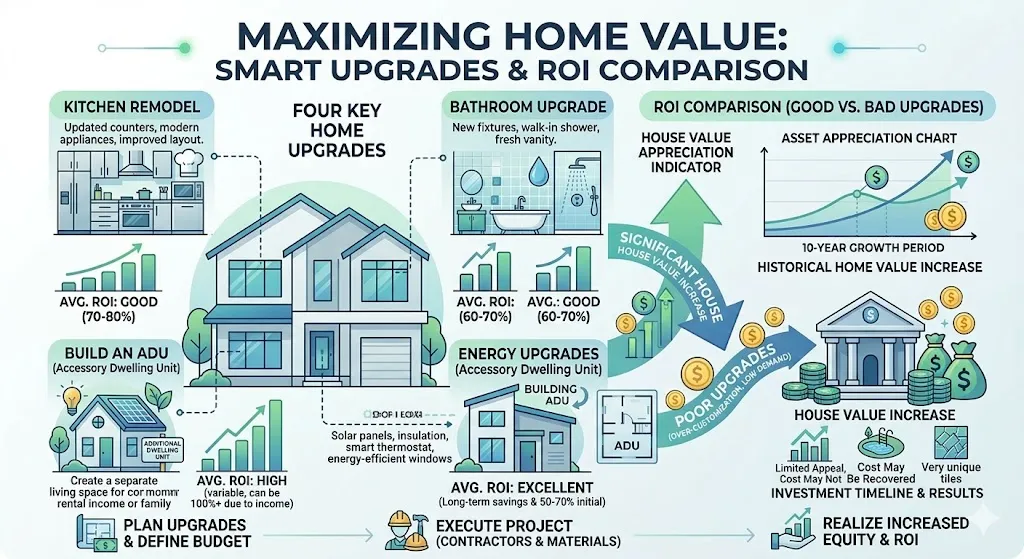
Not all upgrades are equal—focus on improvements that increase value and income
And again, warning, because it's not all sunshine and rainbows. There's positives and negatives to all this stuff. It only makes sense for businesses with track records. I wouldn't recommend that somebody pulls out $100,000 on a flyer, on a dream, on something where they're going to pull this money out and go try something brand new. Take a shot. Do not recommend that. If the business cash flow can't support the risk, don't touch the house. That's what I'm going to say on that.
All right, reason number five. There might be a life event or some sort of strategic reset. I'll explain that one in more detail, but it's not all about optimizing returns and taking money here and reinvesting capital elsewhere. Sometimes it's a divorce buyout. It's a big medical expense that needs to be paid. It's a cash out refinance to split an inheritance, some sort of emergency, or some sort of major transition period. I think about some of the people I'm talking to that are going through either needing money to care for an aging parent, to use that money for their own medical expenses, to put kids through college. There's a bunch of different stuff. Life events. It all fits into that bucket.
And I've had a lot of conversations around refinance where it's not just math, it's stress management. That works well with this reason number five, but also works really well with that debt consolidation piece. Somebody might tell me, man, I'm not going to refinance out of a 3% mortgage because I should never do that. It's a great 3% mortgage. Well, your monthly payments with all your debt equal $8,000. You're going to refinance and go to a 6%. You're going to double your interest rate, but now your total payment is $4,500. You've freed up $3,500 in monthly cash flow. You can sleep at night. I talk to people about stress around money and it is emotional. It gets me in a place where I feel a lot of empathy because I can feel the weight in the conversation. So, a smart cash out refinance can buy time, clarity, and breathing room. Either in this case where it's a life event or in number one where it's debt consolidation.
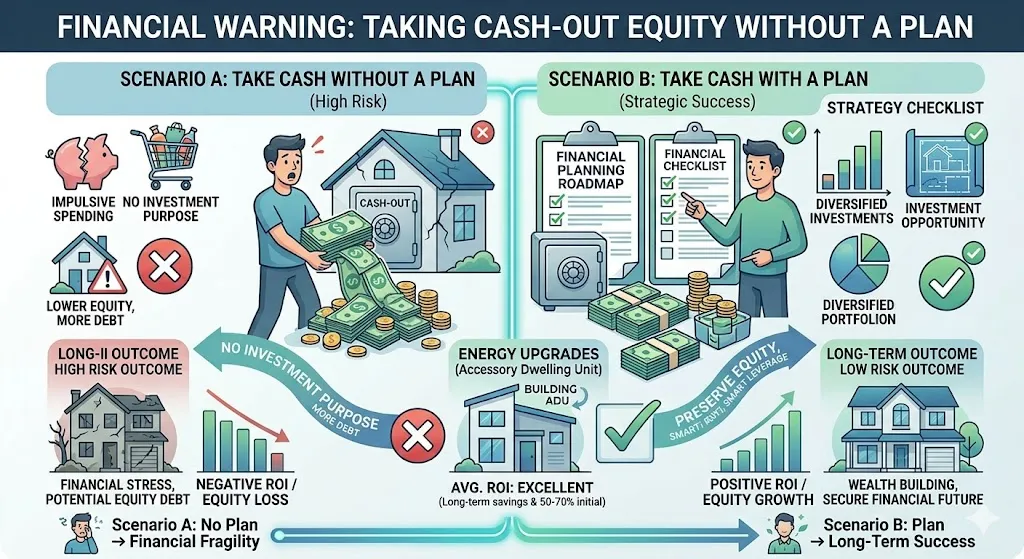
A cash-out refinance without a plan can lead to long-term financial problems
Okay, so I promised I would cover the biggest mistake people make and here's where people screw it up. They focus on rate, payment, and how much cash am I getting, which are important things to think about. But before you obsess on that stuff, think about the long-term plan. Think about opportunity costs. Think about an exit strategy. Because whether it's a refinance and a cash out refinance or it's adding a home equity line of credit as a second, I want people to think about the plan, the strategy behind it. How long am I going to need this money? What am I going to do with this money? How am I going to steward it in a fashion where it's not going to make me worse off in 5 years than I am today? A lot of people call mortgage brokers debt advisors. Just like financial advisers help you with your money that you're investing for the future, we're helping advise you on the debt side of things. So, a cash out without a plan is just debt with better PR.
So, last but not least, a cash out refinance is a tool. Tools can build wealth or they can cause damage. If you're sitting on equity and wondering whether a cash out makes sense for your situation, that's literally what my team and I do every day. I love running refinance scenarios. We're happy to run the numbers for you and give you honest advice whether it makes sense or not. Equity doesn't make you wealthy. How you use it does.