How Much Are Mortgage Closing Costs The Complete Guide
How much are closing costs? And more importantly, are they negotiable? In this article, I'm going to be going over how much closing costs are, what they are, and what you can do about them.
Closing costs. What are they? Closing costs are the costs associated with getting a mortgage. When you go and get a mortgage, there are a lot of moving parts and a lot of people involved. There are appraisers, title companies, attorneys depending on the state, your lender, the government, and many others that are all involved in the transaction and they need to get paid. That's what closing costs are. They are the charges associated with getting a new mortgage or refinancing one.
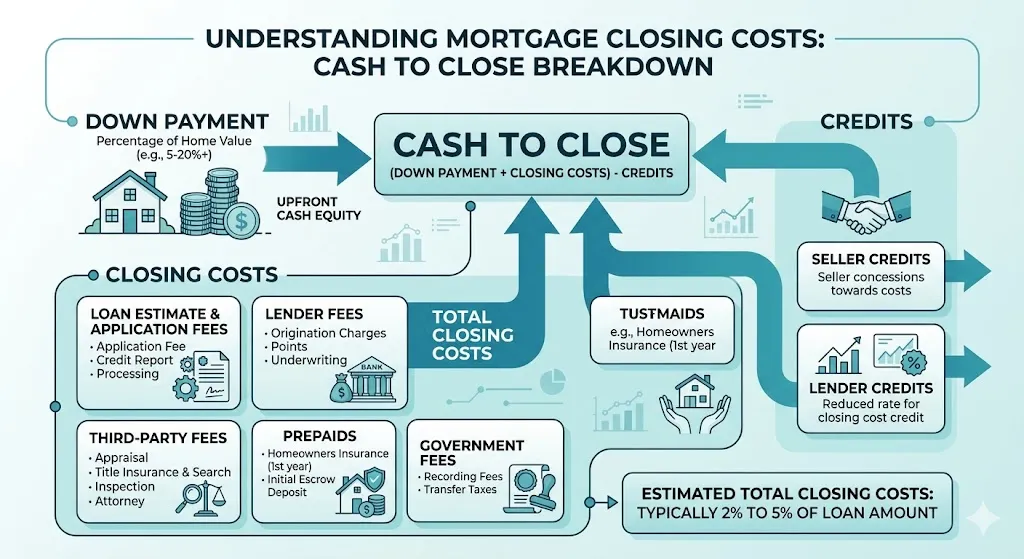
A clear breakdown of how closing costs and down payment combine into your final cash to close
Closing costs, in my experience, generally run anywhere from about two to six percent of the loan amount. The loan amount is the amount that you're borrowing, not the purchase price. So if you have a $400,000 purchase price and you're putting 10% down, your loan amount is $360,000. So you'd be looking at anywhere from roughly $7,200 to about $21,600 in closing costs on that loan. That's a pretty wide range. So let me break down what's actually in there.
Closing costs can be broken down into two categories. The first are lender fees and the second are third party fees. Lender fees are the fees that your lender charges for doing the loan. These can go by a lot of different names — origination fees, processing fees, underwriting fees, application fees, and I've seen many others. These lender fees are paid to your lender and this is essentially their compensation for doing the loan. The amount of lender fees that you are charged will vary widely from lender to lender. Some lenders charge a lot, some charge a little, and some don't charge any at all. It just depends on the lender and also on the loan.
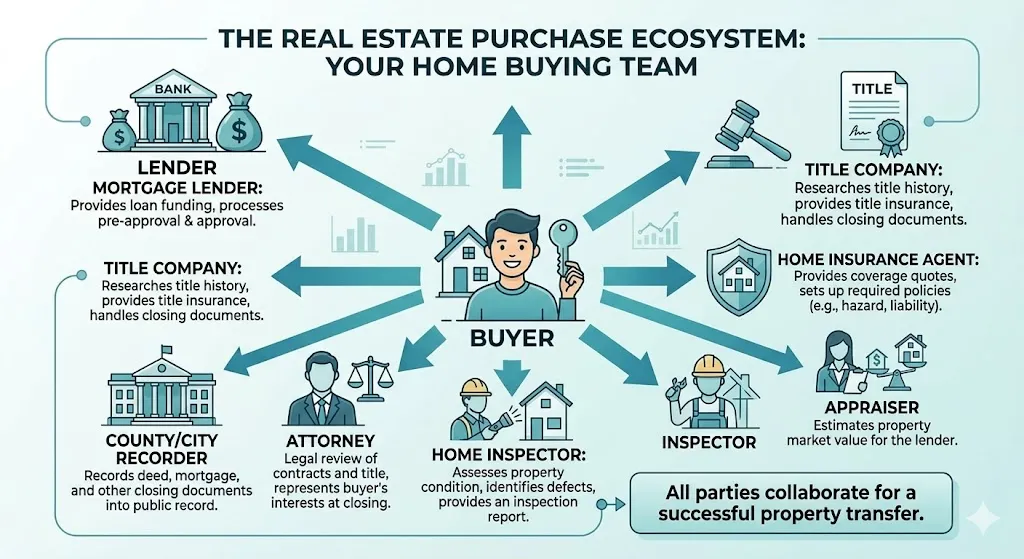
Closing costs pay multiple professionals involved in completing your home purchase
The second category is third party fees. These are fees for services that are provided by third parties, meaning people outside of your lender. Things like appraisal fees, title insurance, settlement fees, attorney fees, recording fees, and many others. The amount of these fees will vary depending on the size and location of the home as well as the county and state that it's in. And unlike lender fees, these are pretty similar from lender to lender because the services are being provided by third parties and not by your lender.
There's actually a third type of closing cost, and these are called prepaids or prepaid items. These aren't technically closing costs but they are often included as part of your total cash to close. These are things like prepaid interest, homeowner's insurance, and the establishment of your escrow account. The amount of prepaids will vary depending on the size of the loan, the interest rate, the time of month that you close, whether or not you're required to have an escrow account, and a number of other factors. So when you're comparing loan estimates from different lenders, you want to make sure that you're comparing apples to apples on the prepaids because sometimes they can make one lender look more or less expensive than another.
So now that we know what closing costs are, how do you minimize them? Well, there are a few ways. The first is to negotiate with your lender. Lender fees vary widely from lender to lender. So one of the best things that you can do is to shop around and get quotes from multiple lenders. And when you're comparing those quotes, pay attention to the lender fees. Are they charging you an origination fee? How much is it? What other lender fees are they charging? And then use that information to negotiate. If lender A is charging you $2,000 in lender fees and lender B is only charging you $500, you can use that as leverage to try to get lender A to lower their fees or you just go with lender B.
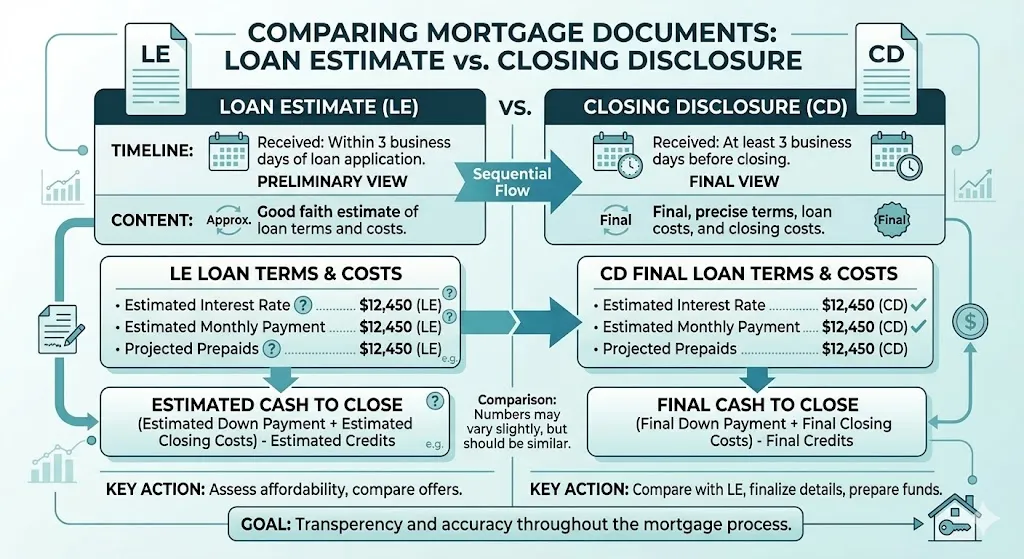
See how your estimated costs turn into finalized numbers before closing
The second way to minimize closing costs is to ask for a lender credit. A lender credit is when the lender gives you money to help cover your closing costs in exchange for a slightly higher interest rate. So let's say your closing costs are $8,000 and you don't have the cash to cover them. You could ask your lender for a lender credit. Your lender might say okay, if you take a rate that's an eighth of a percent higher, we'll give you a $3,000 credit towards your closing costs. This does cost you more over the long run because you're paying a higher rate, but it can help if you're short on cash at closing.
The third way is to negotiate with the seller to pay some of your closing costs. This is called a seller concession or a seller credit. In a buyer's market, sellers are often willing to do this to help get the deal done. In a seller's market, this is much more difficult to negotiate because sellers have a lot of leverage and they're not as motivated to give concessions. But it's always worth asking. There are limits to how much of a seller concession you can receive and it varies by loan type. For example, on a conventional loan with less than 10% down, you can receive up to 3% of the purchase price in seller concessions. Between 10 and 25% down, you can receive up to 6%. And with 25% down or more, you can receive up to 9%. FHA loans allow up to 6% and VA loans allow up to 4%.
The fourth way to minimize closing costs is something called rolling them into the loan. This is only possible on a refinance, not a purchase. On a refinance, if you have enough equity in your home, you can sometimes roll your closing costs into the new loan amount. So instead of paying $8,000 at closing, that $8,000 gets added to your loan balance. This does mean you're paying interest on that $8,000 for the life of the loan, so it does cost more in the long run, but it can help if you don't want to pay out of pocket.
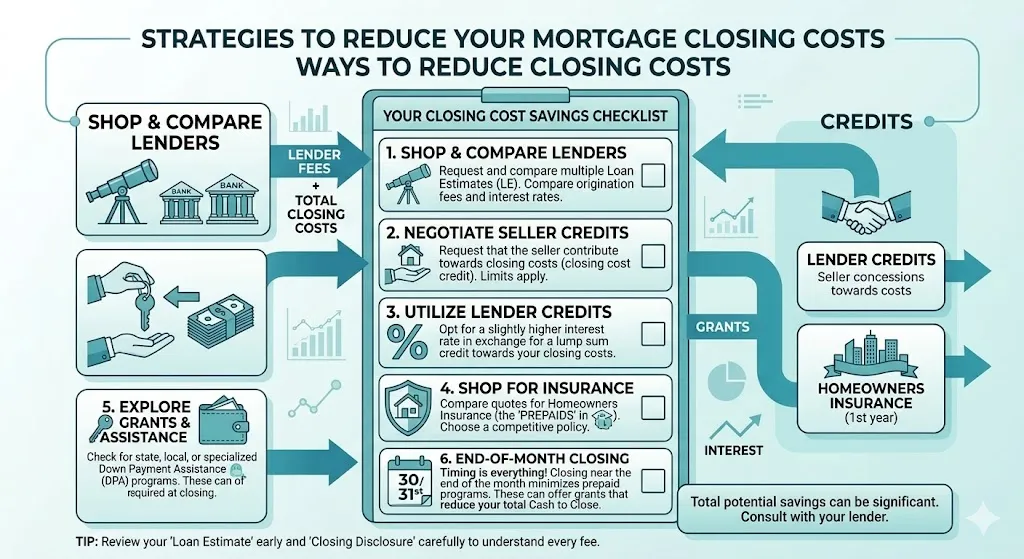
Practical strategies buyers can use to reduce out-of-pocket closing costs
There's one more thing I want to mention about closing costs and that is the loan estimate. When you apply for a mortgage, your lender is required by law to give you a loan estimate within three business days. This is a standardized form that breaks down all of your estimated closing costs. And I want to encourage you to read this document carefully. Go through every single line item and make sure you understand what it is and why you're being charged for it. And if there's something you don't understand, ask your lender to explain it. Don't just sign off on something you don't understand.
Also, when you get closer to closing, you'll receive something called a closing disclosure. This is similar to the loan estimate but it reflects the actual final numbers. You should receive this at least three business days before closing. And again, I want to encourage you to compare it to your loan estimate. If there are any significant changes, ask your lender to explain them. There are rules about what can and can't change between the loan estimate and the closing disclosure, so if something seems off, speak up.
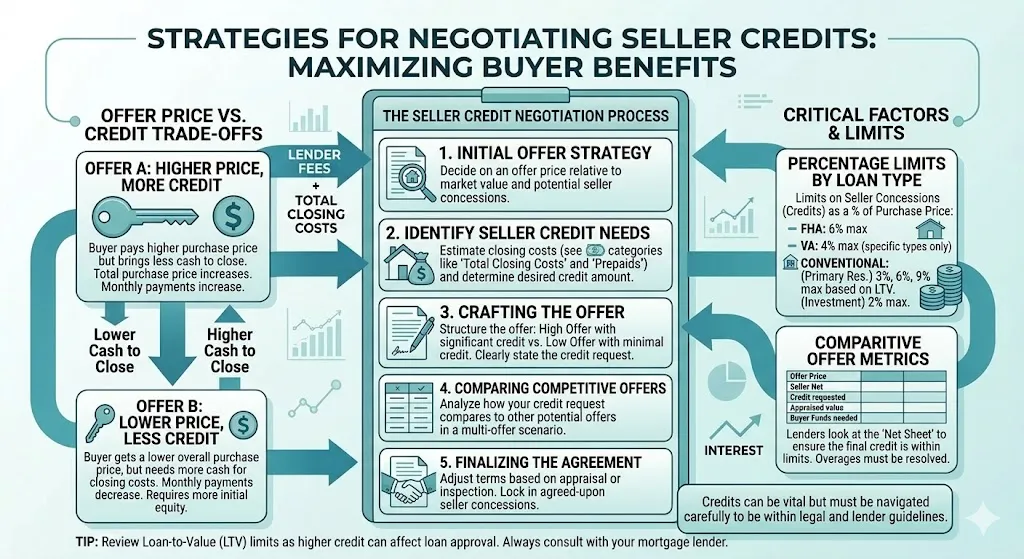
Seller credits can significantly reduce your upfront cash requirements when buying a home
Closing costs generally run about two to six percent of the loan amount. They can be broken down into lender fees, third party fees, and prepaids. And there are several ways to minimize them including shopping around, asking for a lender credit, negotiating a seller concession, and on a refinance, rolling them into the loan.