How Much Housing Can You ACTUALLY Afford By Salary
How much house can you actually afford? Because the number that the bank approves you for and the number you can afford are very different things. So in this article, I'm going to break it down by salary so you know exactly where you stand before you start house hunting.
How Much Rent You Can Afford Based on Salary (30% Rule)
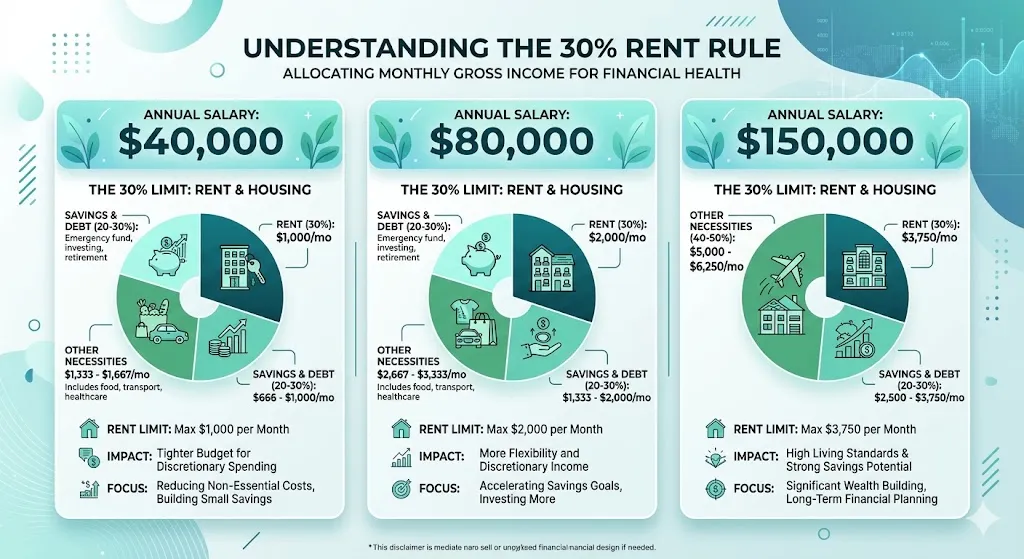
A simple breakdown of how much rent you can afford using the 30% income rule across different salary levels.
So let's talk about affordability. And I want to start by saying that affordability is not just about what the bank will lend you. Banks will often approve you for way more than you should spend. They're looking at your debt to income ratio and making sure you can technically make the payment. They're not looking at your lifestyle, your savings goals, your retirement contributions, or whether you'll be happy making that payment every month for the next 30 years.
So the first thing I want to talk about is the 28/36 rule. This is a general guideline that's been around forever in personal finance. The 28 means that your housing costs, so your mortgage payment including principal, interest, taxes, and insurance, should not exceed 28% of your gross monthly income. The 36 means that your total debt payments, so housing plus car payments, student loans, credit cards, everything, should not exceed 36% of your gross monthly income. Banks will often approve you up to 43, 45, even 50% debt to income ratio. But just because they'll approve you doesn't mean you should do it.
So let's run through some numbers by salary. And I'm going to be using some assumptions here. I'm going to assume a 7% interest rate, a 30-year fixed mortgage, about 1.2% for property taxes annually, and about 0.5% for homeowner's insurance annually. And I'm going to assume you're putting 10% down. Your actual numbers will vary depending on where you live, your credit score, the specific loan you get, and a bunch of other factors. But this will give you a good ballpark.
How Rising Mortgage Rates Impact Monthly Housing Costs
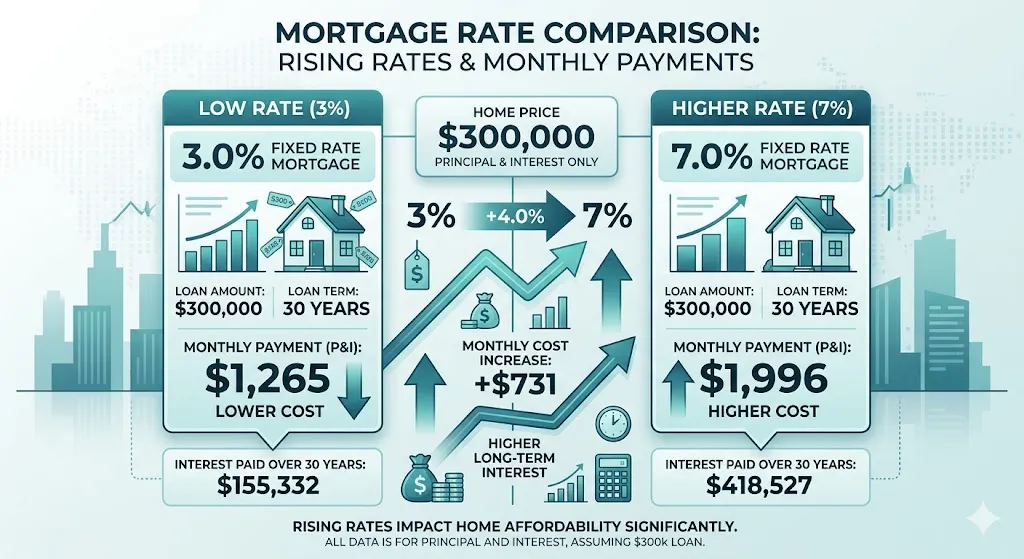
Higher mortgage rates dramatically increase your monthly payment—even for the same home price.
So let's start with a $50,000 salary. At $50,000 a year, your gross monthly income is about $4,167. Using the 28% rule, your maximum housing payment should be around $1,167 per month. With a 7% interest rate and 10% down, that $1,167 payment corresponds to a home price of roughly $160,000 to $170,000. That doesn't buy you much in a lot of markets right now. Affordability is challenging right now, especially for first time buyers at lower income levels. But that's the honest answer at a $50,000 salary using conservative guidelines.
Let's look at $75,000 a year. At $75,000, your gross monthly income is $6,250. 28% of that is $1,750 per month for housing. At 7% with 10% down, that $1,750 monthly payment gets you into a home in roughly the $240,000 to $260,000 range. Again, depending on your taxes and insurance costs which vary by location, that number could shift. But that's the general range.
At $100,000 a year, your gross monthly income is $8,333. 28% of that is about $2,333 per month. At 7% with 10% down, that gets you into a home in roughly the $320,000 to $340,000 range. $100,000 sounds like a lot but when you see that it gets you a $330,000 home at today's rates, you start to understand why so many people feel stretched right now. Because $330,000 doesn't buy you a ton in most major metros.
Understanding the 28/36 Rule for Mortgage Approval
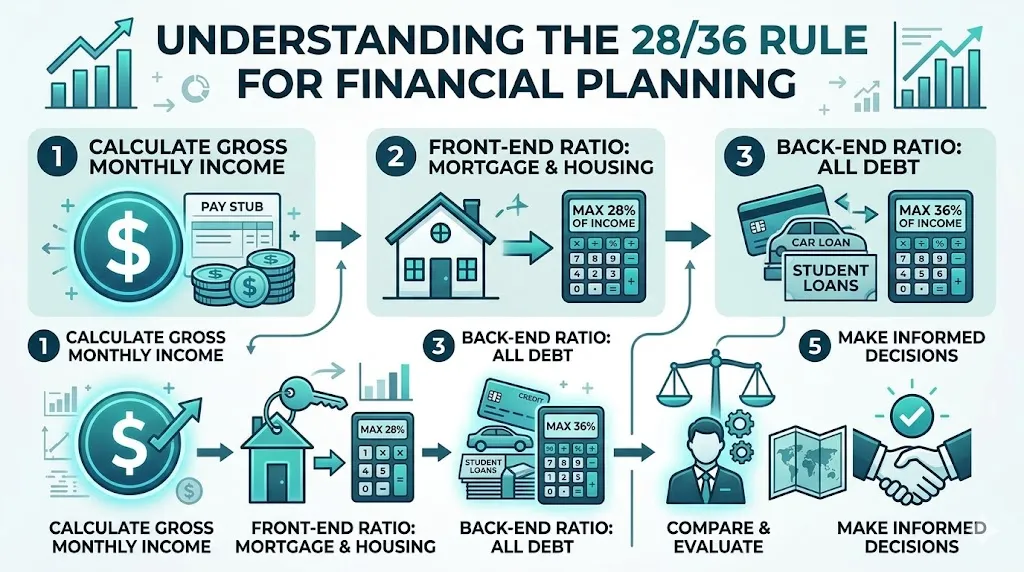
Lenders use the 28/36 rule to determine how much mortgage you qualify for—but it’s not always what you can afford.
At $125,000 a year, your gross monthly income is about $10,417. 28% of that is about $2,917 a month. At 7% with 10% down, that corresponds to a home price in the $400,000 to $420,000 range.
At $150,000 a year, gross monthly income is $12,500. 28% is $3,500 per month. That gets you into roughly a $480,000 to $500,000 home at current rates.
At $200,000 a year, gross monthly income is about $16,667. 28% is $4,667 per month. That gets you into roughly a $640,000 to $660,000 home.
And at $250,000 a year, gross monthly income is about $20,833. 28% is $5,833 per month. That gets you into roughly a $800,000 to $820,000 home at current rates with 10% down.
I want to make a few important points about these numbers. First, these are maximums, not targets. Just because you can afford up to a certain number doesn't mean you should spend that much. In fact, I'd encourage you to aim for something more like 20 to 25% of your gross income for housing, not 28%. That gives you more breathing room for savings, retirement, emergencies, and just enjoying your life.
Second, these numbers assume 10% down. If you put more down, you can afford a more expensive home at the same monthly payment. If you put less down, you'll have a lower purchase price or a higher payment. And if you put less than 20% down, remember you're going to have PMI which adds to your monthly cost.
Third, your debt matters a lot. If you have a $600 car payment, $400 in student loans, and $200 in minimum credit card payments, that's $1,200 a month in debt before you even factor in housing. And that significantly reduces how much house you can afford. Because remember the 36% rule. If your gross monthly income is $6,250 and your total debt cap is 36%, that's $2,250 total. Minus $1,200 in existing debt and you're only left with $1,050 for housing. So instead of the $1,750 I mentioned earlier at that income level, you're looking at $1,050. And that dramatically changes the home price you can afford.
The 30/30/3 Rule: Smart Home Buying Strategy Explained
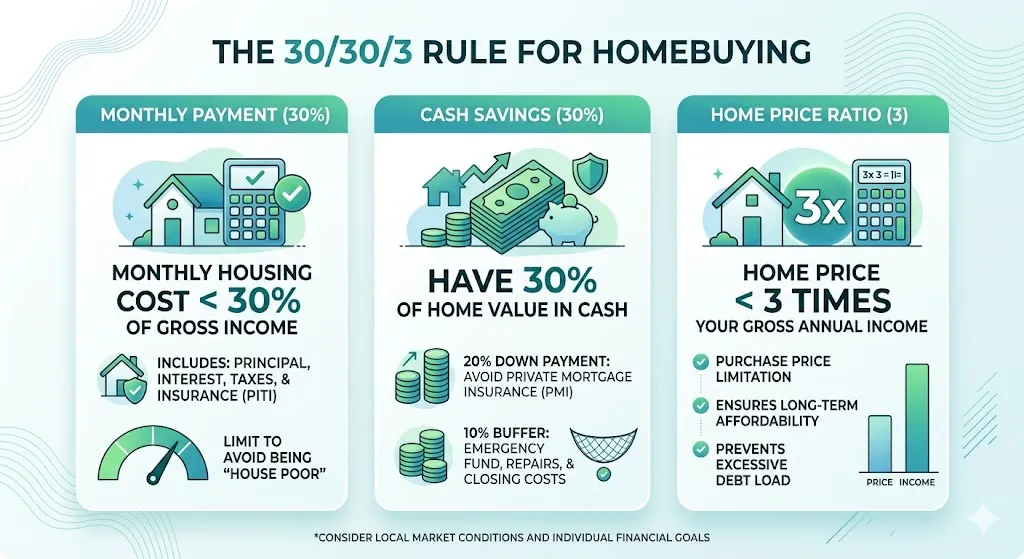
A powerful framework to determine how much house you can truly afford without financial stress.
Fourth, rates matter enormously. I'm using 7% in these examples. If rates were at 3% like they were a few years ago, the same monthly payment buys you a much more expensive home. And if rates go up to 8 or 9%, the same payment buys you less. So these numbers are specific to the current rate environment and they will change as rates change.
Fifth, and this is important, don't forget about the other costs of homeownership. Your mortgage payment is not your only cost. You've got property taxes, homeowner's insurance, HOA fees if applicable, maintenance and repairs, utilities, and potentially PMI. First time buyers focus only on the mortgage payment and then get surprised by all the other costs. A good rule of thumb is to budget about 1% of the home's value per year for maintenance and repairs. So on a $300,000 home, that's $3,000 a year or $250 a month just for maintenance. That's real money and it needs to be factored in.
Affordability right now is genuinely challenging for many people. High home prices combined with 7% rates have pushed monthly payments to levels that require a pretty significant income to manage comfortably. If you're feeling like you can't afford what you want in your market, you're not alone and you're probably being smart by not stretching too far.
Top Home Affordability Mistakes to Avoid in 2026
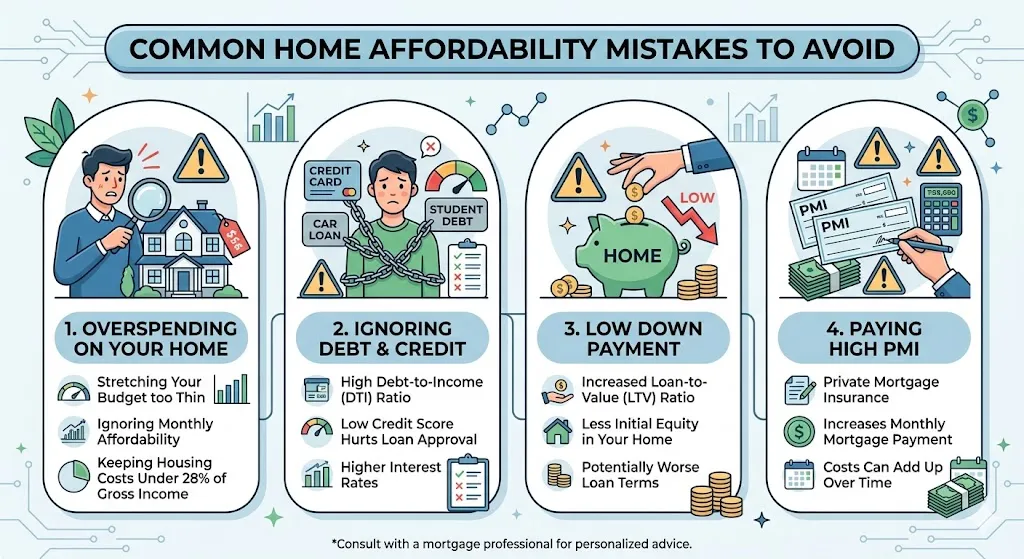
Avoid these common pitfalls to stay financially secure when renting or buying a home.
The options are to increase your income, reduce your debt, save a larger down payment, buy in a more affordable market, or wait and hope that rates come down or prices correct. None of those are easy answers but they're the real ones.