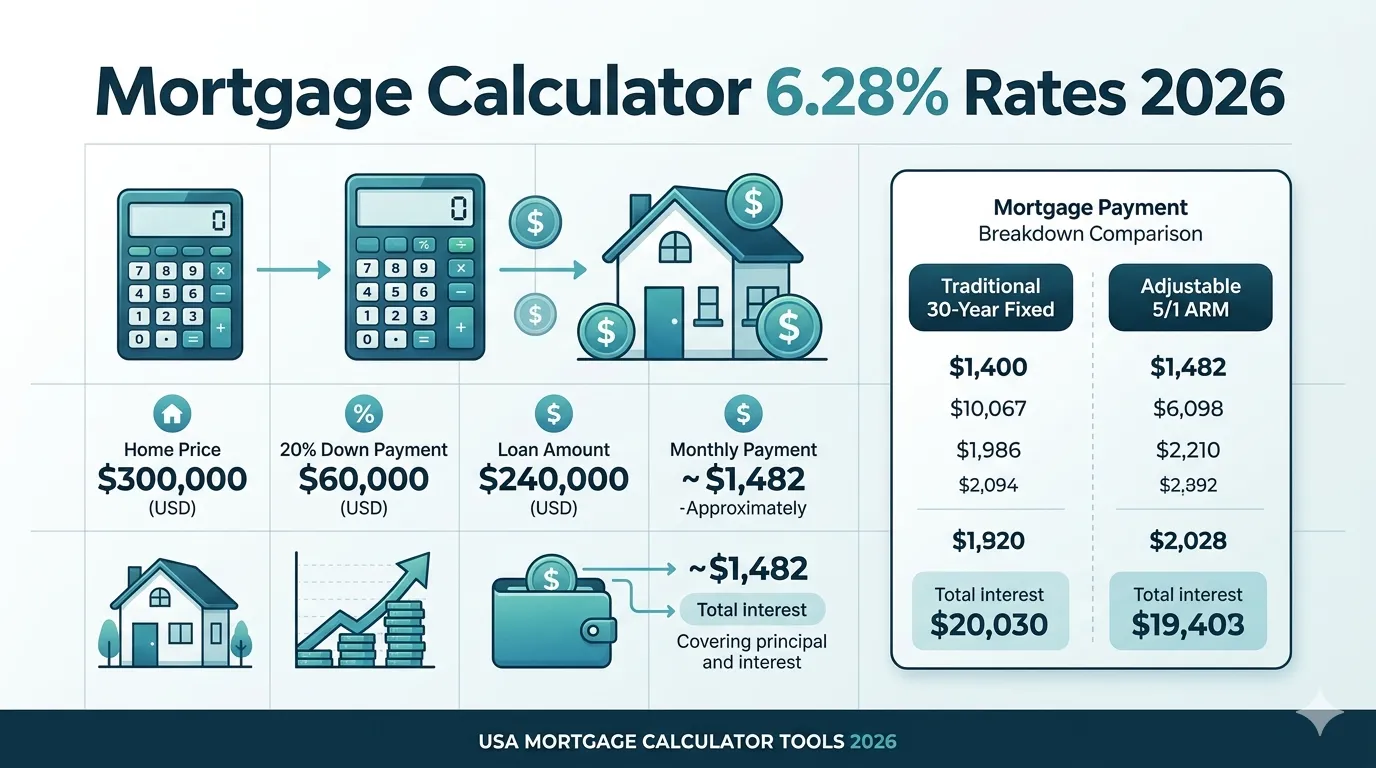
Mortgage Calculator 6.28% Rates 2026
The Real Problem With Mortgage Rates Right Now
You want to buy a home, but every time you check rates, you feel lost in numbers. At 6.28% in 2026, even a small mistake in planning can cost you tens of thousands of dollars over 30 years.
Most people guess at their monthly payment. They find out the real number after they've already fallen in love with a house — and that's a painful spot to be in.
This guide walks you through exactly how a mortgage calculator works at today's 6.28% rate, what your real payment looks like, and how to use those numbers to make a smarter decision.
Quick Answer: What You Need to Know
At the current 6.28% fixed rate (April 2026), here is what your monthly principal + interest payment looks like across common loan amounts — before taxes and insurance:
| Home Price | Down Payment (20%) | Loan Amount | Monthly Payment (30yr @ 6.28%) | Total Interest Paid |
|---|---|---|---|---|
| $200,000 | $40,000 | $160,000 | $988 | $195,628 |
| $300,000 | $60,000 | $240,000 | $1,482 | $293,441 |
| $400,000 | $80,000 | $320,000 | $1,975 | $391,255 |
| $500,000 | $100,000 | $400,000 | $2,469 | $489,069 |
These numbers are principal and interest only. Always add property taxes, homeowner's insurance, and PMI (if your down payment is under 20%) to get your full monthly cost.
Real Example: How Marcus Used a Mortgage Calculator at 6.28% to Buy Smart
Marcus is 34, earns $75,000 a year ($6,250/month), and wants to buy a $320,000 home in Ohio. He has $64,000 saved for a 20% down payment. His loan amount is $256,000.
Before talking to any lender, Marcus plugged his numbers into a mortgage calculator 6.28% rates 2026 tool. His monthly principal + interest came out to $1,580. After adding estimated taxes ($350/month) and insurance ($120/month), his total housing cost is about $2,050/month.
That's 32.8% of his gross income — just inside the safe zone lenders look for (under 36%). Marcus knew where he stood before the bank even pulled his credit. That is the power of using a calculator first.
How a Mortgage Calculator Actually Works
A mortgage calculator uses three inputs: your loan amount, your interest rate, and your loan term (usually 15 or 30 years). From those three numbers, it figures out your monthly payment using a formula called amortization.
Amortization just means your payment stays the same every month, but how much goes to interest vs. principal shifts over time. In the early years, most of your payment goes to interest. By year 25, most goes to paying off the actual balance.
Here is what that looks like on a $300,000 loan at 6.28% over 30 years:
| Year | Principal Paid (that year) | Interest Paid (that year) | Remaining Balance |
|---|---|---|---|
| Year 1 | $3,520 | $14,264 | $236,480 |
| Year 5 | $4,790 | $12,994 | $219,090 |
| Year 15 | $9,100 | $8,684 | $158,400 |
| Year 25 | $17,290 | $490 | $43,200 |
This is why refinancing early matters so much — you save the most interest in the first 10 years of the loan.
15-Year vs. 30-Year Mortgage at 6.28% — Which Saves More?
The most common question when using a mortgage calculator at 6.28% rates 2026 is: should I do 15 years or 30 years? The answer depends on your monthly budget vs. your long-term savings goal.
A 15-year loan has a higher monthly payment, but you pay far less total interest. A 30-year loan is more affordable each month, but you pay nearly double in interest over the life of the loan.
| Loan: $280,000 | 30-Year @ 6.28% | 15-Year @ 5.75%* |
|---|---|---|
| Monthly Payment | $1,729 | $2,330 |
| Total Paid Over Life | $622,440 | $419,400 |
| Total Interest | $342,440 | $139,400 |
| Interest Saved | — | $203,040 saved |
*15-year rates are typically 0.50–0.75% lower than 30-year rates. If you can handle the higher monthly payment, the 15-year is an enormous long-term win.
What Does "Affordable" Actually Mean at 6.28%?
Lenders use two key ratios to decide if you can afford a loan. The first is the front-end ratio — your total housing payment should stay under 28% of your gross monthly income. The second is the back-end ratio — all your debts combined (mortgage + car + student loans) should be under 43%.
Here is a simple income-to-loan guide at current 6.28% rates:
| Annual Salary | Max Monthly Housing Budget (28%) | Approx. Max Loan Amount | Estimated Home Price (20% down) |
|---|---|---|---|
| $50,000 | $1,167 | $188,000 | $235,000 |
| $75,000 | $1,750 | $283,000 | $354,000 |
| $100,000 | $2,333 | $378,000 | $472,000 |
| $130,000 | $3,033 | $491,000 | $614,000 |
These are estimates based on principal + interest only. Your real maximum will depend on your credit score, existing debts, and the lender's specific requirements.
Step-by-Step: How to Use a Mortgage Calculator Right
Most people only enter loan amount and rate — and miss half the picture. Here is the full process to get an accurate number:
- Step 1 — Enter home price: Use your target purchase price, not a rough guess. If you are not sure, pick the median for your area.
- Step 2 — Enter your down payment: If you have 20%, enter 20%. Under 20% means you'll pay PMI (typically $50–$200/month extra).
- Step 3 — Set rate to 6.28%: This is the average 30-year fixed rate as of April 2026. Your actual rate may vary by 0.25–0.75% based on your credit score.
- Step 4 — Choose 30 or 15 years: Run both — see the monthly difference and the total interest gap.
- Step 5 — Add taxes + insurance: Use your county's property tax rate and get an insurance quote. Most calculators have fields for this.
- Step 6 — Compare to your income: Divide the total monthly payment by your gross monthly income. If it's over 28%, you need a smaller loan or a bigger down payment.
Common Mistakes People Make With Mortgage Calculators
A calculator gives you accurate math — but only if you put in accurate numbers. These are the mistakes that lead people to underestimate what they'll actually owe:
- Forgetting PMI: If your down payment is under 20%, add $100–$200/month for private mortgage insurance.
- Skipping property taxes: In high-tax states like New Jersey or Illinois, property taxes alone can add $500–$800/month to your payment.
- Using the lowest possible rate: Unless you have a 760+ credit score, expect a rate 0.25–0.50% higher than the headline rate you see advertised.
- Ignoring HOA fees: In condo communities or HOA neighborhoods, monthly fees of $200–$600 are normal. They are not in most basic calculators.
- Not running a 15-year comparison: Borrowers who skip the 15-year option often don't realize how much they are leaving on the table in interest savings.
How Your Credit Score Changes Your 2026 Mortgage Rate
The 6.28% average rate in April 2026 is for borrowers with strong credit. Your actual rate depends heavily on your credit score. A difference of 100 points on your score can mean hundreds of dollars more per month.
| Credit Score Range | Estimated Rate (30-yr Fixed) | Monthly Payment ($300K loan) | Extra Cost vs. Best Rate |
|---|---|---|---|
| 760–850 (Excellent) | 6.10% | $1,820 | — |
| 700–759 (Good) | 6.28% | $1,851 | +$31/mo |
| 660–699 (Fair) | 6.65% | $1,921 | +$101/mo |
| 620–659 (Low) | 7.10% | $2,005 | +$185/mo |
Even a $31/month difference adds up to $11,160 over 30 years. If your score is below 700, spending 6 months improving it before applying is almost always worth the wait.
6 Tips to Save Money on Your Mortgage at 6.28%
- Raise your credit score before applying: Even a 30-point improvement can drop your rate by 0.25%, saving thousands over the loan's life.
- Make one extra payment per year: On a $300K loan at 6.28%, one extra payment annually cuts your loan term by nearly 5 years and saves around $58,000 in interest.
- Shop at least 3 lenders: Mortgage rates are not fixed — different lenders quote different rates for the same borrower, and comparison shopping saves an average of $1,500 over the life of the loan.
- Put 20% down if you can: Eliminating PMI saves $100–$200/month immediately, and you start with real equity in your home.
- Choose a 15-year term if your budget allows: The monthly payment is higher, but you will pay roughly $200,000 less in interest on a $300K loan compared to a 30-year term.
- Lock your rate when it's favorable: Rates change daily. Once you are pre-approved and the rate feels right, ask your lender for a 45–60 day rate lock so you are protected from increases during closing.
Frequently Asked Questions
What is the monthly payment on a $250,000 mortgage at 6.28%?
On a 30-year fixed loan of $250,000 at 6.28%, your monthly principal and interest payment is approximately $1,543. Add taxes, insurance, and any HOA fees to get your total monthly housing cost.
Is 6.28% a good mortgage rate in 2026?
Yes, 6.28% is close to the current national average for a 30-year fixed mortgage as of April 2026. Borrowers with excellent credit (760+) may qualify for rates slightly below this, while those with fair credit may see rates above 6.50%.
How much income do I need to afford a $400,000 home in 2026?
With a 20% down payment ($80,000), your loan is $320,000. At 6.28%, that is about $1,975/month in principal and interest. To stay under the 28% front-end ratio, you would need a gross monthly income of roughly $7,054, or about $84,650 per year — before factoring in taxes and insurance.
Can I use a mortgage calculator 6.28% rates 2026 tool for an FHA loan?
Yes, but FHA loans have two extra costs to add: an upfront mortgage insurance premium (1.75% of the loan amount) and an annual MIP (usually 0.55%/year). Use the calculator for the base payment, then manually add those amounts to see your real FHA cost.
Your Next Step
Now that you know how the numbers work, the best move is to get a real quote. Talk to a lender today — even a 10-minute call can tell you exactly what rate you qualify for and how much house fits your budget.
Bring your income, credit score estimate, and the down payment amount you have saved. You don't need to be ready to buy tomorrow — just ready to understand your real options.
Knowledge is your best negotiating tool. Use it.