Mortgage Interest Rates 2026 Forecast
The Real Problem With Mortgage Rates Right Now
You want to buy a home — but every time you feel ready, mortgage interest rates seem to shift again and throw off your whole plan. It feels impossible to know when to lock in, when to wait, or whether rates will ever come back down to a comfortable level.
Quick Answer: What You Need to Know
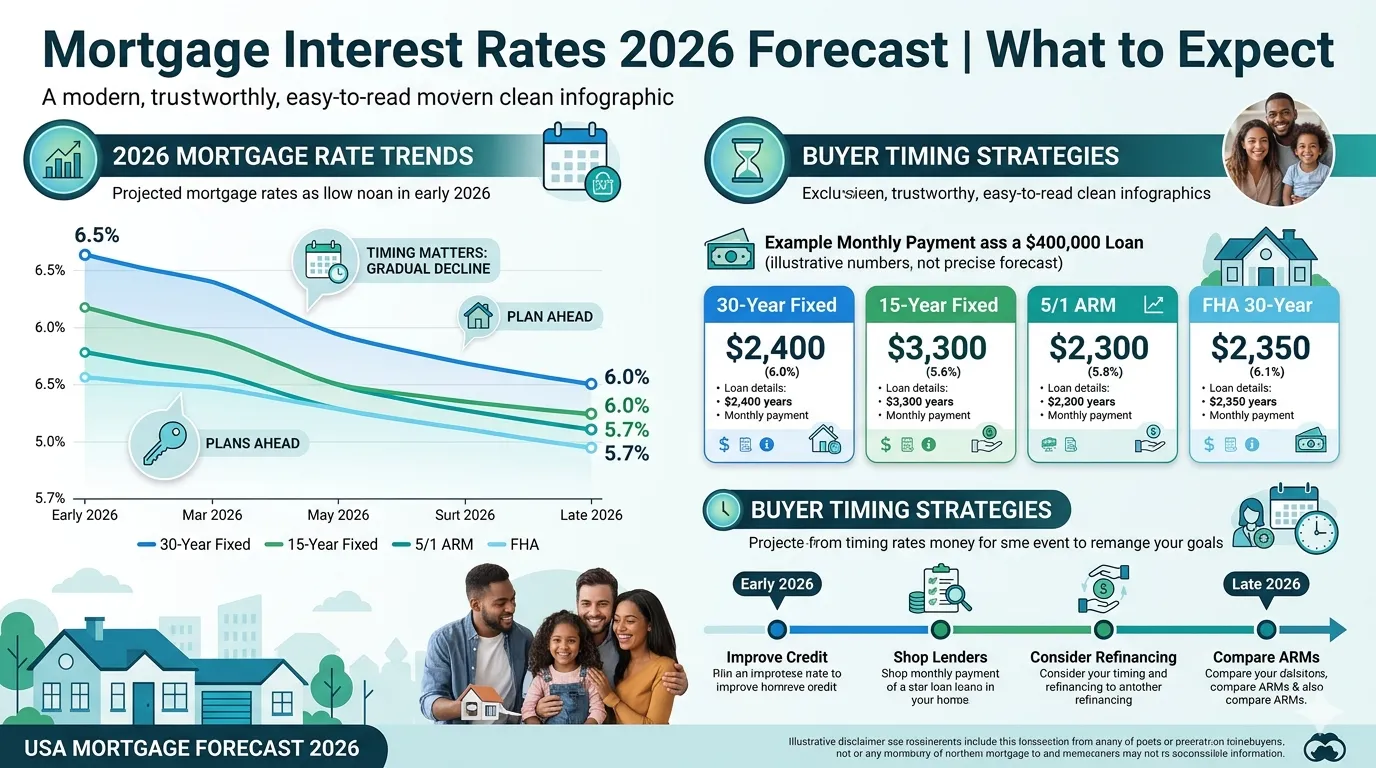
The mortgage interest rates 2026 forecast points to a slow, gradual decline — most experts expect 30-year fixed rates to land somewhere between 6.0% and 6.5% by late 2026, down slightly from the current 6.28% average.
| Loan Type | Rate (April 2026) | Forecast (Late 2026) | Monthly Payment ($400k loan) |
|---|---|---|---|
| 30-Year Fixed | 6.28% | 6.0%–6.3% | ~$2,470 |
| 15-Year Fixed | 5.65% | 5.4%–5.7% | ~$3,310 |
| 5/1 ARM | 6.10% | 5.9%–6.2% | ~$2,430 |
| FHA 30-Year | 6.05% | 5.8%–6.1% | ~$2,415 |
Real Example: Marcus + a $380,000 Home Purchase
Marcus is a 34-year-old teacher in Ohio earning $72,000 a year. He wants to buy a $380,000 home and has saved up a 10% down payment — that's $38,000. He's been watching rates for two years and is wondering if 2026 is finally the right time to buy.
With a $342,000 loan at the current 6.28% rate, Marcus's monthly payment (principal + interest) would be about $2,113. If rates drop to 6.0% by fall 2026, that same loan drops his payment to roughly $2,050 — a saving of $63 per month, or $756 per year.
It sounds small, but over 30 years that difference adds up to over $22,000. Marcus's situation shows why the mortgage interest rates 2026 forecast matters so much — even small rate moves make a real difference over time.
| Scenario | Rate | Monthly Payment | Total Interest (30 yrs) |
|---|---|---|---|
| Buy now (April 2026) | 6.28% | $2,113 | $418,680 |
| Wait for 6.0% | 6.0% | $2,050 | $396,000 |
| Wait for 5.5% | 5.5% | $1,942 | $357,120 |
| Rates rise to 6.75% | 6.75% | $2,220 | $457,200 |
What Actually Drives Mortgage Rates?
Mortgage rates are not set by your bank. They move up and down based on bigger economic forces — mainly the bond market and the Federal Reserve. When investors feel nervous about the economy, they buy bonds, which pushes mortgage rates down.
The Fed sets the federal funds rate, which influences short-term lending costs. Mortgage rates tend to follow the 10-year Treasury yield more closely than the Fed's rate — but both matter. Inflation also plays a huge role: when prices rise fast, rates rise too.
- Inflation: Higher inflation = higher rates to slow spending
- Federal Reserve policy: Fed rate cuts often pull mortgage rates down eventually
- 10-Year Treasury yield: Mortgage rates track this closely — watch it weekly
- Employment data: Strong jobs reports can push rates up by spooking inflation fears
- Housing demand: High demand for mortgages can keep lender rates elevated
What Experts Are Predicting for 2026
Most major housing economists — from Fannie Mae to the Mortgage Bankers Association — agree on one thing: rates in 2026 will be lower than 2023 and 2024 peaks, but they won't return to the 3% era anytime soon. The general consensus is a slow grind downward.
The Federal Reserve has signaled it may cut rates once or twice more in 2026 if inflation stays under control. Each cut doesn't directly slash your mortgage rate — but it builds market confidence, which nudges rates down gradually.
| Source | Q2 2026 Forecast | Q4 2026 Forecast |
|---|---|---|
| Fannie Mae | 6.2% | 6.0% |
| Mortgage Bankers Association | 6.3% | 6.1% |
| National Association of Realtors | 6.1% | 5.9% |
| Wells Fargo Economics | 6.25% | 6.05% |
Should You Wait for Rates to Drop — or Buy Now?
This is the question everyone asks, and the honest answer is: it depends on your situation. Waiting for lower rates makes sense if you have time, your finances are solid, and you don't face a deadline. But waiting also means paying rent while home prices may keep climbing.
Here's the key thing people forget: you can always refinance later. If you buy at 6.28% today and rates fall to 5.5% in 2027, you can refinance your loan and lower your payment. You can't go back and buy a house at last year's price, though — that window is gone.
- Reason to buy now: Home prices may rise while you wait, wiping out any rate savings
- Reason to wait: A 0.5% rate drop on a $400k loan saves you $120+ per month
- Middle path: Buy now, plan to refinance when rates dip — known as "date the rate, marry the house"
Which Loan Type Makes Sense in a High-Rate Environment?
Not all mortgages react the same way to rate changes. A 30-year fixed loan locks in your rate for life — great if you plan to stay put. An adjustable-rate mortgage (ARM) starts lower but can jump after a few years.
In 2026, ARMs are getting more popular again because the initial rate is usually 0.2%–0.5% lower than a 30-year fixed. If you plan to sell or refinance within 5–7 years, an ARM might actually save you money — just go in with eyes open about how it adjusts.
- 30-Year Fixed: Best for stability; locks in your payment forever
- 15-Year Fixed: Lower rate, but higher monthly payment — best if you can afford it
- 5/1 ARM: Fixed for 5 years, then adjusts — good for shorter-term owners
- FHA Loan: Lower credit score needed, smaller down payment — popular with first-time buyers
How Your Credit Score Affects Your Rate in 2026
The mortgage interest rates 2026 forecast gives you a national average — but your personal rate depends a lot on your credit score. Lenders reward borrowers who are low risk with lower rates. A difference of 100 points in your credit score can mean a rate difference of 0.5% to 1.5%.
That might not sound like much. But on a $350,000 loan over 30 years, a 1% rate difference costs you over $70,000 extra in interest. Work on your score before you apply — even a few months of effort can move you into a better rate tier.
| Credit Score | Estimated Rate (2026) | Monthly Payment ($350k) | Extra Cost vs. Best Rate |
|---|---|---|---|
| 760+ | 6.0% | $2,098 | — |
| 720–759 | 6.3% | $2,166 | +$24,480 over 30 yrs |
| 680–719 | 6.7% | $2,257 | +$57,240 over 30 yrs |
| 640–679 | 7.1% | $2,351 | +$91,080 over 30 yrs |
Should You Lock Your Rate or Float It?
When you apply for a mortgage, your lender will ask if you want to "lock" your rate or "float" it. Locking means the rate you get today is guaranteed for a set period — usually 30 to 60 days. Floating means you'll take whatever rate is available when you close.
In a forecasted declining rate environment like 2026, floating sounds tempting — but it's risky. Rates can jump in a week based on one inflation report. For most buyers, locking in a rate you can afford is the smarter, safer move.
- Lock if you close in 30–60 days and the rate works for your budget
- Float only if you have strong market knowledge and close in 14 days or less
- Ask your lender about "float-down" options — some let you lock but drop if rates fall before closing
6 Tips to Save Money on Your Mortgage in 2026
- Boost your credit score before applying: Pay down credit card balances below 30% utilization — this alone can raise your score 20–40 points in 60 days.
- Shop at least 3 lenders: Rates vary by 0.25%–0.75% between lenders for the same borrower — always compare before committing.
- Put 20% down if you can: You'll avoid private mortgage insurance (PMI), which adds $100–$200 per month to your payment.
- Consider buying mortgage points: One point costs 1% of your loan and typically lowers your rate by 0.25% — worth it if you stay in the home 7+ years.
- Choose a shorter loan term if affordable: A 15-year mortgage usually carries a rate 0.5%–0.75% lower than a 30-year — you pay less interest overall.
- Plan to refinance when rates drop: Set a reminder to check rates every 6 months — refinancing at 0.75% lower can save $150+ per month on a $350k loan.
Frequently Asked Questions
Will mortgage rates go below 6% in 2026?
It's possible but not guaranteed. Most forecasts put rates in the 6.0%–6.3% range by end of 2026. A rate below 6% would likely require faster-than-expected Fed rate cuts or a surprise economic slowdown. Don't count on it, but don't rule it out either.
How often do mortgage rates change?
Mortgage rates can change daily — sometimes multiple times in one day during volatile markets. The rate a lender quotes you today may not be available tomorrow. Always get your quote in writing and ask about locking it immediately.
Does the Federal Reserve directly control mortgage rates?
Not directly. The Fed controls the federal funds rate — the rate banks charge each other overnight. Mortgage rates are more closely tied to the 10-year Treasury bond yield. But Fed decisions influence investor confidence, which eventually moves mortgage rates up or down.
Is 2026 a good year to buy a home?
For most buyers, the "right time" is when you're financially ready — not when rates hit a magic number. With rates slowly trending down and refinancing always an option, 2026 is a reasonable time to buy if your income, savings, and credit are in good shape.
Your Next Step
You don't have to figure this out alone. Talk to a mortgage lender today — even a free 10-minute call can tell you exactly what rate you qualify for right now and what small changes could unlock a better deal. The mortgage interest rates 2026 forecast looks encouraging, but the best rate you'll ever get is the one you actually lock in. Get the conversation started.