Mortgage Interest Rates Are About To Get WORSE
If you're currently sitting on the sidelines waiting, hoping, wishing for mortgage rates to drop before buying a home, the next thing you should be paying attention to is not the Federal Reserve, but what's actually happening in the Middle East. Because right now, that conflict involving Iran has the potential to push inflation higher yet again. And if inflation moves higher, mortgage rates are not only likely to go higher, but stay higher for longer with the potential to even move higher from there.
How Global Events and Oil Prices Impact Mortgage Rates
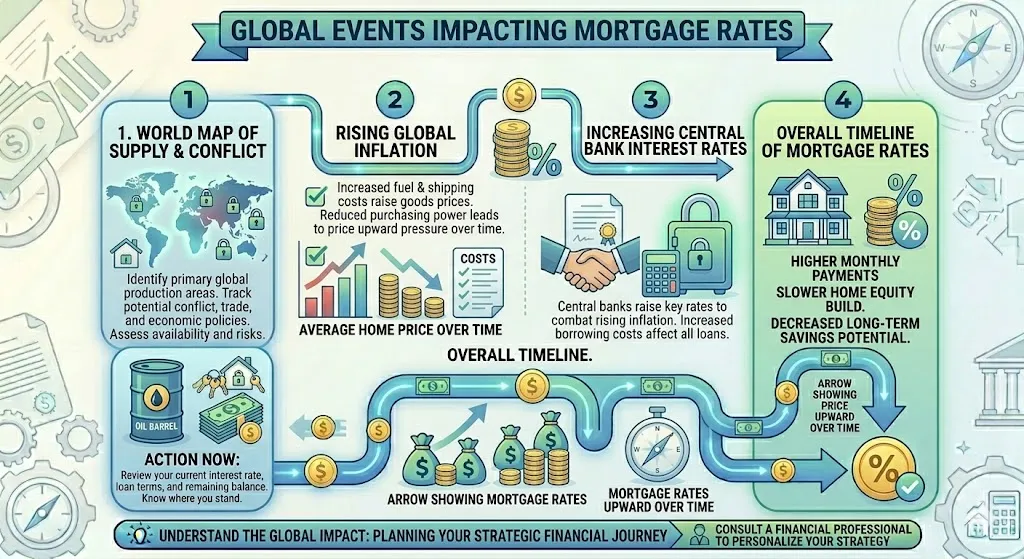
Global conflicts and oil prices can directly influence mortgage rates
Now, the latest economic data we just received would normally suggest the opposite. Over the last couple of years, as soon as inflation comes down and employment starts to weaken is when mortgage rates should start to decline. Inflation came in right at expectations, the job market is starting to soften. And historically, those two things together would push mortgage rates lower. But that's not what's happening. Instead, what we're seeing is volatility in the financial markets and mortgage rates moving in the opposite direction.
So, what I want to do in today's article is break down exactly what's happening. We're going to talk about the latest inflation report, the newest jobs data, and how the war evolving Iran could impact inflation and why mortgage rates are rising when the economic data seems to suggest they should be falling. And if you're someone who's waiting for mortgage rates to drop before buying a home, the big question you should be asking yourself is what if interest rates don't fall as quickly as everyone expects.
So let's start with inflation. The latest CPI, the consumer price index report showed that inflation increased 2.4% year-over-year in February. Core inflation, which excludes food and energy, came in at 2.5%. Both of those numbers were basically right in line with expectations. And under normal circumstances, that type of inflation report would be great news for mortgage rates because it would suggest that inflation is continuing to move in the right direction.
The Federal Reserve has been trying to bring down inflation to its 2% target. The Fed has a dual mandate with one of them being price stability. They want inflation somewhere around 2%. That's their target. And while we've made a lot of progress compared to where inflation was a couple of years ago, there's an important detail that many people are missing.
The inflation data that was just released reflects what the economy looked like before the conflict involving Iran escalated, which means economists are now treating this report more like a baseline. The real question now is what inflation will look like in the coming months. And the biggest variable everyone is watching is oil.
Why Rising Inflation Can Push Mortgage Rates Higher
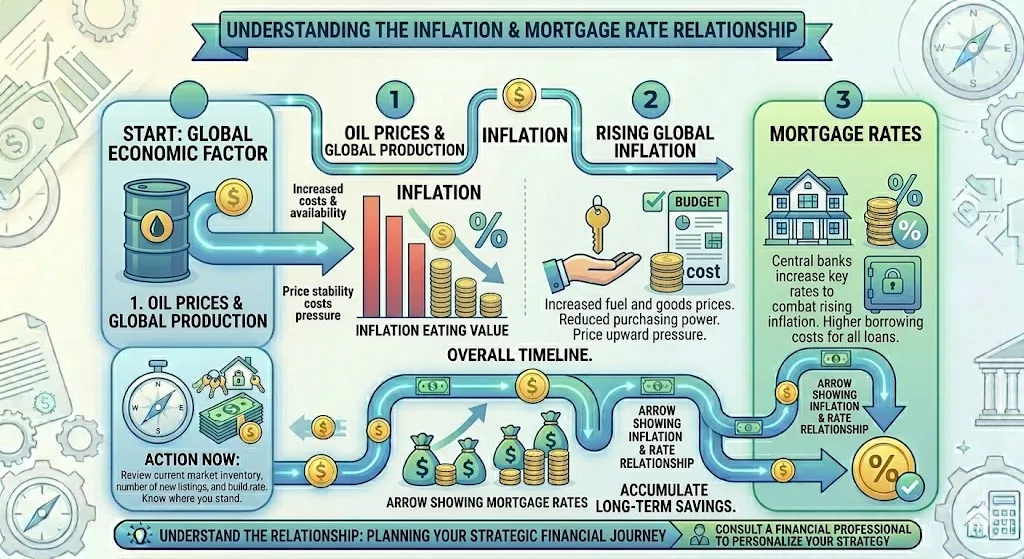
Higher inflation often leads to higher borrowing costs
Before the conflict started, oil prices were averaging roughly $65 a barrel. Since the conflict began, oil prices have become extremely volatile and have traded closer to $82 a barrel. In fact, we've seen oil over $120 a barrel during this same period of time. And one of the biggest concerns is the potential disruption of shipping through the Strait of Hormuz. As you probably know, that area is one of the most important oil transportation routes in the world. Roughly 20% of global oil supply moves through that narrow channel. And if shipping disruptions occur there, oil prices are likely to move significantly higher.
And when oil prices rise, it eventually feeds directly into inflation. Economists have a simple rule of thumb when it comes to energy prices. For every $10 increase in oil prices, inflation tends to increase by 0.2 percentage points. Now, that might not sound like a huge number, but when the Federal Reserve is trying to bring inflation down to that 2% target, even small increases can make a huge difference. And if energy prices stay elevated long enough, those costs begin spreading throughout the entire economy. Transportation becomes more expensive, manufacturing costs increase, shipping becomes more expensive, and eventually companies pass those costs directly along to consumers. That's exactly how energy shocks can turn into broader inflation.
Now, at the exact same time energy prices are becoming a concern, the labor market is starting to soften. Something we've been waiting on for the last couple of years. The most recent jobs report showed that the US lost 92,000 jobs in February. The unemployment rate increased slightly to 4.4%. And previous jobs reports were revised lower by roughly 69,000 jobs combined. So, hiring momentum is clearly slowing. And normally that type of data would help push interest rates lower because when the job market weakens the economy tends to slow down and when the economy slows inflation typically follows.
So right now we have two different forces pulling the economy in opposite directions. On one hand the labor market is weakening. On the other hand energy prices could push inflation higher. Yet again this is the type of environment that creates uncertainty and volatility in financial markets. And that uncertainty and volatility often leads to additional volatility in interest rates.
Why Mortgage Rates Rise Even When Economic Data Improves
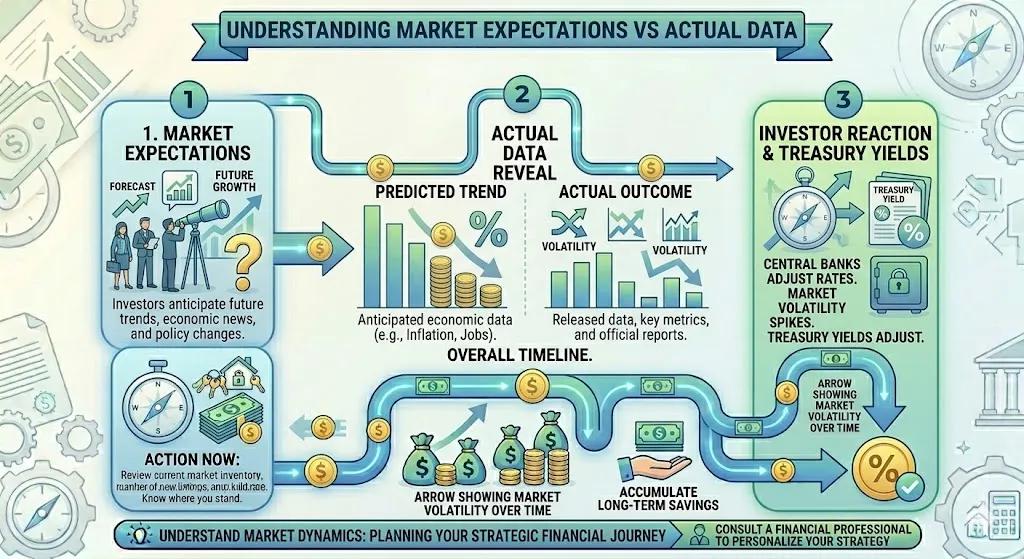
Markets react to future expectations, not just current data
So let's talk about something that many people find confusing. Why are mortgage rates moving higher even when the data appears to be improving? And this comes down to something that is important to understand about financial markets. Markets don't price today's data. They price future expectations. Mortgage rates are heavily influenced by the 10-year Treasury yield. And the 10-year Treasury moves based largely on expectations about inflation. So, if investors believe inflation will fall, Treasury yields will typically decline. If investors believe inflation could rise again, Treasury yields usually increase. And because mortgage rates are closely tied to Treasuries, mortgage rates often move in the same direction.
So, even though the most recent inflation report looked relatively calm, markets are already looking ahead. Investors are asking themselves what inflation might look like 6 months from now. If energy prices stay elevated long enough, inflation could move higher yet again. And if inflation moves higher again, the Federal Reserve would likely need to keep interest rates elevated. That possibility alone is one of the main reasons we're seeing volatility in mortgage rates right now.
And this is where looking at history becomes important because we've seen similar situations play out before. Energy shocks have historically had a major impact on inflation and interest rates, and the effects often last much longer than people expect. If you go back to the 1970s, geopolitical conflicts in the Middle East triggered major disruptions to global oil supplies. Oil prices surged, inflation skyrocketed, and it eventually forced the Federal Reserve to dramatically raise interest rates to bring inflation under control. Mortgage rates eventually climbed into the double digits during that period.
Now, today's economy is very different from the 1970s, but that period shows how powerful energy shocks can be when it comes to inflation. A more recent example happened in 2022 when Russia invaded Ukraine. Oil prices also surged during that time above $120 a barrel. Gas prices spiked across the US. Inflation accelerated dramatically, and the Federal Reserve had to respond by aggressively raising interest rates. Mortgage rates went from around 3% to over 7% within roughly a year. One of the fastest increases in mortgage rates we've ever seen.
And the interesting thing about that period is that many people initially believed the inflation spike would be temporary. But inflation ended up lasting much longer than expected. This is one of the biggest lessons from past energy shocks. Once energy prices rise and start pushing inflation higher, it can take a long time for things to normalize. Supply chains adjust, businesses lock in higher costs, companies raise prices, and inflation becomes more persistent.
How Low Housing Supply Keeps Home Prices Elevated
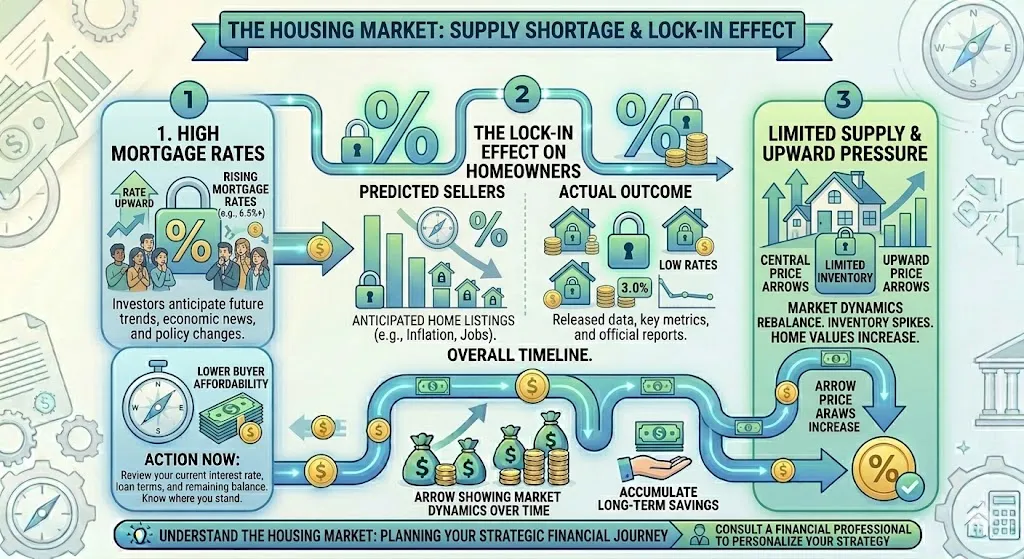
Limited inventory continues to support rising home prices
That's exactly why economists are watching the situation involving Iran so closely because the real risk isn't just a short-term spike in oil prices. The real risk is that elevated energy prices could stick around long enough to push inflation higher. And if that happens, the Federal Reserve may have to keep interest rates higher for longer.
Now, what does all of this mean for mortgage rates? Right now, many forecasts from economists suggest mortgage rates could remain roughly in the 6 to 6 1/2% range for the foreseeable future. Now, that doesn't mean rates will never fall again, but it does mean the timeline for significantly lower mortgage rates could take longer than many buyers were hoping. And if inflation does move higher again because of energy prices, mortgage rates could even rise from current levels.
Now, let's talk about what that means for the housing market. One of the biggest challenges buyers face right now is affordability. Higher mortgage rates increase monthly payments, and that makes it harder for many buyers to qualify for a home. But there's another factor that continues supporting house prices, and that's supply. Millions of homeowners currently have mortgage rates between 2 and 4%. And many of those homeowners are reluctant to sell because moving would require giving up that low interest rate. Economists often call this the lock-in effect, and it's one of the main reasons housing inventory remains historically low. When inventory is limited, home prices tend to remain supported even when interest rates are higher.
So waiting for dramatically lower mortgage rates doesn't always produce the outcome buyers expect. Because when interest rates eventually fall, demand often increases quickly. And when demand rises faster than supply, home prices can move higher. This is why trying to perfectly time mortgage rates can be extremely difficult. Interest rates are influenced by inflation, economic growth, global events, and investor expectations. And sometimes something happening thousands of miles away can influence the cost of borrowing money here in the US. That's exactly why we're seeing this right now.
Smart Home Buying Strategy When Mortgage Rates Are Rising
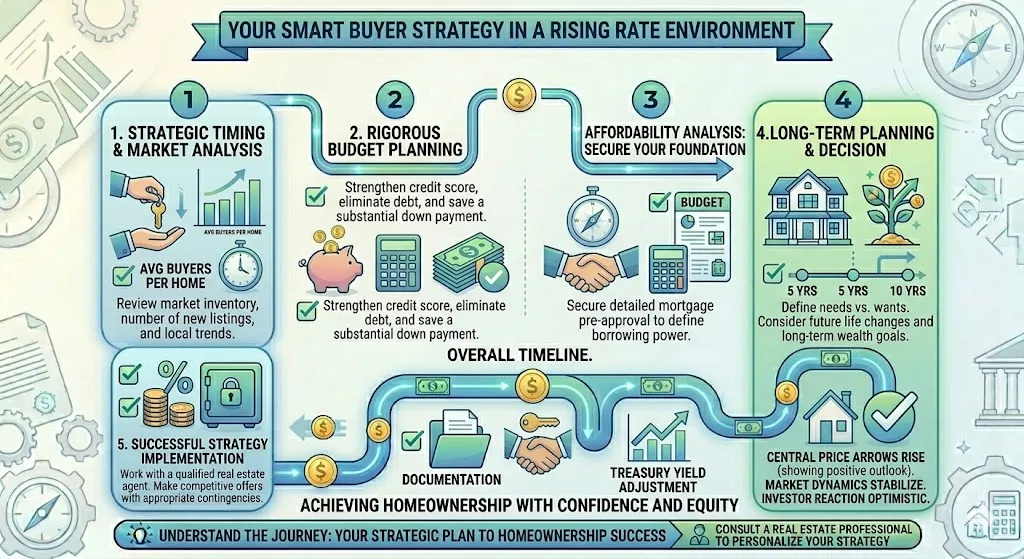
Focus on affordability and long-term goals over timing rates
So, if oil prices stabilize and inflation continues trending lower, mortgage rates could gradually move down over time. But if energy prices continue rising and inflation picks up again, mortgage rates could remain elevated or even move higher. So, the direction of mortgage rates over the next several months may depend less on domestic economic data and more on what happens in global energy markets.
For buyers trying to navigate today's housing market, the most important thing is focusing on the things you can control. Your financial stability, your income, your long-term housing goals, and whether the home you're considering fits comfortably within your budget. Because while mortgage rates may change over time, the fundamentals of buying a home remain the same. And if rates do fall later, refinancing is always an option. But waiting indefinitely for the perfect interest rate environment may not always produce the outcome buyers are hoping for.