NEW FHA Loan Requirements 2026 - First Time Home Buyer - FHA Loan 2026
Are you looking to buy a home with as little as three and a half% down in credit scores in the 500s? If so, then this article is for you. Today's article, we're going to be breaking down the updated FHA loan requirements for 2026, while also answering some of your most commonly asked questions around qualifying, credit scores, debt to income ratios, mortgage insurance, in addition to what documents you'll actually need to get preapproved.
FHA Loan Requirements 2026: Down Payment & Credit Score Explained
Understand how credit score impacts your FHA down payment requirements
But before we do that, I want to get something out of the way. FHA loans are not just for first-time home buyers. They're not just for people with minimal down payments, and they're not just for people with low credit scores. In fact, FHA loans can be used by anyone at almost any time. Put it really simply, this loan is for anyone buying a primary residence that actually meets the loan requirements. That's it.
So, you're probably asking, "What are the loan requirements?" That's what I want to dive into right now.
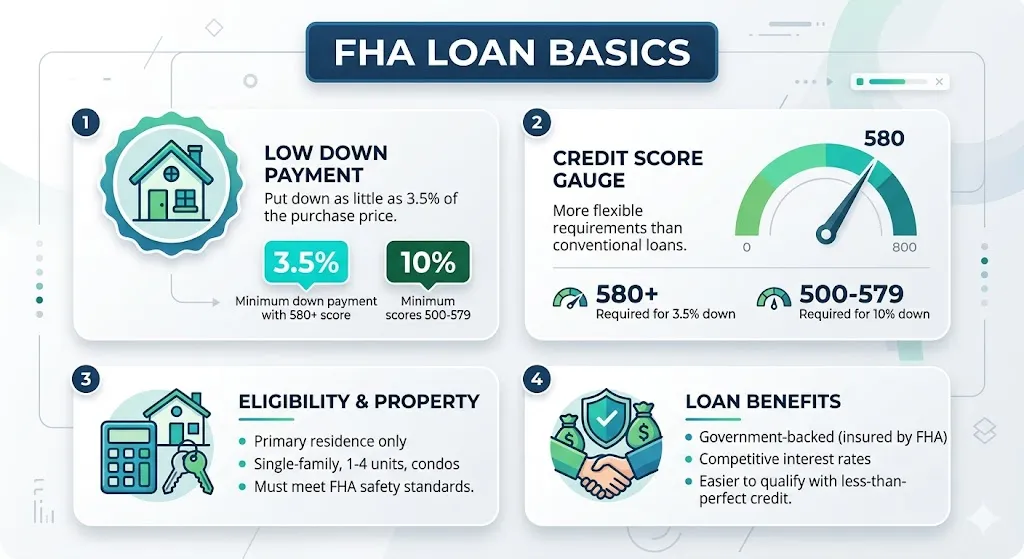
So, for many of you watching this article, the big draw to FHA is the low down payment. FHA allows you to purchase a home with as little as $3.5% down. Which means if you're buying a $100,000 home, your down payment is only $3,500. A $200,000 home, $7,000. A $300,000 home, $10,500. And you can see the list go up from here.
There's something very important to note about this down payment. You can only do the minimal down payment of 3 12% down if you have a credit score higher than 580. If your credit score is below 580, you have to put at least 10% down. So, if your credit score ranges between 500 and say 579, that's going to require a 10% down payment. But once you hit 580, your credit scores can be as high as 800 and you only have to put 3 and 12% down.
So, for example, let's say that you're buying a $400,000 home and your credit score is above 580, you'll only need a $14,000 down payment. Whereas, if your credit score is below 580, let's say it's 550, that's going to require a $40,000 down payment.
One bonus tip I want to give you right here is that down payment funds can come from savings, they can come from your checking account, they can come as a gift from a family member, or better yet, they can even come in the form of down payment assistance.
So, now that we've talked a little bit about the down payment and the credit score, I want to elaborate a little bit here on the credit score. We just talked about it, but I want to make sure it's really clear. You need at least a 580 or better credit score to put 3 and 12% down. Below 580 requires 10%. And if you're wondering what happens if your credit score is below 500, unfortunately, you're not eligible for an FHA loan at this time.
How FHA Debt-to-Income Ratio Works (2026 Guidelines)
FHA allows higher debt ratios to help buyers qualify for more home
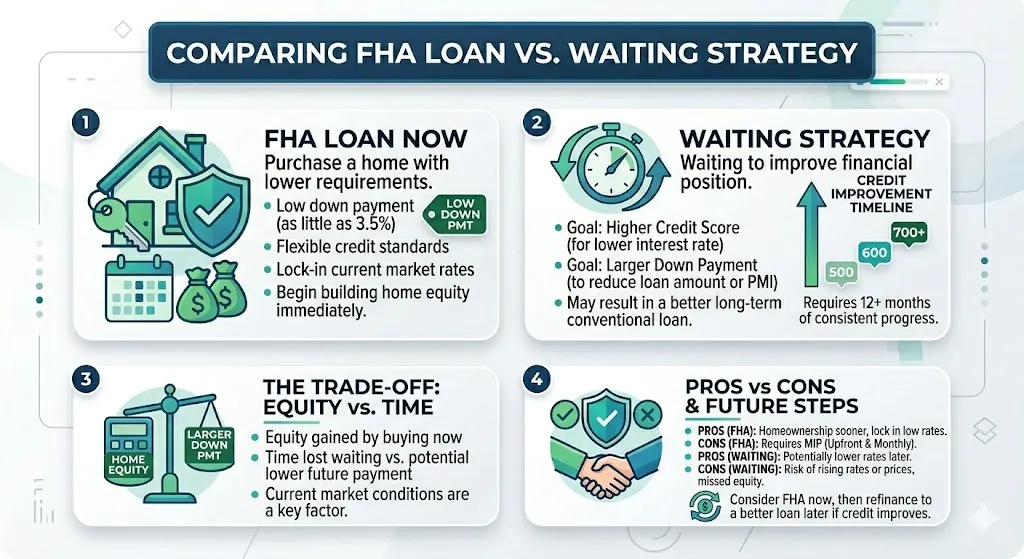
But here's where I want to take a minute and pause. If you're watching this at the moment and your credit score is say below 580, even if it's in the low 600s, I personally think you should wait on buying a home and work on your credit score. I think you should work on trying to improve that score because the higher that score is, the better the terms of the loan are going to be, the better interest rate. You're going to be able to qualify for more home. You're also going to get a lower monthly mortgage payment because at the end of the day, that credit score impacts everything.
So, I would personally rather see you wait and improve your credit score a little bit before trying to rush in and buy a home if you have a super low score.
On top of that, it can be very difficult out there to get an FHA loan if you have a super low credit score. While the guidelines allow it, the guidelines say yes, we do this, that doesn't necessarily mean the lender that you call is actually going to have that loan program available. And the main reason for that is because lenders out there put overlays on their programs. It's like an additional guideline.
So even though FHA says yes, you can do this, lenders out there say, "Instead of allowing a 580 credit score, we're going to make it a 620 credit score instead." The primary reason they do that is because the lower your credit score, the more you're seen as a risk to the lender. So lenders don't really want to take on that risk. So oftent times they'll raise that minimum credit score above what FHA actually requires.
With that, what I will tell you is that if you call a lender out there and they say, "Listen. We don't do this loan program, what I would suggest is maybe shopping around. A lot of times, if you go into your bank or your credit union, they're not going to do FHA loans." And if they do, they're definitely not going to do them at the lower credit scores. You need to work with a broker that understands FHA, that also understands the guidelines, and can take you through this program.
When it comes to FHA loans, down payment and credit score are what most people are familiar with when it comes to the lending program, because that's what they've seen. That's what they've seen on the thumbnail. That's what they've heard about. But one of the biggest benefits of FHA outside of the lower down payment and allowing lower credit scores is that they allow you to qualify for more home because they allow a higher debt to income ratio, which means they allow you to have more debt on your credit report than qualify than you could with a conventional loan.
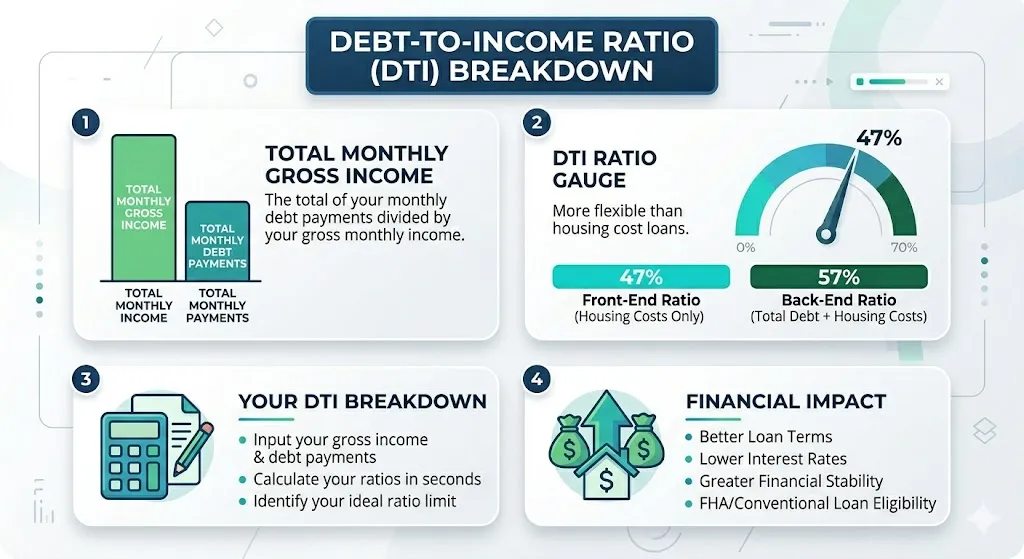
So, if you're watching this going, I have no idea what you're even talking about. Your debt to income ratio is essentially the debt that shows up on your credit report divided by your gross monthly income. That's how a lender calculates how much home you can actually afford to purchase.
So, in today's article, we're going to do some rough calculations here to give you an idea of what that actually looks like. So, if you're at home and you want to run some back of the napkin calculations, you can try this yourself and figure out if you can actually qualify for this home.
So, the very first thing we need to do is determine what your gross monthly income is. This is how much you bring home every single month before taxes. Now, if you're self-employed, this is a much more difficult calculation. I recommend you speak with a lender, have them calculate it for you because it can be very difficult to determine what that number is because of depreciation and write-offs and all of these different things.
But, if you're a W2 employee, if you're a wage earner, you work for someone else, you get a paycheck every week or every two weeks or once a month or whatever, it's a pretty easy calculation. What you do is you take your yearly income and you just divide it by 12. So for purposes of this article, let's just say you make $100,000 a year. If you divide that by 12, that's $8,333 per month. So for purposes of our conversation here, that is your gross monthly income.
FHA Mortgage Insurance Costs: Upfront & Monthly Breakdown
Mortgage insurance is the trade-off for low down payment FHA loans
Now, what we need to do is determine how much debt you actually have. A lot of people think their debt includes their grocery bills and how much they spend on date night and childare and all of that stuff. And the reality is it's not. The lender uses the stuff that shows up on your credit report. These are things like credit cards, car payments, installment loans. If you went out and bought furniture or something like this and you got the little card at the store, they allowed you no interest for the year or whatever, that shows up on your credit report. We need to take that payment into consideration.
In addition to those debts, the lender is also going to take into consideration the monthly mortgage payment that's associated with the house that you're going to buy. or in the case that you're going through the pre-approval process, they're going to give you an estimate based on a price range and help you determine how much home you can actually purchase.
So, with that said, there's a front-end ratio and a back-end ratio when it comes to calculating your debt to income. Your front-end ratio is all of your housing expenses. It's your mortgage payment. It's your property taxes. It's your homeowner's insurance. If there's an HOA on that property, that's all part of your housing expenses. That's part of your front-end ratio.
Let's say, for example, that all equals $3,500 a month. What you do is you take that 3500 and you divide it by that 8,333 because that was your gross monthly income. That's going to give you a decimal. In this case, it's42. And if you multiply that by 100, it's going to give you 42%. So, in this case, your front-end ratio is 42%. That's good because FHA allows you to go up to a 47% on your front-end ratio and as high as a 57% on the back end.
So, what is the backend ratio? The backend ratio is all of those expenses on the front, all of that housing expenses, that 3500 that we talked about, plus anything that shows up on your credit report. So, say for example, you had a car payment and a credit card and an installment loan, and all of that stuff equaled $700 per month. If we add that to the $3,500 housing payment that you had, that's $4,200. If we divide that by the $8,333, then we have a ratio of 50%. which again means you would qualify for that FHA loan, but they would allow you to go as high as a 57% on the back end.
Now, if you're listening to this and you're completely confused and you have no idea what I'm talking about, that's completely understandable. I do this all the time, so I understand the numbers, but if you don't, what I would recommend instead of trying to do this, make sure you talk to a lender who understands it.
So far, we talked about down payment, credit scores, as well as your debt to income ratio, which to me are probably the main three things to talk about when it comes to qualifying for an FHA loan. But there is one thing that gets a lot of push back when people talk about FHA, and it's something I want to talk about now, and that is mortgage insurance.
So, mortgage insurance gets a really bad rap because people don't think you should have to pay mortgage insurance for one reason or another. But understand that mortgage insurance is the price of doing business. It's the price of getting a loan when you don't have at least 20% to put down to buy a home. And that's because if you have at least 20% down to buy a home, for one, you're probably not using FHA, but secondarily, you're not going to have mortgage insurance. Mortgage insurance is there to ensure the lender in case you default on the loan.
FHA Loan Process 2026: Step-by-Step Approval Guide
Follow these steps to get preapproved and buy your home with FHA
So, if you end up not making payments on your loan and you foreclose, that mortgage insurance essentially compensates that lender for taking on a higher risk profile of someone putting less than 20% down and also somebody that potentially has lower credit scores in some cases, which FHA allows.
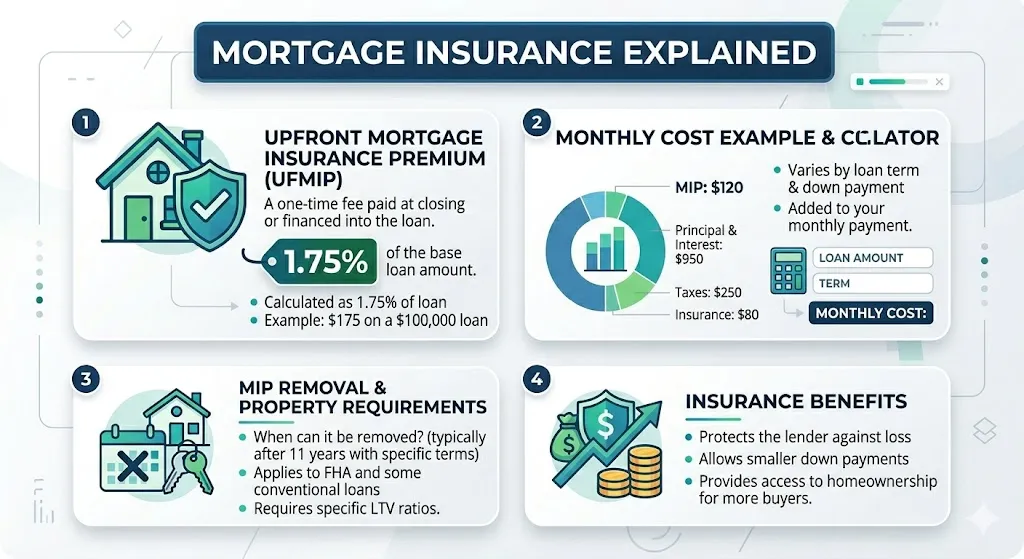
With that, let's talk about mortgage insurance because it's often misunderstood. There's two fees when it comes to mortgage insurance. First, there's an upfront mortgage insurance premium. This is probably the biggest hurdle, the biggest push back to overcome, when it comes to using an FHA loan. And that's because they charge 1.75% of the loan amount in order to use an FHA loan. So, anyone using an FHA loan is going to have to pay this upfront mortgage insurance premium of 1.75%.
Now, if you're listening to this and you're going, I don't even know what that means. Let's say, for example, you're buying a $350,000 home and you're doing the minimal down payment of 3.5%. That's going to be $12,250, which means you're financing $337,750. This is where that $1.75% comes in. FHA takes that $337,750 and multiplies it by $1.75%. Which in this case is $5,910. They add that back to that base loan amount of $337,750, which means you're actually financing $343,660.
So, part of your down payment that you use to buy that home is essentially eaten up by that mortgage insurance, which leaves you very little equity in the property. Now, a lot of people push back and go, "If that's the case, I don't want to buy a home using an FHA loan because it's eating up my equity." The alternative is you wait until you have enough down payment so that you can avoid using FHA and not have to pay that upfront mortgage insurance premium. So, for a lot of people, that means waiting months, some cases years before they can actually buy a home.
So, for me, it's the cost of doing business. It's the cost of not being able to have any other options out there. In fact, I've had many clients over the years use FHA loans to be able to purchase a home that they were able to refinance out of later, get into conventional loans, and those people are sitting on a lot of equity today. had they waited, I'm not sure what would have happened. So, the reality is it's not a bad thing. You just have to understand what you're getting into.
With that said, there is also a monthly mortgage insurance premium that you're going to pay whenever you don't have that 20% down. In fact, all FHA loans have monthly mortgage insurance regardless of whether you're putting 5% down, 10% down, 20% down. They're going to have the monthly mortgage insurance as well as the upfront mortgage insurance that I just mentioned.
In the case that you're putting three and a half% down, which is what most people do with FHA, monthly mortgage insurance amount is going to be 0.55%. Which in the case of the example we just used where your base loan amount became 343,660 because of the upfront mortgage insurance premium. You would multiply that by 0.55%. Which in this case gives you a yearly amount of $1,890 for the mortgage insurance to figure out what that's going to be monthly because you pay your mortgage insurance monthly. You don't pay it annually or yearly. You're going to pay it every single month. you make your mortgage payment. In this case, that's going to be $157.51.
So, that's going to be on top of your mortgage payment, on top of your property taxes, on top of your homeowner's insurance, which is different than your mortgage insurance because your homeowner's insurance covers fire, theft, that sort of thing with your property. So, with that, it's just an additional fee you're going to pay every single month. When a lender qualifies you, they're going to take into consideration all of these fees that we're talking about to figure out exactly how much home you can afford.
When it comes to mortgage insurance, there's also something really important that you need to know. That mortgage insurance, if you put 3 and a half% down, is going to be on your loan for the life of that loan. So, as long as you have that loan, you're going to have mortgage insurance on that loan. Now, many of you have probably heard once you get to 20% equity on your loan, that mortgage insurance is going to fall off. That only happens on conventional financing. Whenever you do FHA, you have to pay that mortgage insurance forever unless you put at least 10% down to start.
FHA Loan Strategy: Buy Now or Wait to Improve Credit?
Decide whether to buy now or improve your credit for better loan terms
Now, if you put 10% down to start, the mortgage insurance does fall off, but it doesn't fall off until after year 11. In my experience, most people using an FHA loan aren't putting 10% down, which means they're going to have that mortgage insurance on the loan forever.
But here's the cool thing. In fact, if interest rates don't come down, at any point you wanted to refinance and get out of that FHA loan into a conventional loan and you have enough equity there to have 20% equity in your property, then you're not going to have that mortgage insurance. If you move to a conventional loan, conventional is going to allow you to refinance into a conventional loan and drop that mortgage insurance. So, you're only going to have that mortgage insurance as long as you have the FHA loan. But once you build enough equity, you refinance into a conventional loan, that mortgage insurance is going to drop off.
Now, earlier in the article, I stated that this loan is for anyone buying a primary residence and meets the lending guidelines. Primary residence, that means you have to live in this home as your primary home for at least a period of time. Now, the question often comes up, how long do I have to live in the property? Can I rent it out after a year? Can I turn it into a rental? And the easy answer is yes. But you can't buy the property initially as an investment property. It has to be a home that you're going to move into.
So, if you already own a property and you're trying to buy another property using FHA, it's got to make sense right now. If you're a first-time home buyer, it's probably less of a concern because lenders think that that's probably going to be your primary home, assuming it's in the area that you work and all of that stuff.
But with that, FHA allows you to buy single family homes. It allows you to buy condos, town homes, assuming they're on the approved condo list. In addition to that, they also allow you to buy two, three, and even fourunit properties as long as you plan to live in one.
That's probably the biggest hack when it comes to FHA is that if you're able to find a four-unit property where you're willing to live in one of the units and rent the other three out, they'll allow you to use those rents in order to help you qualify. But with that said, the biggest caveat is it doesn't really work in high-cost areas because they require something called a self-sufficiency test.
Here in the state of California, Southern California I'm located, it's almost impossible to find a forplex, a 3plex, or whatever where you can use an FHA loan. Whereas in other parts of the country, like the Midwest, the South, you can definitely find fourunit properties where you can live in one and rent the other three out and use the income from those units in order to help you qualify.
With that, it's important to understand that it must meet the minimum property standards for FHA in order to allow you to use an FHA loan, which means you can't really have any health and safety issues in that property. Outside of that, it's pretty basic. You just can't have things like exposed wiring, peeling paint, or any sort of major roof or foundation issues unless you plan on using an FHA 203K, which is an entirely different loan.
So, if you are planning on buying a fixer, you might research the FHA 203K because that will allow you to do the improvements and actually finance them through the loan, whereas a standard FHA loan will not.
Now, before we talk about the documents you'll need, let's talk about the loan limits. The loan limits for FHA change almost every single year. And the reason I say almost every single year is because it's based off the median home price in the United States. If that median home price continues to increase every single year, then the loan limits usually go up every single year. If that median home price moves sideways or comes down, then essentially those loan limits stay the same.
But either way, when you talk to your lender, they should be able to tell you how much they'll actually finance using the current loan limits. But depending on where you're located in the country, the loan limits are going to vary. If you're in what's considered a lowcost area, your max loan limit with an FHA loan is going to be somewhere in the mid500,000 range. Whereas, if you're located in a high-cost area like here in Southern California, then those loan limits are going to be well over a million dollar.
In fact, if you're looking to finance 2, three, four units, that loan limit increases for every unit you add.
Now, if you've watched this so far and you're thinking, "FHA might be the right loan for me." What I'd ask you to do is stop here for a second. And before we talk about the documentation, I just want to point something out. Don't go into your lender thinking, "FHA is the only loan I'll consider, or I would never consider FHA." What I would ask you to do is have your lender do a sideby-side comparison of all the loan programs that you qualify for when you're going through that pre-approval process so that you know what you qualify for, what the down payment's going to be, what's the cash to close, and all of that stuff.
And you can look at all the loan programs side by side and then make a determination which one is best for you. Because what I often hear is people going into the process thinking, "FHA is the only loan I would consider." Whereas there are better options for them. In some cases, it's the opposite. I would never consider an FHA loan, whereas FHA in that case might be the better option of the ones that they're qualified for, and they just need to see it on paper. So, go in with an open mind.
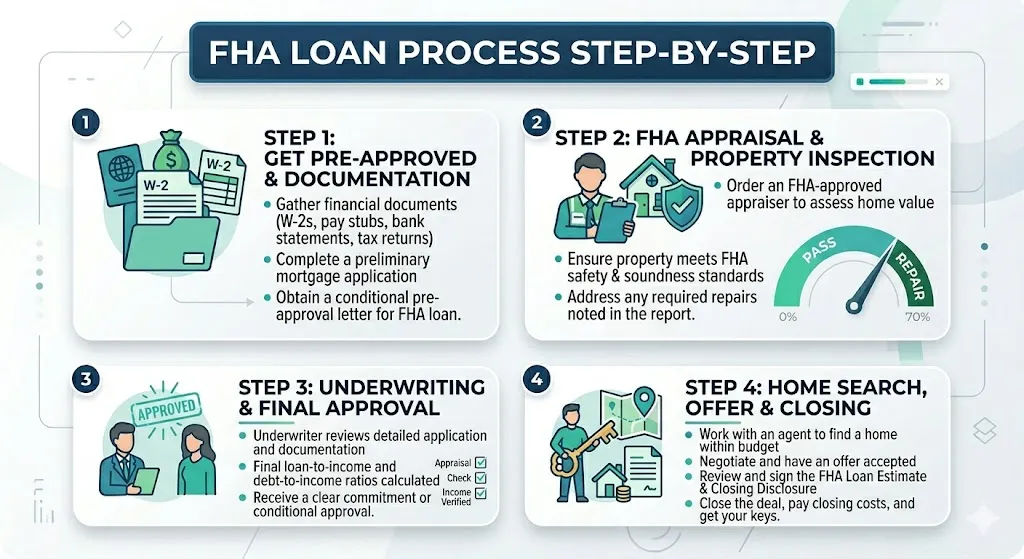
But when you're going through that pre-approval process, you're going to need some documents in order to provide that lender to see exactly how much home you can afford. With that, you're going to need your last two years of W2s. Now, if you're self-employed, it might be your last two years of tax returns as well. In addition to that, you're going to need your last two payubs as well as your last two months of bank statements, checking account, savings account, wherever your down payment's coming from, you're going to need to be able to document those bank accounts that shows where that money is.
In addition to that, the lender will need to see a governmentissued ID, so a driver's license, passport photo, that sort of thing, on top of being able to pull your credit. The lender can't do much unless they see your credit scores.
Now, a lot of people out there like, "I don't want to have my credit pulled because it's going to impact my score. My score is going to go down." Yes, that can be the case if you're shopping everywhere all over the place and doing it for a longer period of time. Understand that you have 45 days to shop various lenders, have your credit pulled, and it only impacts you one time.
So, if you truly want to know what you qualify for, the lender needs to pull your credit to see exactly what your scores are and what debts are associated with your credit report because that's how they're going to determine how much home you can actually afford to purchase because they need to see that debt to income. They only see your income without seeing your debt, then they don't truly know how much home you can afford to purchase.
And once a lender has all of that information, they should be able to tell you how much home you can afford to purchase. Now, in some cases, it's more than you thought. In some cases, it might be less than you thought. But either way, make sure you're working with a professional. Don't just Google lenders online or mortgage person online or walk into your bank. Make sure you go with somebody that understands FHA loans and can guide you through the process.
So, here's what I would say. At the end of the day, FHA loans continue to be one of the most powerful tools out there for home buyers in this market. With housing affordability issues, with high prices, FHA gives you another option, especially if you're working with limited income, down payment, or lower credit scores.