Red Flags How To Spot a MONEY PIT in 60 Seconds
You can spot a money pit in under 60 seconds if you know what to look for. Now, I'm not talking about fixer uppers or homes that need a little love. I'm talking about homes that look fine on the surface, maybe even updated, but underneath the paint and flooring are problems that can drain your savings. So, before you fall in love with the backyard or the countertops, let's walk you through how to protect yourself from buying a home that'll bleed you dry. As many of you know, I'm a real estate agent. I've been practicing real estate for over 20 years and I've been inside thousands of homes over the last two decades. In fact, I work with buyers almost every single day and part of my job is spotting what they missed.
The Big Five Home Inspection Checklist Every Buyer Must Know
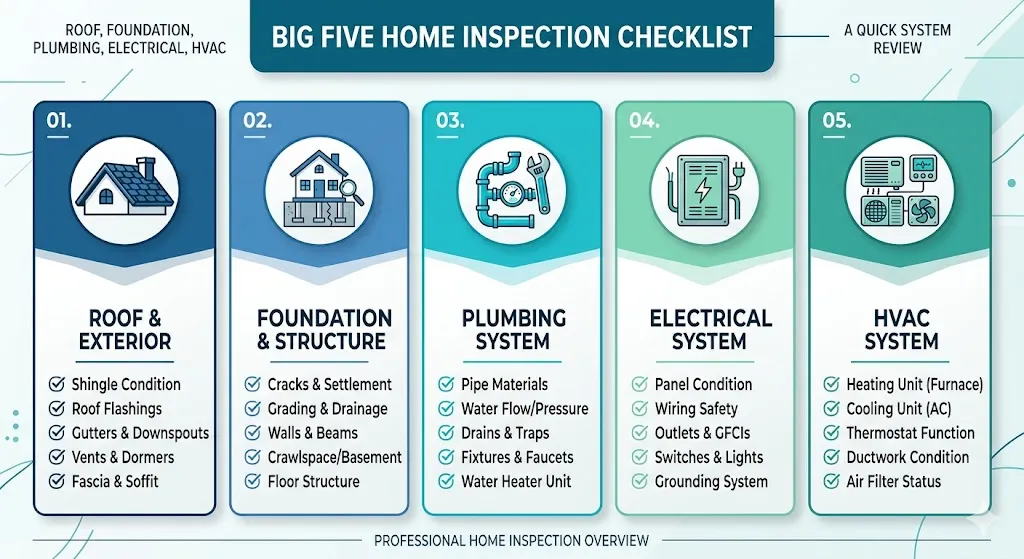
Focus on major systems first to avoid expensive surprises
You've probably heard me say it before. People buy emotionally and justify logically. And with that, most people are focused on the big picture. They're focused on staging, layout, finishes, whether or not the kids rooms are big enough, whether they can entertain there, how's Christmas going to look. whereas my job is to focus on the details that actually cost you money.
Today, I'm going to give you a walkthrough script so that you can start spotting red flags the moment you pull up to a home. Now, I'm going to call this section the big five. And I want to be clear here. Finding one issue on this list doesn't mean the home is a money pit. Most homes have some wear and tear. That's completely normal. In fact, one of the things I say to buyers every single time before we have a home inspection is that the home inspector is going to find problems. You're paying that person to find issues with that property. In fact, home inspectors can even find problems on new construction. But when multiple major systems are questionable or if one of them looks like it's on its last leg and the rest haven't been touched either, that's when you need to start thinking critically.
Now, before we go any further, I'd like to take a minute and ask a favor. If you find any value in my articles at all, make sure you hit that thumbs up and do me a favor and smash I mean smash that subscribe button to stay updated on everything real estate related.
Now, one of the easiest things to spot as soon as you pull up to a home is the roof. I want you to look for curled shingles. I want you to look for shiny bald spots, missing pieces, or even dips or waves in the roof. I want you to pay attention to the ridge caps in any areas around the chimneys or the flashing. On top of that, I want you to look to see if there are multiple layers of shingles, which typically means it was done cheaper, but it also shortens the lifespan. Replacement costs on a roof can range anywhere from, say, $10,000 upwards of $100,000, depending on the size and the materials.
Now, the second thing I want you to focus on in the big five is the foundation. I want you to look for diagonal or stair step cracks in stucco or concrete, especially ones that are wider than say a quarter. Stick a golf ball or a marble on the floor in the interior of the property and if it rolls one way, you might have settling or worst case structural movement. I've been doing this long enough where I can walk around a property and kind of feel if the floors are uneven. Now, I'm not talking about the soft giveness in say laminate flooring or vinyl type flooring because those floorings do have a little bit of give when you walk on them and that's because they contract and expand depending on what the weather looks like. I'm more talking about floors that are actually uneven. And [clears throat] you can tell that a lot of times by looking at doors that stick or large gaps around trim because that can be a clear indicator of something bigger going on.
Now, foundation repairs can range from something as small as say a cosmetic crack that you're just sealing to major structural lifts. And this is one of those things that I quite frankly don't have a lot of experience in because most of the houses my clients are buying, in fact, almost every single house, not one that I'm aware of, has actually had an actual foundation issue where the buyer's actually proceeded through the purchasing process. Most of the time, if there's a major issues like this, the buyer ends up backing out. But the thing with foundation repairs is they can range from say 5 grand to 50 grand to $1, $150,000 depending on how bad that foundation is. In fact, as a real estate agent that's been doing this a very long time, I would say if the property has major foundation issues, you should probably just run versus trying to fix that issue.
Now, the next thing on this list I want you to pay attention to is the plumbing. Is it older? Has it been repiped? And I'm talking about galvanized piping here. Because if it's old galvanized pipes, you need to go in and already expect to plan for a repipe on that house. Now, the way to tell is check under the sinks, behind the toilets, around the water heater. look at the main coming into the house and see what kind of material it is.
Top Structural Red Flags: Roof and Foundation Warning Signs
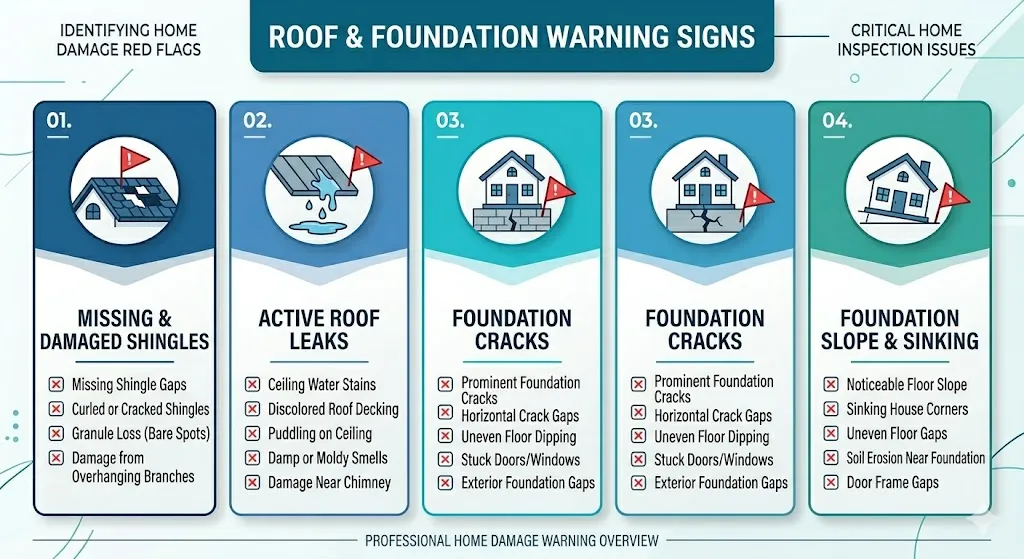
Structural issues can lead to the highest repair costs
Now, when we're talking about plumbing, I also want you to look for things like mold, musty smells, dark wood, or deterioration because that often means there are slow leaks or prior water damage. Also, one of the very first things I do when I walk into a garage or whenever I see the water heater is I look on that tag on the front of the water heater and I try to figure out when that water heater was manufactured. Now, just because it was say manufactured in 2010 doesn't necessarily mean it was installed in 2010. It could be installed, you know, in 2013 or 2014, but at least you have an idea of how old it is. So, with that, I want you to look at the water heater tag. Anything that's older than, say, 10, 12, 15 years, you need to start planning for a new one. And that's because the newer water heaters don't last nearly as long as the older ones. In fact, I go into homes right now where people have owned them 30, 40, 50 years, and sometimes the original water heater is still in that property. And guess what? It still works. In fact, those work better than many of the new ones. So, if it is a newer water heater that's been installed in, say, the last 15 years, chances are it's going to be time for a new one.
On top of that, when we're talking about plumbing, sewer lines in older neighborhoods can also be an issue. If there are mature trees nearby, you want to make sure your home inspector is also scoping the sewer line just to make sure roots aren't intruding, making sure the pipes haven't separated because you want to make sure that the water or whatever is coming through those lines can actually flow out to the street.
Now, the fourth thing I'm going to talk about is something your home inspector is probably going to do on your behalf. You don't want to start doing some of the things that I'm going to talk about here unless you're qualified to do it. In fact, your home inspector should be doing it. At best case, I want you to open the panel if you can and just see if it's an older panel or a newer panel. How many amps is that panel? Your agent should be able to look inside there and tell you, is it a 100 amp panel? Is it a 200 amp panel? And also kind of see if there's any open breakers in there. What you don't want to see are signs of concern. Things like rust, double tap breakers, loose breakers, any sort of scorch marks, which quite frankly, you're not going to see unless that panel is actually taken off, which is exactly what your home inspector should be doing.
Now, I can't tell you how many times I've actually opened the panel when I've had a buyer and we're touring homes where that panel's not even there. You can actually see the breakers, you can see the wires, you can see everything, which is not only a health and safety concern, but it's something that absolutely needs to be addressed before you purchase that home.
Now, the reason we want to know how many amps that panel is is so we can tell if it's outdated because something like a 100 amp panel might just be borderline, especially with everything people have going on today. Most homes today need at least 150 or 200 amps, especially if you're trying to do EV chargers or air conditionings or run a spa. So, just make sure your inspector actually does their due diligence. And on top of that, panels from certain brands like Zenso, Federal Pacific are flagged by many insurance companies. Your insurance company won't even allow you to get insurance on that property until those are actually replaced.
Now, here's the thing. Depending on where you're located in the country, the cost is going to vary. I recently replace my main panel to a 200 amp panel, and it cost me about $3500 bucks. But my understanding is that these can range anywhere from about 3 grand upwards of $10,000.
Plumbing Problems and Water Damage: Hidden Costs to Watch
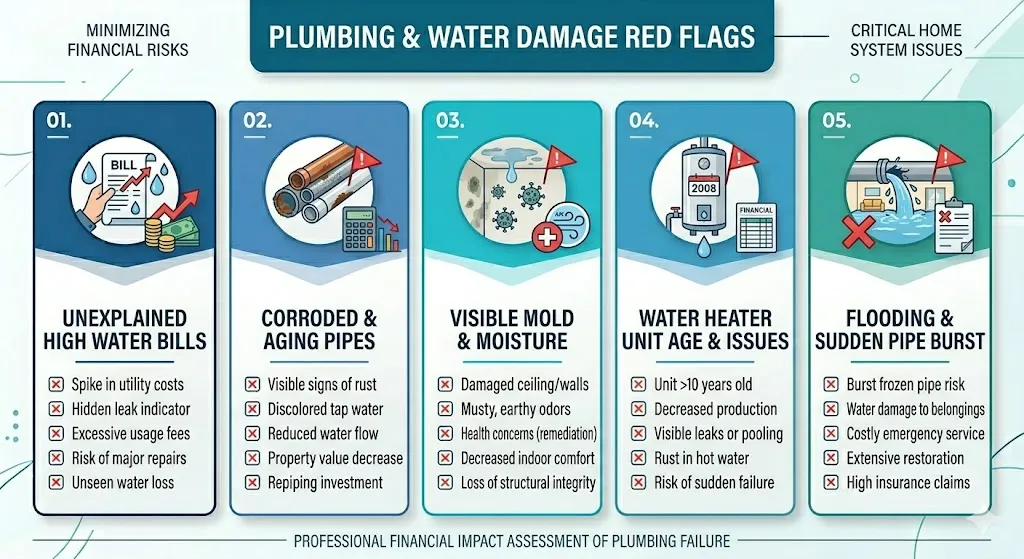
Small leaks can turn into major repair expenses over time
Now, the next thing on this big five list I want you to focus on is the HVAC. Now, if you start on the outside of the property, make sure you're checking the condenser. This is the, you know, the the big square thing out there that has the fan on the top and you can tell on the outside, is it rusted? Is it covered in debris? Does it look like it hasn't been touched in years? Because if that's the case, then it could be a reason for concern. I'm one of those people that have my condenser serviced about every year, every 2 years, where they take everything off, they hose off the inside, they make sure everything is up to date, wellmaintained, that there's also enough coolant in there to actually get down to the temperatures it's supposed to.
Now, with that, remember that's only one side of the actual HVAC. That's the condenser. That's the part that actually cools the house. Inside, you should check the furnace. If it's original, you should probably plan for replacement. Now, depending on where you're located in the country, this is going to be something that may or may not be an issue. I'm located here in Southern California. A lot of people don't really use their furnaces during the winter because it doesn't really get that cold. So, you can have a house that has an original furnace where the heat works just fine. It's an older unit, but everything works fine. In that case, you might not need to replace it. Whereas, if you're in an environment that gets four seasons, it actually gets cold, maybe it snows outside, then this is definitely something you want to focus on. On top of that, check the filter dirtiness, too. A dirty system signals poor maintenance in many ways, especially if somebody has pets.
Now, a full replacement cost on something like this, depending on what you're doing, can range $8,000 up to 20 $25,000 depending on the home size and the ducting needs.
Now, the reason I call these the big five is because all of these items are expensive to replace. So, when you go in to buy a home, you want to make sure the major systems of the house are good so that you're not going in spending a lot of money on things that cost a lot of money. You know, things like the roof we mentioned, the plumbing, the HVAC, the water heater, you know, all of those things are high ticket items and they can be very, very expensive to replace.
But here's the thing, red flags don't always look like damage. Some of the worst signs are cover-ups. But here are the things that I look for when going through a property. A lot of properties these days have been remodeled. They've been upgraded. They've been flipped. And I want you to focus on sloppy remodels. Crooked cabinets, uneven tile work, cheap laminate, or sometimes gaps in the baseboard suggest poor craftsmanship, or in some cases, somebody that doesn't know what the hell they're doing. And what I often tell buyers is if the cosmetic [clears throat] work was rushed, the things that you can actually see, it raises questions about what's actually underneath it. What's behind the walls? what can't you see in that property?
In addition to that, if you live in an area where there are garage conversions or enclosed patios, you need to focus on whether permits were actually pulled. Now, in many cases, they weren't, but how do you feel about the work? Do you feel like it was done in a workmanlike manner? Do you feel like it was done by a licensed contractor or a contractor that knew what they were doing, but the owners just didn't go through the permitting process? So, with that, focus on whether or not there were structural changes made to the property. If walls were removed and there's a second floor and that sort of thing, you probably want to make sure it's permitted because the last thing you want to do is risk the integrity of that home.
In addition to that, I want you to look for signs of water intrusion, sloping floors, or uninsulated walls. In addition to that, I can't tell you how many times I see fresh paint in properties that are just done over patches. So, pay attention to random spots of fresh paint, especially on ceilings or underneath windows, because they could be hiding leaks or potential stains. In addition to that, mismatch flooring can also be something you want to pay attention to. Things like frequent transitions or different heights between rooms might suggest patch jobs after potential water damage.
Now, in the state of California, you're supposed to disclose water damage on properties. But many times, people believe that, hey, it was [clears throat] a small deal. I don't need to disclose it. Therefore, you need to pay attention to signs that might show you that there was something more going on.
Electrical and HVAC Issues That Can Drain Your Budget
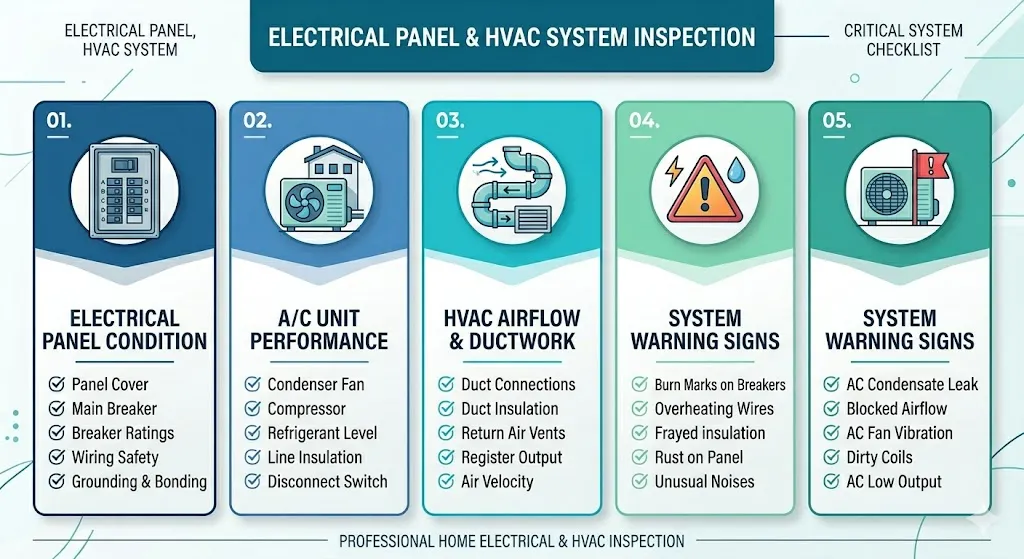
Outdated systems can lead to safety risks and high replacement
Now, I often tell buyers that you don't need to buy a pretty home on the interior. You just need to buy a house that was well-maintained, where it has good bones, where you can go in and do the things that you want to do to that property. So, with that, I want you to pay attention to signs of neglect. Neglect tells you how the home has actually been treated. A lot of older homeowners as they get older in their property aren't really able to do upgrades to the property. In fact, many of them don't even care about it. But with that, many times they're replacing things as needed. Right? If something is leaking, they're getting fixed. if the HVAC isn't working, they're getting it replaced, so they're actually doing the work to that property, they're not neglecting it. So, you also have to understand your audience a little bit. If you're walking through a property and see some of these things, if it's a super old person, then there's probably a reason things haven't been getting done. But, if it's a younger couple or a younger person and everything's just a mess, then chances are they're probably not maintaining that property.
You know, I mentioned a moment ago, but you could look at the HVAC vent, the filters. Have people actually been maintaining this sort of thing? Because if they haven't, that could impact the ability for that system to perform as it should over time. On top of that, peeling paint, cracked coaul, and sagging gutters are surface issues that hint at deeper problem. On top of that, I like to look at the fascia boards. Are they rotting? Has it been maintained? Do you think they're doing termite treatment on that property? How about the fences? Are they leaning? Are the sprinklers broken? Because in many cases, these aren't just [clears throat] is eyes, but they're clues to pay attention to. So, I want you to look for how the yard and the exterior are maintained. If they're being neglected, then I want you to ask yourself, what else is?
And while we're talking about the outside, I want to talk about a pool. I want you to check the coping around the pool. What does the texture look like on the bottom of the pool? How does the equipment look? Are there any visible leaks on that property? Pools, they're very, very expensive to fix. They're very, very expensive to maintain. And the equipment is also very, very expensive. So, if you're buying a home with a pool, you just want to make sure you're doing your due diligence upfront and not finding out about the issues once you move in.
Now, so far, we've just focused on the house, but right now, I want you to focus on the environment and what's surrounding it because it's not just the house, it's where it's located and what's going on in that particular area. Is the [clears throat] property located in a flood zone? Because guess what? That's going to impact your insurance cost. Also, is the home located in an area with a lot of trees in a high fire zone area like here in Southern California? Because guess what? That's also going to impact your insurance costs. Are there mature trees with roots close to the home? Cuz that could mean sewer line intrusion or potential slab cracking depending on how big these trees are.
On top of that, I want you to check neighboring homes. You know, the homes that are directly beside it, you know, and maybe if you're in the second story, you can look down into the yards or maybe you can peek over the fence because that gives you a really, really good sign of how well those homes are being maintained. I can't tell you how many homes I've shown where the people have actually loved the home and then we've kind of seen what the neighbors doing and it's turned us off entirely because guess what? Their maintenance or lack thereof can actually hurt your future resale value. So, it's not just about paying attention to that home, but it's about paying attention to everything that surrounds it.
Now, if there's an HOA, I want you to pay attention to what are the monthly costs. Does the HOA actually have reserves? What's going to happen when things need to get replaced? On top of that, are they planning on raising dues? What do those dues cover? Because the last thing you want to do is get in an HOA that doesn't have proper funding where they have to do assessments that end up draining your bank account.
Now, I realize many of you reading are not home inspectors. In fact, many of you are probably buying your first house and you're going, "Jeb, this is a lot of information to throw at me. How do I actually verify what I'm seeing?" Well, here's the thing. You do not have to guess. There are ways to confirm what your gut is telling you. The first thing is walk the inspection with your inspector. Ask questions. If you're not able to walk around with the inspector, once the inspection is finished, be there. Have them go over the things they found. Have them show them to you personally so you know exactly what's going on. What I can tell you is that if you're just reading a home inspection, it's going to seem a lot bigger issue than it actually is in many cases than you actually just looking at it. Because inspectors word things one way, whereas when you look at them and see them in person, it's a whole different scenario.
Hidden Home Red Flags: Cosmetic Fixes That Hide Bigger Problems
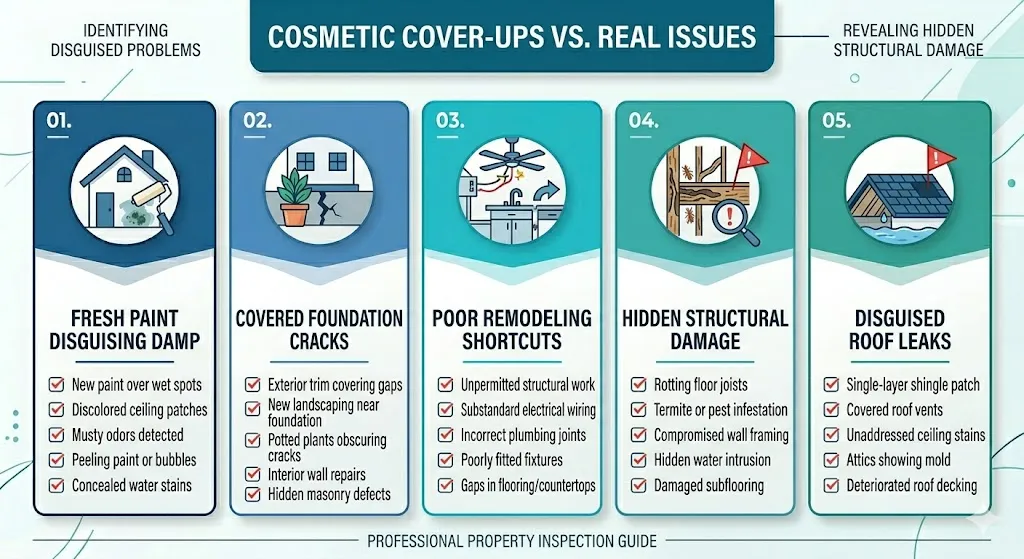
Cosmetic upgrades can sometimes hide serious underlying issues
On top of that, if the home has been remodeled or has additions, you should be asking for permits and potential repair receipts depending on the scope of work that's done. On top of that, you're going to get seller disclosures for that property. You should be reading through them. See if the seller has pointed out or mentioned anything that you should be paying attention to.
Now, earlier I mentioned it, but if the home has a lot of trees nearby or potential for mold or water leak, you should be adding things like a sewer scope or a mold inspection just to make sure there's nothing bigger going on. On top of that, a roof certification is not a bad idea either.
Now, as I mentioned at the beginning of the article, there are going to be issues. So, the goal here isn't perfection. Most homes are going to have something wrong. But when you start seeing multiple red flags stacked on top of each other, like an outdated roof, sounds of foundation movement, an older HVAC, you know, questionable remodel, or clear signs of neglect. That's when you need to slow down because remember, you're not just buying a house, you're buying future cost. So, walk it like you're already the owner. Would you want to deal with those issues if they popped up in say the first 6 months?