Why Houses Are So EXPENSIVE And WHY It Won't Change Anytime Soon
Black Rockck is not the reason you can't afford a home. I know that's not what people want to hear, but it's the truth. Homes aren't expensive right now because of corporate greed, investors, or some huge hedge fund buying everything in sight. That narrative sounds good online, but it's not the truth. Homes are expensive because we've made it nearly impossible to build the kind of affordable entry-level homes that used to exist everywhere in this country.
And before we get into the data, let me ask you a real question. What do you think is the number one reason homes are so expensive today? Is [clears throat] it Wall Street? Is it immigration? Is it zoning? Drop your answer in the comments because I think today's article might change your mind.
When people talk about how cheap homes were in the 1950s, they're comparing today's market to a product that literally doesn't exist anymore. In 1950, the average new home was under 1,000 square ft. It was one bathroom, typically no air conditioning, basic finishes, really basic materials, a lot of plywood, really small rooms, no insulation standards, no energy codes.
Today, the starter home is 2 and 1/2 to three times larger. You're getting two to three bedrooms, a lot of times a fullcar garage, HVAC, modern insulation, energy efficient windows, fire safety requirements, electrical requirements, water efficiency rules, and on top of that, bigger square footage across the board.
So, when you hear homes used to cost three times the average salary, and now they cost seven or eight times, sure, but the product has changed. We aren't comparing apples to apples. We used to build small, simple homes. Now we build large complex homes by default.
In the 1980s, 40% of new construction was entry- level. Today, just 9%. Not because nobody wants entry-level homes, but because we've slowly made it illegal or uneconomical to build them.
Now, before we talk about the real costs, do me a favor and hit that thumbs up if you find any value in my articles at all. And make sure you smash that subscribe button to stay updated on everything real estate related.
1950s Starter Homes vs Today’s Larger and More Complex Homes
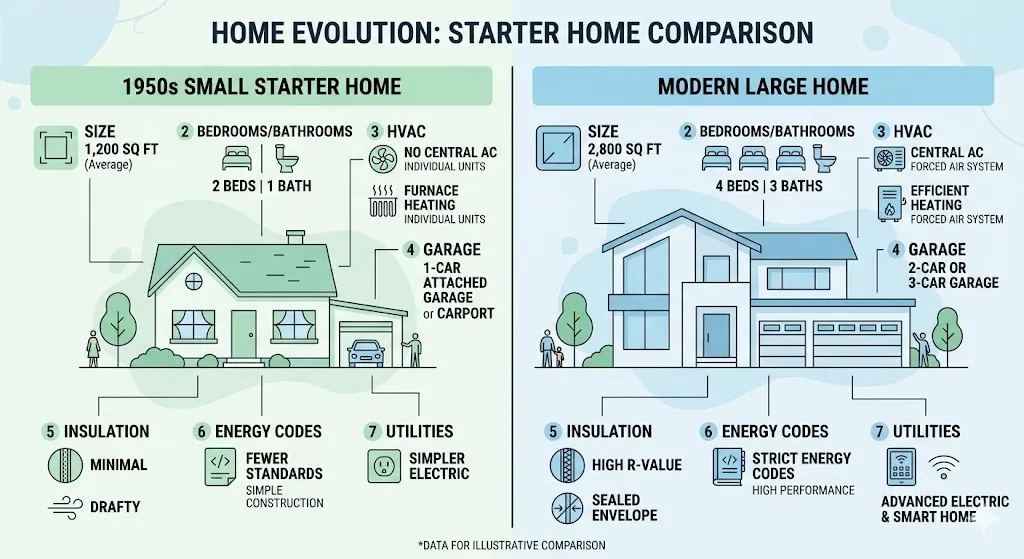
Today’s homes include more space and features, making them more expensive than older starter homes.
Now, let's talk about the biggest reason homes are expensive. And almost nobody online talks about this. It's not investors. It's not corporate greed. It's not the bureaucracy premium. The National Association of Homebuilders estimates that 25% of the price of a new home is regulatory cost. One out of every $4 you spend is for permission, not materials, not labor, not land, just permission to build.
Let me give you a real world example. In Minneapolis, a builder priced out a home at $182,000 for materials and labor. By the time the home was finished, the price was $372,000. Where did the extra $190,000 go? Well, 56,000 of it was directly government fees, impact fees, permit fees, plan review fees, inspection fees, the list goes on. The rest time delays, carrying costs, interest on the land, design changes, compliance, repermitting, environmental studies, more delays. Every time the clock ticks, the cost goes up.
Now, on top of that, I want to give you a real world example from Graham Stefen here on YouTube. One of the biggest YouTubers out there went through a similar process in LA. He tried to build a modest 720 ft ADU and paid around $10,000 just to get the city permits. Then he had to pay another $20,000 to fix a sewer line because of code requirements. But the real kicker on top of that was a tree that was involved. There was a diseased tree in the way. To remove that tree, he needed a permit to inspect the tree, a separate permit to remove the tree, and then another permit to plant a replacement tree. On top of that, there were delays in each step. And as you've probably guessed at this point, all of that costs money. And when you delay a project for weeks or months, that cost gets passed directly to the buyer.
This is the part that nobody wants to admit. Builders aren't avoiding entry-level homes because they're greedy. They avoid them because the economics don't work. If a builder can't make money, they don't build. If they don't build, supply doesn't improve. And if supply doesn't improve, prices stay high. It's not greed, it's math.
How Regulations and Permits Add Thousands to Home Prices
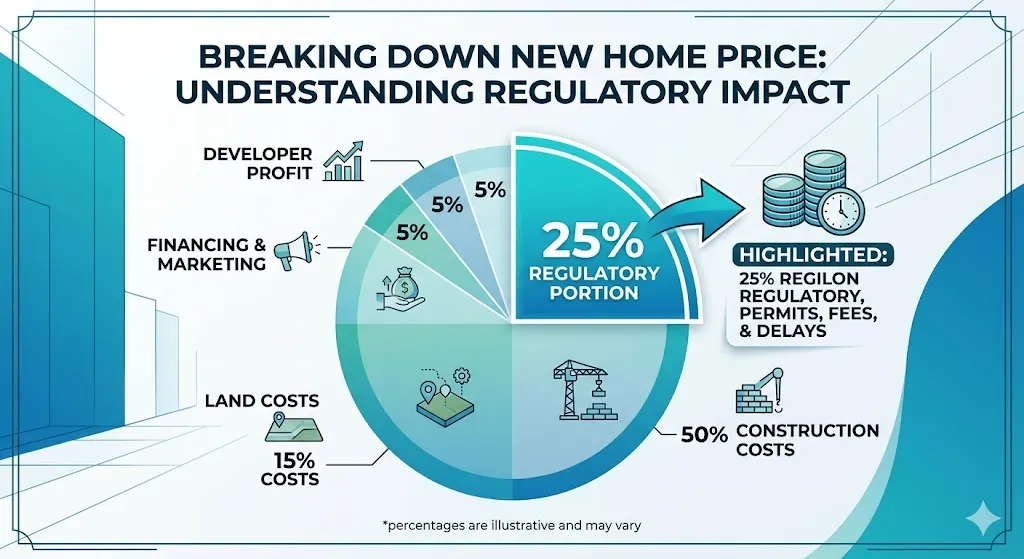
A large portion of home prices comes from regulatory costs, not just materials or labor.
Now, I know you've probably heard it online, whether it's Tik Tok, Instagram, Twitter, you've probably heard the claim that Black Rockck or Blackstone are buying up entire neighborhoods and pricing out every family in America. It's a great villain story, but unfortunately, it's not true. There was a viral tweet claiming that Black [clears throat] Rockck was paying 20 to 50% above asking price to steal homes from families. It went viral, millions of views, but guess what? That tweet was deleted after it was proven false. The neighborhood in that tweet was a purpose-built rental community by Dr. Horton. It was never for sale to individual families.
But let's look at the bigger picture. When you see institutional investors bought one in four homes last year, it sounds terrifying until you dig into who those institutions really are. 50% of them are momand pop landlords with less than nine properties. 11% are large corporations. When it comes to actual hedge funds, they make up 2.8% of purchases. In total, institutional investors own 1.6% of all single family homes. Let me say that again. 98.4% of homes are owned by regular people. If we banned Wall Street from the housing market tomorrow, inventory would rise by less than 1%. It wouldn't move prices at all. It's a distraction. The real issue is regulation and supply, not hedge funds.
In addition to that narrative, we have another narrative going viral, and it's that the average first-time home buyer is now 40 years old, and the National Association Realtors data does say that. Here's the problem. The NAR survey had a 3.5% response rate. Younger buyers simply weren't responding to 120 question paper survey that got mailed to their house. When you look at the actual data from the Federal Reserve, which comes from a 5% sample of all credit reports, you get a completely different story. The average first-time home buyer age is 36.2. The median age 33. And that number hasn't really changed since 2001 or 2021.
So, the issue isn't age, the issue is affordability. From 2019 to 2024, the income needed to buy a medianric home rose 41%. Median household income rose 11%. It's not that people suddenly want to buy later. It's that prices and rates surged faster than people's incomes. It's that prices and rates surged faster than people's incomes could keep up. You're not behind. You're not doing anything wrong. The environment changed faster than people could adjust.
Now, we can sit here and complain about investors all day long, but it won't fix affordability. We need to change the way we build housing. And right now, the system is set up to make affordable homes nearly impossible to produce.
Solutions That Could Make Homes More Affordable Again
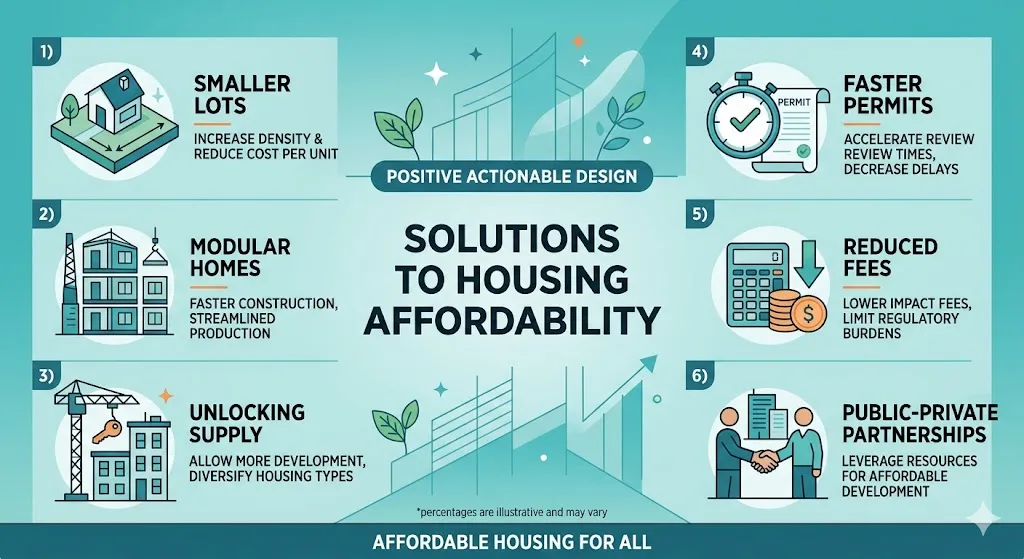
Policy and construction changes could help bring back affordable housing options for buyers.
Here are the fixes that actually work. Streamline approvals. a one-stop shop for permitting. Hard deadlines, no endless loops of reviews and reviews. On top of that, you need to reduce or restructure fees. Impact fees often make small homes impossible to build. If you lower the fees, then builders can produce affordable homes again. On top of that, they should allow smaller lots and more flexibility. This is a big one. Many cities legally prohibit small lot homes. The exact homes firsttime home buyers need. There's a federal proposal that offers states $25,000 per home built on smaller lots and another $25,000 for homes near manufacturing zones. This could help fund 240,000 new starter homes per year.
In addition to that, you need to unlock existing supply. There are 9 million homeowners aged 65 or older who exceed the current capital gains exclusion limit. Many stay put because selling triggers a huge tax bill. A full [clears throat] capital gains exemption for owners over 65 could free up 200,000 single family homes per year. And then in addition to that, we could embrace modular construction. It's faster. It's cheaper. It's less labor intensive. Cities like Austin saw rents drop 22% after [clears throat] relaxing zoning and parking mandates.
Now, I want to talk to you directly as a buyer because many of you out there can't aix affordability. You can't fix the supply. You can't wait for government policy to fix anything, especially housing overnight. You can't wait for the perfect market or the perfect rate. But here's one of the positive things. As we move into 2026, inventory is likely going to improve. On top of that, rates will likely trend lower, but not in a straight line. Every dip in rates brings a wave of buyers off the sideline.
If you followed this channel for a while, you know my stance. Buy when the payment makes sense and when the house fits your life, not when you think the market has bottomed. Because the truth is simple. Every time buyers wait in mass, competition gets worse, not better. Focus on what you can control. Your debt, your credit, your income, your down payment, the areas you're open to, the loan programs you choose, and more importantly, your timeline. The market won't suddenly become easy, but it can become manageable when you're prepared.
So, here's the truth. Homes aren't expensive because of investors. They're expensive because of regulation, bureaucracy, and decades of making it harder to build the kinds of homes that people actually need. If you found this breakdown helpful, do me a favor, hit that like button and tell me in the comments what do you think the biggest barrier to affordability is right now. If you want more straight talk like this without the hype, subscribe to the channel. I go live every week to answer your questions in real time on Wednesdays at 5:00 p. p.m. Pacific Standard Time. So, if you have questions about mortgage or real estate, make sure you check it out. On top of that, I appreciate you reading. Happy New Year. We'll see you in 2026.