Los Angeles Mortgage Journey 2026 – From Pre-Approval to Dream Home
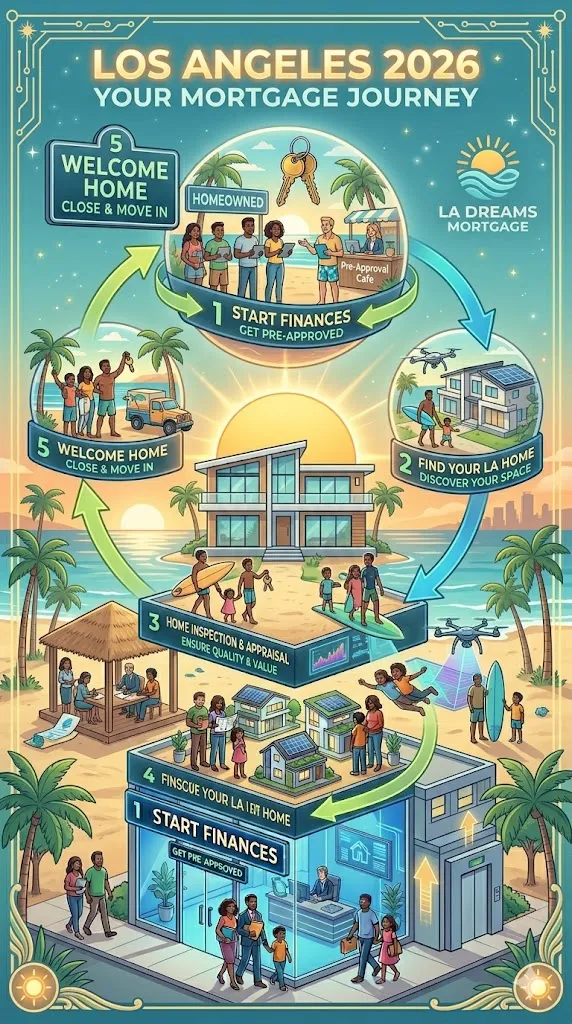
Visualize your complete home loan journey in Los Angeles from start to finish
Mortgage and Housing Guide for Los Angeles, USA – 2026 Edition
Los Angeles is one of the most exciting — and most complex — real estate markets in the country. This guide cuts through the noise with real 2026 data, honest comparisons, and local insights to help you make the smartest move for your situation, whether you're buying your first home or upgrading to something bigger.
Current Mortgage Rates in Los Angeles (April 2026)
Mortgage rates in Los Angeles have eased significantly from their 2023 peak — and that's good news for buyers who have been waiting on the sidelines. Rates are still elevated compared to the pandemic-era lows, but the direction of travel is encouraging.
April 2026 Rate Snapshot
- 30-Year Fixed: ~6.1% – 6.3% (national average sits near 6.3%; LA buyers with strong credit can access the lower end of that range)
- 15-Year Fixed: ~5.5% – 5.7% — a smart option if you want to build equity faster and can handle higher monthly payments
- FHA Loans (30-Year): ~5.9% – 6.2% — often the most accessible rate for first-time buyers with smaller down payments
- Jumbo Loans: ~6.2% – 6.6% — critical in Los Angeles, where a large share of properties exceed the conforming loan limit
- 5/1 ARM: ~5.6% – 5.9% — worth considering if you plan to move or refinance within five years
Los Angeles doesn't typically see dramatically different rates from the national average, but your credit score, down payment size, and loan type will move your rate up or down by as much as half a percentage point — which on a $900k+ loan, is thousands of dollars a year.
Pro tip: Shopping just three lenders can save Los Angeles buyers an average of $3,000–$5,000 over the life of a loan. Don't accept the first rate you're quoted.
Forecasters at the California Association of REALTORS® and Fannie Mae expect rates to drift toward the high-5% range by late 2026 — meaning buyers who lock in now may also benefit from a future refinance opportunity.
Los Angeles Housing Market Snapshot 2026
Los Angeles real estate entered 2026 in a more balanced, deliberate phase after years of pandemic-era whiplash. Prices have stabilized, inventory has improved, and buyers finally have a bit more breathing room — though "affordable" is still relative in one of America's priciest markets.
Key Market Stats (April 2026)
- Median Sale Price (City of LA): ~$975,000 – $1.0 million — condos and townhomes typically range from $700k to $900k, offering a more accessible entry point
- Year-Over-Year Change: Prices are roughly flat to slightly down (Redfin shows -4.7% YoY as of February 2026, while other sources show modest +1–2.5% growth depending on the data source and geography — LA County vs. City of LA tells a different story)
- Days on Market: Homes are averaging 68–80 days on market — a big change from the frenetic 29-day median of 2022, and a genuine opportunity for buyers to be more thoughtful
- Active Inventory: LA County had over 10,800 active listings in January 2026, up nearly 15% year-over-year — the most supply buyers have seen in years
- Months of Supply: About 2.8 months — still technically a seller's market, but far more balanced than the sub-1-month supply of peak pandemic years
- Sale-to-List Ratio: Homes are selling at roughly 98–100% of asking price, meaning overpriced listings sit, but well-priced homes still attract offers
What This Means for Buyers
Los Angeles in 2026 is not a buyer's market — but it's the closest thing to one that this city has seen since before the pandemic. Sellers are more willing to negotiate on closing costs, accept contingencies, and consider repair credits than at any point in the past four years.
The wildfire insurance crisis across California is an important new variable. Insurance premiums and availability vary dramatically by neighborhood — particularly in hillside and fire-adjacent areas like the Pacific Palisades, Altadena, and parts of the San Gabriel Valley. Factor insurance costs into your monthly budget calculations before falling in love with a property.
Neighborhood Price Ranges (February 2026)
- Downtown LA / Koreatown: $500k – $800k (condos and lofts; good entry-level options)
- Mid-City / Culver City: $900k – $1.3M (strong family demand, good schools)
- Silver Lake / Echo Park: $1.0M – $1.5M (high desirability, tight inventory)
- West LA / Santa Monica adjacent: $1.3M – $2.5M+ (premium westside pricing)
- San Fernando Valley (Van Nuys, Reseda, North Hills): $650k – $900k (more space for the dollar)
- South Bay (Inglewood, Hawthorne, Gardena): $700k – $1.1M (improving infrastructure, good upside)
Rent vs Buy in Los Angeles – Which Makes More Sense Right Now?
This is the question every Angeleno eventually asks — and in 2026, the honest answer is: it depends on your timeline and finances. The monthly cost gap between renting and owning in Los Angeles is real and significant. But so is the long-term wealth gap between renters and owners.
The Monthly Numbers
- Average rent in Los Angeles (2026): ~$2,740/month for all unit types
- 1-bedroom: ~$2,350/month | 2-bedroom: ~$3,200/month | 3-bedroom: ~$4,291/month
- Estimated monthly mortgage on a $975,000 home (10% down, 6.2% rate, 30-year fixed):
- Principal & Interest: ~$5,370/month
- Property taxes (at ~1.18%): ~$958/month
- Homeowner's insurance: ~$150–$300/month (varies significantly with wildfire risk)
- PMI (if less than 20% down): ~$150–$250/month
- Total estimated PITI: ~$6,600 – $7,000+/month
The monthly gap is substantial. But it's not the only number that matters.
Rent vs Buy: Side-by-Side Comparison
- RENTING in Los Angeles
- 💰 Monthly cost: $2,350 – $4,291 (depending on size)
- ✅ Lower upfront costs — typically first month + security deposit
- ✅ No maintenance bills, HOA fees, or property tax responsibility
- ✅ Flexibility to relocate for work or lifestyle changes
- ✅ Capital stays liquid — down payment funds can be invested
- ❌ No equity building — every payment goes to your landlord's mortgage
- ❌ Rents in Los Angeles have risen ~2–4% annually — no payment stability
- ❌ Subject to lease non-renewals and landlord decisions
- ❌ Zero tax benefits on rental payments
- BUYING in Los Angeles
- 💰 Monthly cost: ~$6,600 – $7,200+ (on median-priced home with 10% down)
- ✅ Building equity from day one — every payment works for you
- ✅ Fixed-rate mortgage = payment stability (your rent equivalent never rises)
- ✅ Tax benefits: mortgage interest and property tax deductions
- ✅ Los Angeles home values have appreciated ~3–5% annually over the long term
- ✅ Freedom to renovate, personalize, and put down permanent roots
- ❌ Large upfront costs — down payment, closing costs, and reserves
- ❌ Ongoing costs: maintenance, property taxes, HOA, wildfire insurance
- ❌ Less flexibility if your life circumstances change in the short term
The Honest Verdict for Los Angeles in 2026
In most California markets, the break-even point — where buying becomes cheaper than renting on a cumulative basis — is 5 to 7 years. In Los Angeles specifically, the high purchase prices push that timeline to the longer end of that range.
Buying makes strong financial sense if: you plan to stay in Los Angeles for at least 5–7 years, have sufficient savings for a down payment and reserves, and value long-term stability over short-term flexibility.
Renting may be smarter if: your timeline in Los Angeles is uncertain, you're still building your down payment, or you're in a phase of life where flexibility matters most.
One underrated strategy in Los Angeles: buyers who purchase a home with an Accessory Dwelling Unit (ADU) — or add one — can rent it out and offset a significant portion of their monthly mortgage, dramatically improving the rent vs. buy math.
Ready to see exactly what your mortgage payment would look like? Use the calculator on this page to plug in your numbers — down payment, interest rate, and loan term — and get a clear monthly picture in seconds.
Latest Mortgage Guides & Tips
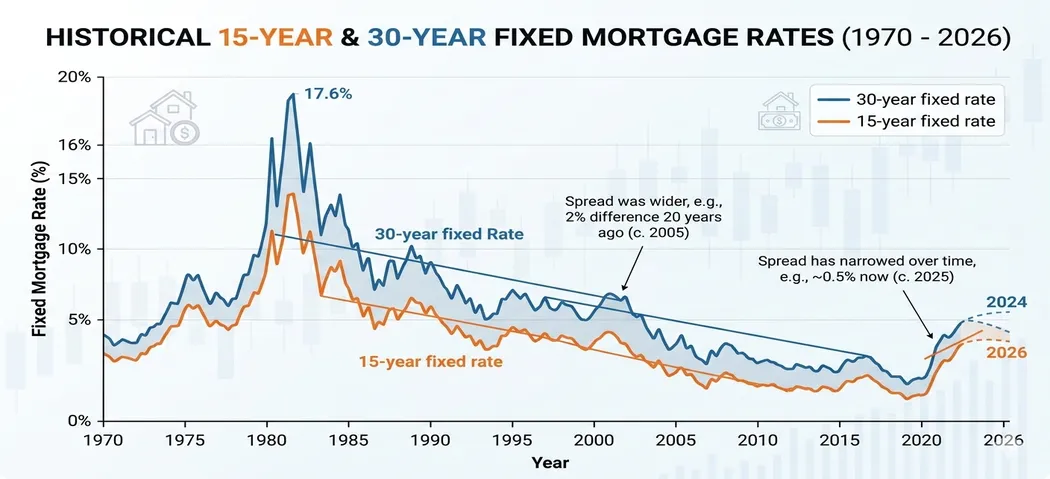
Learn the 4 key components of your monthly mortgage payment.
Compare the pros and cons for your situation.
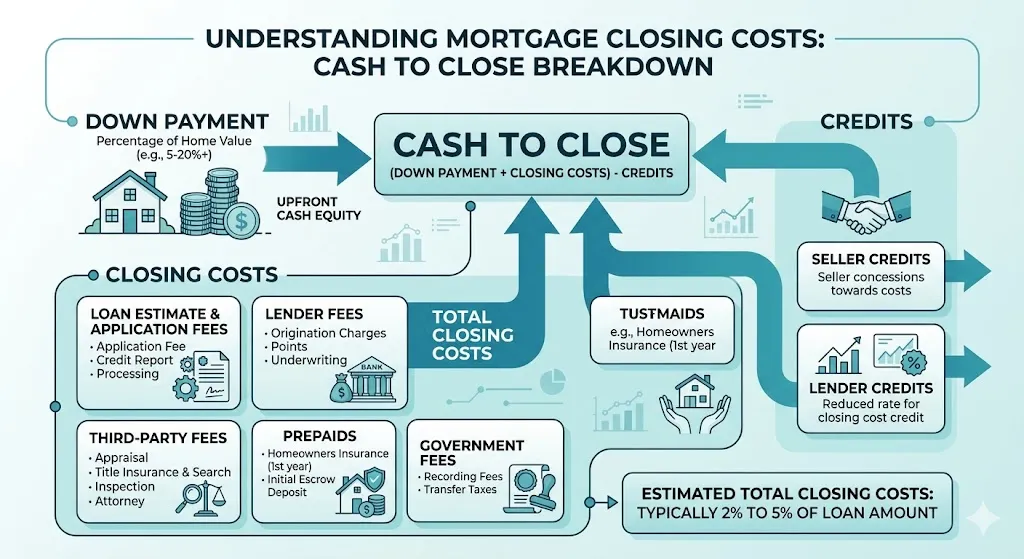
A clear breakdown of how closing costs and down payment combine into your final cash to close
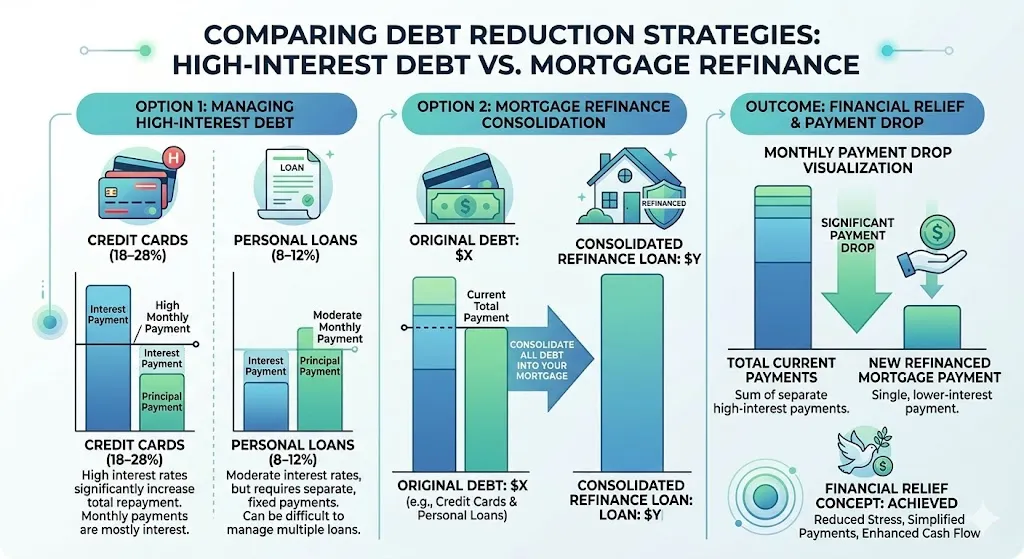
See how consolidating debt into a mortgage can dramatically reduce monthly expenses
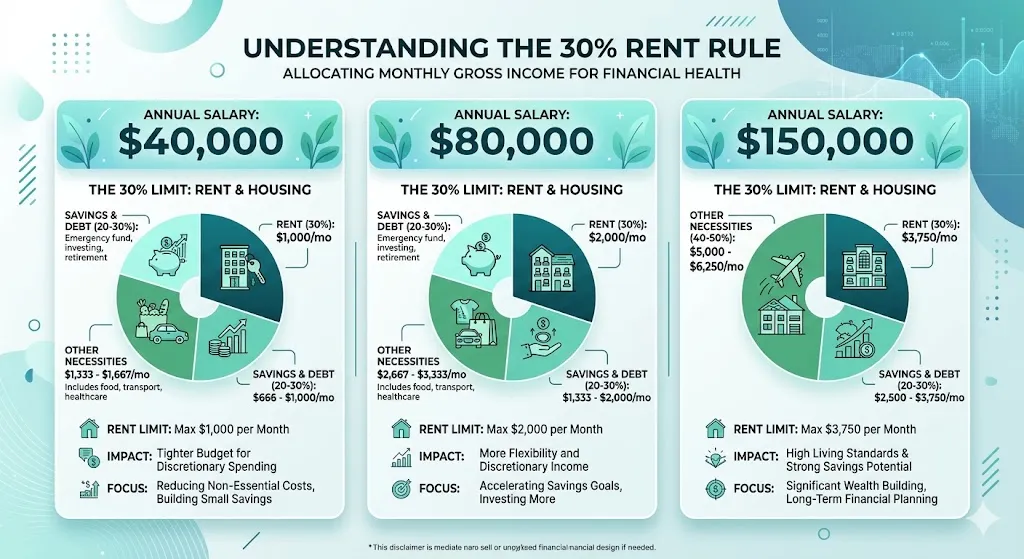
A simple breakdown of how much rent you can afford using the 30% income rule across different salary levels.
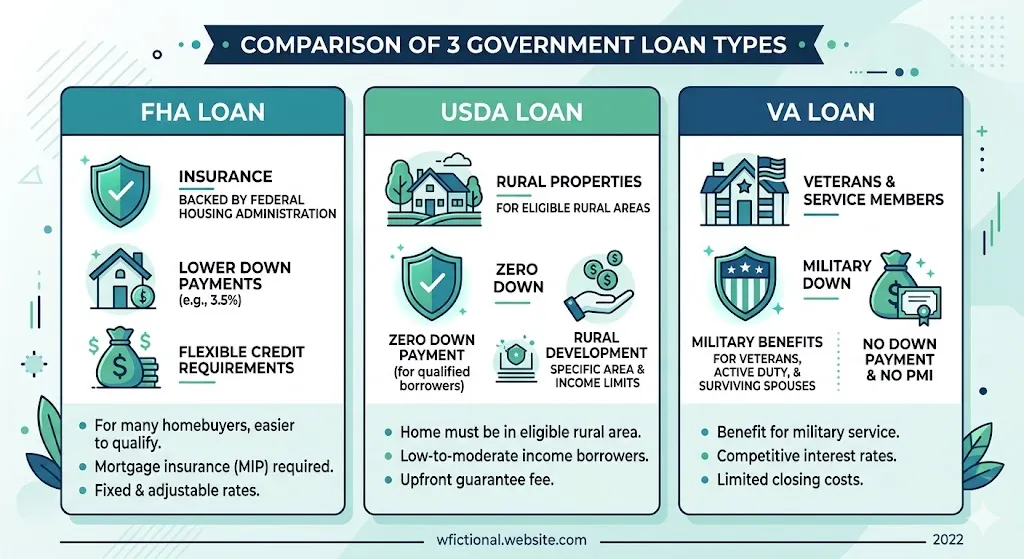
A simple breakdown of the three major government-backed home loan programs and how they differ.
Los Angeles Neighborhood, Economy & Cost of Living Guide – 2026
Where to Buy in Los Angeles – Neighborhood Breakdown 2026
Los Angeles isn't one housing market — it's dozens of distinct micro-markets stacked on top of each other. Where you buy matters enormously, both for your lifestyle and your long-term equity. Here's an honest, neighborhood-by-neighborhood breakdown for 2026.
Luxury and Premium Areas
These neighborhoods command the highest prices in Los Angeles — and for reasons that are unlikely to change. Think proximity to the ocean, world-class schools, strong price floors, and the kind of cachet that keeps demand perennially high.
- Beverly Hills — The gold standard of LA luxury. Median sale price: ~$2.4M (with the 90210 zip pushing north of $4M). Immaculate streetscapes, BHUSD public schools, and a central location make this a perennial top pick for high-net-worth buyers. Quiet, orderly, and discreetly expensive.
- Bel Air / Holmby Hills / Brentwood — The ultra-prime hillside and Westside estates corridor. Prices regularly exceed $3M–$10M+ for single-family homes. Privacy, views, and proximity to UCLA drive sustained demand from entertainment and tech executives.
- Santa Monica — Beachfront access plus one of the best walkability scores in Los Angeles. Median prices hover around $1.8M–$2.5M. Strong rental market underneath, great schools, and Abbot Kinney / Main Street lifestyle appeal keep demand tight year-round.
- Malibu — For buyers who want ocean-front or canyon privacy above all else. Prices range from $2M to $30M+. Important caveat for 2026: Malibu's wildfire insurance situation has become significantly more complex following the January 2025 fires — work with a specialist insurer before committing.
- Silver Lake / Los Feliz — LA's creative-class premium neighborhoods. Median prices: $1.2M–$1.7M. Strong demand from entertainment professionals and design-world buyers, walkable main streets, and limited new inventory keep prices firm. Los Feliz in particular has some of the most architecturally distinctive stock in the city.
Most Affordable and Accessible Areas
Yes, you can still find relatively accessible entry points in Los Angeles in 2026 — you just need to know where to look. These areas offer genuine value and, in many cases, real upside.
- San Fernando Valley (Van Nuys, Reseda, North Hills, Pacoima) — The Valley remains Los Angeles's largest reservoir of relative affordability. Single-family homes with yards start around $600k–$750k in these neighborhoods. Best suited for families who need space and are willing to commute. Good freeway access to the Westside and Downtown.
- Inglewood — One of the most actively discussed value plays in Los Angeles right now. Median prices: $700k–$900k. Proximity to SoFi Stadium, the new Intuit Dome (Clippers arena), and the expanding Crenshaw/LAX Metro line have repositioned Inglewood as a genuine growth story. Still priced below comparable west-side neighborhoods.
- El Sereno — A charming, hilly Eastside neighborhood drawing buyers priced out of Silver Lake and Highland Park. Median prices: $700k–$850k. Classic California bungalow architecture, walkable streets, and close proximity to DTLA make this a strong first-time buyer option.
- Eastside Los Angeles (Boyle Heights, Lincoln Heights) — Median prices: around $650k–$749k as of late 2025. Close to Downtown, with growing café and restaurant culture. Well-suited for buyers who want genuine urban living at a relative discount. Strong community identity throughout.
- South Bay (Hawthorne, Gardena, Lawndale) — Affordable relative to adjacent beach cities, with prices typically $650k–$850k. Good infrastructure, improving access to the Metro Green Line, and less wildfire risk than hillside neighborhoods are underrated selling points.
Up-and-Coming and Best-Value Neighborhoods
These areas offer what Los Angeles buyers are always hunting for: the combination of current affordability and future upside. Experts in 2026 are watching all of these closely.
- Inglewood — Already mentioned in affordability, but worth double-listing here. The Crenshaw/LAX Metro line, SoFi Stadium energy, and the new Intuit Dome arena are reshaping the neighborhood's identity faster than prices have fully reflected. Many analysts see Inglewood the way they saw Culver City a decade ago.
- El Sereno — Gaining popularity steadily as buyers discover its quiet hills and classic neighborhood character. More inventory turnover than neighboring Highland Park at a meaningful discount.
- Downey and Lakewood (Gateway Cities) — Often overlooked by buyers focused on the City of LA proper, these southeastern LA County cities offer single-family homes from $650k–$850k, strong community infrastructure, good schools, and easy freeway access. Ideal for families who prioritize space and stability over trendiness.
- Koreatown / Mid-Wilshire — Condos and smaller multi-family properties start around $500k–$700k here, making it one of the few genuine urban entry points in central Los Angeles. Walkability, Metro access, and a vibrant food scene are strong lifestyle draws. Best for buyers comfortable with condo-style living.
- Pasadena — A few miles northeast of Downtown, Pasadena offers Craftsman architecture, excellent schools, and a true neighborhood feel. Median sale price: ~$1.14M — premium, but more accessible than the Westside for comparable quality of life. The Gold Line Metro extension connects it to DTLA.
Areas with Economic Challenges
A balanced Los Angeles housing guide has to acknowledge that the city has significant economic inequality. The following areas have higher rates of poverty, lower median incomes, and housing conditions that reflect those pressures. This isn't a reason to avoid them — many long-term residents have deep roots and strong community ties here — but buyers should understand the context.
- Skid Row / South Park (Downtown LA) — The area immediately surrounding LA's Skid Row has the highest concentration of unsheltered residents in the country. Ongoing city redevelopment efforts exist, but the neighborhood context is a significant consideration for buyers and investors.
- Watts / Willowbrook / Compton — These South LA neighborhoods have historically had below-median household incomes and higher rates of concentrated poverty. Home prices are lower (often $500k–$650k), but public infrastructure, school quality, and services vary significantly. Buyers here often find motivated sellers and space — but should research specific blocks carefully.
- Pacoima / Arleta (Northern San Fernando Valley) — The northern Valley corridor has higher poverty rates than southern Valley cities like Sherman Oaks or Encino. Home prices remain accessible ($550k–$700k), and the area is predominantly working-class Latino — it has strong community character but fewer high-end amenities nearby.
Los Angeles has robust tenant protections and active anti-displacement advocacy across many of these communities. If you're investing here, understanding local regulations — including rent stabilization ordinances — matters.
Economic Zones and Local Economy in Los Angeles
Los Angeles runs on one of the most diverse and globally connected economies in the world. It's not just Hollywood — the city's economic base spans technology, trade, healthcare, manufacturing, and logistics. That diversity is a genuine buffer against single-industry downturns.
Major Industries and Employers
- Entertainment & Media — The industry Los Angeles is best known for. Disney, Warner Bros., NBCUniversal, Netflix, Paramount, Sony Pictures, and hundreds of independent studios and agencies are all headquartered or significantly based here. The industry is rebounding in 2026 after the 2023 strikes, with production activity recovering.
- Technology — Los Angeles is now firmly the second-largest tech hub in the U.S. after the Bay Area. Companies like Snap, SpaceX, Riot Games, Hulu, Tinder, and a growing constellation of startups have established major presences. The "Silicon Beach" corridor (Santa Monica, Venice, Playa Vista) remains the epicenter, with expanding nodes in Culver City and DTLA.
- Healthcare — Cedars-Sinai, UCLA Health, USC Keck Medicine, Kaiser Permanente, and Children's Hospital Los Angeles are among the largest employers in the region. The healthcare sector is one of the most recession-resistant industries in the city.
- Trade, Logistics & Manufacturing — The Port of Los Angeles and Port of Long Beach together form the busiest port complex in the Western Hemisphere. Supply chain, logistics, warehousing, and light manufacturing employ hundreds of thousands across the LA Basin.
- Aerospace & Defense — SpaceX (Hawthorne), Northrop Grumman, Raytheon, and L3Harris Technologies all have major Los Angeles County footprints. Aerospace remains one of the highest-paying employer clusters in the region.
- Finance & Real Estate — Los Angeles is home to significant banking operations, private equity funds, and one of the country's most active commercial real estate markets. Downtown LA's financial district houses dozens of major institutional players.
Salary Ranges for Typical Residents
Salaries in Los Angeles run above the national average — but so does everything else. Here's a realistic picture of what different workers earn:
- Median household income (City of LA): ~$69,778 – $79,701 depending on data source — notably below what's needed to comfortably afford the median home
- Median individual salary: ~$72,384/year, with 80% of salaries falling between $31,320 and $156,600
- Average weekly wage (LA Metro, Q2 2025): $1,562 — above the U.S. average of $1,436, per Bureau of Labor Statistics data
- Tech workers: $110k–$200k+ (software engineers at major companies often exceed $150k with equity)
- Entertainment professionals: Extremely wide range — from below $50k for entry-level crew to $200k+ for established writers, directors, and agents
- Healthcare workers: Registered nurses ~$95k–$130k; physicians $200k–$400k+
- "Good salary" threshold: Most financial advisors and local experts peg a comfortable single-person income in Los Angeles at $100k–$200k gross — when you factor in housing, taxes, and cost of living
Key Economic Developments in 2025–2026
- LA 2028 Olympics infrastructure build: The upcoming Summer Olympics is pumping billions into Los Angeles — transit expansions, venue upgrades, and hospitality development are creating significant construction and service employment across the region.
- Wildfire recovery (January 2025): The devastating Palisades and Eaton fires of early 2025 destroyed thousands of homes and displaced tens of thousands of residents. Recovery and rebuilding efforts are underway, but the insurance market fallout — with multiple major carriers pulling back from California — is reshaping affordability calculations citywide.
- Tech sector stabilization: After significant layoffs in 2023–2024, the LA tech sector is on a more stable footing heading into 2026. AI-related hiring at companies like Google DeepMind (which has a Los Angeles office) and new startups is partially offsetting losses from the prior correction.
- Port activity recovery: Global trade disruptions eased through 2025, and the LA/Long Beach port complex is seeing volume recovery — good news for the tens of thousands of logistics workers in the region.
Cost of Living Snapshot for Los Angeles
The big picture: Los Angeles has a cost of living index of approximately 166 — meaning it costs 66% more to live here than the national average. Housing is the largest driver, but it's far from the only one. Here's what buyers need to budget for beyond the mortgage.
Property Taxes
- Effective property tax rate in Los Angeles County: ~1.18% of assessed value annually
- California's Proposition 13 caps annual assessment increases at 2% per year for existing owners — a significant long-term benefit for buyers who hold their home
- On a $975,000 home, expect annual property taxes of roughly $11,500 (~$958/month)
- 2026 tax note: The SALT deduction cap was raised to $40,400 under the One Big Beautiful Bill Act — welcome news for Los Angeles homeowners who previously couldn't fully deduct state and local taxes under the old $10,000 cap
- New construction and recently sold properties are reassessed at purchase price, so buyers should expect full-rate taxation from day one — unlike long-term owners who may be paying taxes on a much lower assessed value
Homeowners Insurance
- Insurance is a growing and serious consideration in Los Angeles in 2026. Multiple major insurers — including State Farm and Allstate — have paused or restricted new home policies in California
- Typical insurance cost for a standard Los Angeles home: $150–$400/month, depending on location, structure type, and risk profile
- Hillside, canyon, or fire-adjacent properties: Premiums can run $500–$1,500+/month or more — and some properties now require coverage through California's FAIR Plan (the insurer of last resort)
- Always budget insurance before making an offer. For some Los Angeles properties, insurance costs have become a deal-breaker in 2026 — get a quote as part of your due diligence process, not after
HOA Fees
- Average HOA fee for condos and planned developments in Los Angeles: $340–$388/month
- Modest condo buildings: under $400/month
- Mid-range communities with pool, gym, and security: $400–$700/month
- Luxury high-rise condos in DTLA, Century City, or Westwood: $700–$1,500+/month
- Single-family homes in non-HOA neighborhoods: $0 — a real advantage of Los Angeles's older residential stock
- Always request the HOA's financial statements and reserve fund status before buying into a building — underfunded reserves are a significant hidden risk
Commute Times and Transportation
- Los Angeles has an average commute time of 30–40 minutes by car — but this varies enormously. Peak-hour freeway commutes from the Valley to the Westside can run 60–90 minutes each way
- Metro rail expansion is ongoing and meaningful: the Crenshaw/LAX, Purple Line Extension (to Westwood by 2027), and Regional Connector are all reshaping which neighborhoods offer car-free or car-light commuting
- Neighborhoods with strong Metro access (Koreatown, DTLA, Culver City, Pasadena) offer real commuting advantages — and are increasingly valued for it
- Gas prices in Los Angeles typically run $4.00–$5.00/gallon, among the highest in the country. Car ownership costs should be factored into monthly housing budgets
- Walkability varies dramatically: Santa Monica and West Hollywood score very high; most of the San Fernando Valley and South Bay score significantly lower
Schools and Family-Friendly Considerations
- Los Angeles Unified School District (LAUSD) is the second-largest in the U.S. Quality varies enormously by school and neighborhood — research individual schools at GreatSchools.org before choosing a neighborhood based on schools alone
- Top-rated public school zones include Playa Vista, Westwood, West LA, and parts of the San Fernando Valley (especially the South Valley — Sherman Oaks, Encino, Woodland Hills)
- Beverly Hills Unified School District (BHUSD) is widely considered one of the best public school districts in Southern California — a key driver of Beverly Hills home prices
- Pasadena Unified and Glendale Unified are well-regarded districts for families buying in those neighboring communities
- Private school tuition in Los Angeles runs $20,000–$50,000/year per child — a significant budget line for families who choose that route
- Parks, beaches, and outdoor recreation are genuine strengths of Los Angeles family life — the city has extraordinary access to nature, from Griffith Park to the Santa Monica Mountains to dozens of public beaches
The cost of living in Los Angeles is real and meaningful — but so is what you get for it: climate, career opportunity, cultural richness, and long-term home appreciation that has historically outpaced most U.S. markets. The key for buyers is going in with eyes open, numbers in hand, and a clear sense of which neighborhoods match both your budget and your life.
The Complete Mortgage & Housing Guide for Los Angeles, USA
Best Mortgage Options for Different Salaries in Los Angeles
Los Angeles is one of the most expensive housing markets in the country — but that doesn't mean homeownership is out of reach. The right mortgage strategy depends heavily on where your household income falls. Here's a breakdown by salary range to help you find your best path forward.
For Low-to-Mid Income Households ($40k–$80k)
Buying a home in Los Angeles on this income is challenging but absolutely possible — especially with the right loan programs and down payment assistance.
- FHA Loans are your best friend here. With as little as 3.5% down and a minimum credit score of 580, FHA loans are designed for buyers who haven't had the chance to build massive savings.
- CalHFA (California Housing Finance Agency) offers income-based programs including the MyHome Assistance Program, which provides a deferred-payment junior loan to cover down payment and closing costs.
- LACDA (LA County Development Authority) runs local down payment assistance programs specifically for lower-income buyers purchasing in LA County.
- Look into HUD-approved housing counselors in Los Angeles — they're free, local, and can walk you through every available subsidy and program.
- Target neighborhoods with lower price points such as Palmdale, Lancaster, Compton, or the San Fernando Valley where entry-level homes may still be within reach.
Tip: At this income level, focus on total monthly payment — not just the home price. Use a mortgage calculator to see what a 3.5% down FHA loan would cost you monthly, including mortgage insurance premiums (MIP).
For Middle Income Households ($80k–$150k)
This income range gives you more flexibility — but in Los Angeles, you'll still need to be strategic. Median home prices hover around $800,000–$900,000 in many neighborhoods, so stretching smartly is key.
- Conventional loans with 5%–10% down become accessible here, especially if your credit score is 680+.
- Consider a conventional 97 loan (only 3% down) backed by Fannie Mae or Freddie Mac — ideal for first-time buyers who want to preserve cash.
- The CalHFA Conventional Program pairs a conventional mortgage with down payment assistance, making it a smart combo for this income bracket.
- If you're a first-time buyer, check out the California Dream For All Shared Appreciation Loan — the state provides up to 20% of the purchase price in exchange for a share of future appreciation.
- Private Mortgage Insurance (PMI) kicks in below 20% down — budget approximately 0.5%–1.5% of the loan annually until you hit 20% equity.
Tip: At this income level, getting pre-approved with multiple lenders and comparing APRs (not just interest rates) can save you tens of thousands over the life of the loan.
For Higher Income Households ($150k+)
With a stronger income, you have access to the full spectrum of mortgage products — including jumbo loans, which are common in Los Angeles given the high home values.
- Jumbo loans are required for loan amounts exceeding $1,149,825 in LA County (the 2025–2026 conforming loan limit). These require stronger credit and typically 10%–20% down.
- A 20% down conventional loan eliminates PMI entirely and gives you the best rate — worth pursuing if you have the savings.
- Consider adjustable-rate mortgages (ARMs) — a 7/1 or 10/1 ARM can offer lower initial rates if you plan to sell or refinance within a decade.
- High earners who are self-employed (very common in LA's entertainment and tech sectors) should look at bank statement loans or asset-based lending programs.
- Work with a certified financial planner alongside your mortgage broker to understand how a large mortgage interacts with investments, taxes, and retirement savings.
Tip: In Los Angeles, Proposition 19 affects property tax portability for seniors and disaster victims. If you're buying in this income tier as a retiree or long-time homeowner, consult a tax advisor before you close.
---
Local Success Stories and Practical Tips
Sometimes the best way to understand what's possible is to see how real Los Angeles buyers — people just like you — made it work.
🏙️ The Young Professional: Maria, 31, Silver Lake
Maria works in digital marketing and earns $72,000/year. She assumed she'd be renting forever in Los Angeles. Then she discovered CalHFA's MyHome program combined with an FHA loan.
- She purchased a $480,000 condo in the northeast LA area with just 3.5% down — about $16,800 out of pocket.
- The MyHome program covered most of her closing costs as a deferred loan.
- Her total monthly payment (mortgage + HOA + insurance) came in at $2,950/month — less than what many of her friends were paying in rent.
Lesson: Don't assume LA is impossible on a single income. Target condos and townhomes in transitional neighborhoods, and stack every assistance program you qualify for.
👨👩👧 The Growing Family: The Nguyens, Torrance
David and Lisa Nguyen have a combined income of $135,000 and two young kids. They needed more space but were priced out of the Westside neighborhoods they loved.
- They shifted focus to the South Bay area and found a 4-bedroom home in Torrance for $820,000.
- Using a conventional loan with 10% down and a strong credit score of 740, they locked in a competitive rate.
- They used the California Dream For All program to cover part of the down payment, preserving their emergency fund.
- Their kids stayed in a strong school district — a bonus of choosing Torrance over more expensive westside options.
Lesson: In Los Angeles, flexibility on neighborhood can unlock dramatically better value. A 20-minute drive can mean a $200,000 difference in home price.
🌅 The Retiree: Bob, 67, San Pedro
Bob retired after 30 years in the aerospace industry and wanted to downsize from his large Pasadena home into something more manageable near the coast.
- He used Prop 19 to transfer his low property tax base from Pasadena to a new home in San Pedro — saving thousands per year.
- Because he was asset-rich but income-limited post-retirement, he worked with a lender specializing in asset depletion mortgages.
- He put 30% down to keep monthly payments manageable on a fixed income.
Lesson: Retired buyers in California have unique advantages through Prop 19. Work with a mortgage broker who has specific experience with retirees — not just a general lender.
✅ Actionable Tips for Los Angeles Buyers in 2026
- Get pre-approved before you fall in love with a home. LA is a competitive market — sellers won't take you seriously without it.
- Work with a local real estate agent who specializes in your target neighborhood. LA is made up of dozens of micro-markets with very different dynamics.
- Budget for closing costs of 2%–4% on top of your down payment — in LA, this can easily be $15,000–$40,000 or more.
- Check the LADWP and SoCalGas utility history on any home you're serious about — older homes can have surprisingly high utility bills.
- Factor in earthquake risk. Seismic retrofit requirements on older homes can cost $5,000–$15,000. Always get a full inspection.
- Interest rates in 2026 are expected to remain in the mid-to-high 6% range — locking in sooner rather than waiting for a drop that may not come is often the smarter play.
---
Frequently Asked Questions about Mortgages in Los Angeles
What credit score do I need to buy a home in Los Angeles?
For an FHA loan, you'll need a minimum of 580 with 3.5% down (or 500 with 10% down). Conventional loans typically require 620+, though the best rates go to buyers with scores of 740 or higher. In LA's competitive market, a strong credit score isn't just about qualifying — it's about getting a rate that saves you real money.
What is the conforming loan limit in Los Angeles County?
For 2025–2026, the conforming loan limit in LA County is $1,149,825 for a single-family home. Loans above this amount are considered jumbo loans and come with stricter qualification requirements.
Are there first-time homebuyer programs specific to Los Angeles?
Yes! Beyond state-level CalHFA programs, Los Angeles has its own local resources:
- LACDA (Los Angeles County Development Authority) — down payment assistance for income-qualified buyers in unincorporated LA County.
- City of Los Angeles HCID — the Housing + Community Investment Department runs periodic first-time buyer programs for City of LA residents.
- NeighborhoodLIFT programs — occasionally offered by Wells Fargo and other lenders in partnership with local nonprofits.
How much do I need for a down payment in Los Angeles?
It depends on the loan type. FHA loans require as little as 3.5%. Conventional loans can go as low as 3% with qualifying programs. However, on a $750,000 home, even 3.5% means $26,250 upfront — and that's before closing costs. Down payment assistance programs can dramatically reduce this burden.
Is it better to rent or buy in Los Angeles right now?
It's a highly personal decision, but the data in 2026 shows that monthly rent for a 2-bedroom in LA averages $2,800–$3,500, often comparable to a mortgage payment on a moderately priced home. Buying builds equity; renting offers flexibility. If you plan to stay for 5+ years, buying often makes financial sense — especially with LA's long-term appreciation history.
Can I get a mortgage in LA if I'm self-employed?
Absolutely. Many LA buyers are self-employed — in entertainment, tech, real estate, and the gig economy. You'll need to document 2 years of tax returns and may qualify for bank statement loans or stated-income programs. Work with a mortgage broker who has experience with non-traditional income structures.
How long does the mortgage process take in Los Angeles?
From pre-approval to closing typically takes 30–45 days once you have an accepted offer. In competitive bidding situations, some buyers pursue fully underwritten pre-approvals upfront to be able to close in as little as 21 days — which can be a major advantage in LA's fast-moving market.
---
Ready to Buy in Los Angeles? Start Here
Los Angeles may be one of the most competitive housing markets in the country — but thousands of people buy homes here every single month. With the right information, the right programs, and the right strategy, you can be one of them.
Whether you're a first-time buyer stretching to make it work, a growing family searching for more space, or a savvy investor ready to plant roots in one of America's most dynamic cities — your path to homeownership in Los Angeles starts with knowing your numbers.
Here's what to do right now:
- 🧮 Use the mortgage calculator on this page to estimate your monthly payment based on current LA home prices and today's interest rates.
- 📋 Check your credit score — free through Experian, Credit Karma, or your bank. Even small improvements can unlock better rates.
- 💼 Gather your financial documents — recent pay stubs, 2 years of tax returns, and bank statements. You'll need these for pre-approval.
- 📞 Connect with a HUD-approved housing counselor in Los Angeles for free, unbiased advice on programs you qualify for.
- 🏡 Start exploring neighborhoods — Los Angeles is a city of communities, each with its own price point, character, and opportunity.
The dream of owning a home in Los Angeles is real — and it's closer than you think. Run the numbers today and take the first step.
Mortgage Services in Other Cities

New York City
Get accurate mortgage estimates, PITI calculator, and competitive rates for New York City home buyers.
Explore New York →

Los Angeles
Calculate monthly payments and compare fixed & adjustable mortgage rates in Los Angeles.
Explore Los Angeles →

Chicago
Instant mortgage payment calculator with current rates for Chicago homebuyers in 2026.
Explore Chicago →

Phoenix
Find the best mortgage options and estimate payments for homes in Phoenix, Arizona.
Explore Phoenix →

Philadelphia
Affordable mortgage solutions and FHA, VA, USDA loan options for Philadelphia buyers.
Explore Philadelphia →

San Antonio
Easy mortgage calculator with current interest rates for San Antonio home purchases.
Explore San Antonio →

San Diego
Compare mortgage lenders and calculate payments for properties in San Diego.
Explore San Diego →

Dallas
Fast mortgage estimates and expert loan guidance for Dallas-Fort Worth area buyers.
Explore Dallas →

San Jose
High-value mortgage solutions and rate comparisons for San Jose homebuyers.
Explore San Jose →

Houston
Reliable mortgage tools and current rates for Houston metropolitan area buyers.
Explore Houston →
About the Author
This article was written by the Me (Pardeep) and My Financial Guide Team,
a group of researchers focused on mortgage education and home financing tools.
Our goal is to help home buyers understand mortgage payments, interest rates,
and loan options through simple guides and calculators. Last Updated: April 2026