Why Every House Built After 2010 Feels Off And What To Do About It
Have you ever stepped into a brand new home? Gleaming countertops, spotless floors, everything looks perfect, and yet something just feels off. You pause for a second and think, "This place feels more like a hotel or maybe even a hospital than a home. It's not cozy. It's not welcoming. It doesn't make you feel grounded. And yet, you can't explain why." Well, here's the thing. You're not crazy. You're not being picky. These are real researchback reasons these homes don't feel right.
And in this article, we're going to break down exactly what's going on psychologically, architecturally, and emotionally, so you can understand why so many homes built after 2010 are leaving buyers cold.
Over the last 10 to 15 years, the purpose of residential design has changed. We've gone from building homes for how people live to building homes for how they look online. Builders aren't designing for comfort or function. They're designing for listing photos, big square footage, open layouts, giant islands, tall ceilings, wide-angle photography bait. But once you're actually in the home, you start to realize it wasn't built for living. It was built to sell.
And here's the bigger issue. Builders are optimizing for profit. They're not artists or even craftsmen anymore. They're developers, often backed by private equity or shareholders. They want to fit the most homes possible on a piece of land. So, what do they do? They go tall and skinny. They build homes close together. They eliminate the yards. They remove character features that cost more time or money to install. In the name of efficiency, we're getting homes that check boxes, but don't inspire anything. No soul, just square footage.
Older Home Character vs Modern Builder-Grade Design
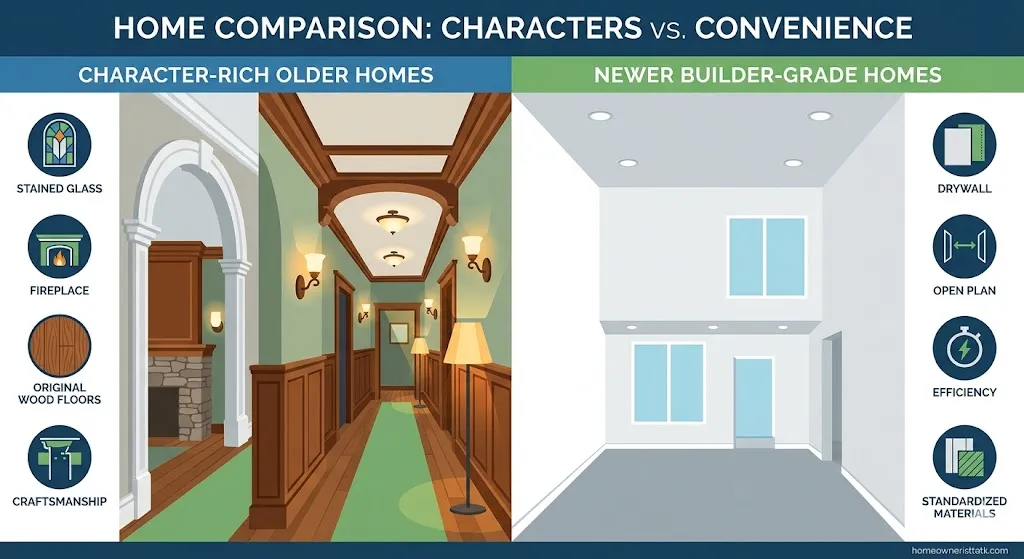
This comparison shows why texture, trim, and architectural detail often make older homes feel warmer.
In fact, I'm seeing a lot of these homes in my market where they just look like square boxes where no one took the extra time just to add a little additional character.
So, why do modern homes feel like hotels and hospitals? It's because when you step inside most new builds, what do you see? You see flat white paint. You see smooth drywall. You see minimal trim, bright white lights and tons of echoes. It feels sterile, like a commercial space, like you're checking in for a dentist appointment. It doesn't feel like anyone cared when they actually designed it. It doesn't feel layered. It doesn't feel intimate. It doesn't even feel human. And that's because we've removed texture, rhythm, and transition from these spaces. We've replaced cozy with clinical.
Here's the thing. A house can be clean and modern and still feel warm, but that requires thought, intention, and design. And in my opinion, that's what most of these new homes are missing. Most new construction today skips right over that.
Now, before we dive into the missing character, I'd like to take a minute and ask a favor. If you find any value in my articles at all, make sure you hit that thumbs up and be sure to subscribe to the channel to stay updated on everything real estate related. And if you're someone who's considering buying a home, you're not sure where to start. You want to work with a detailed agent that understands the process, can guide you in the right direction, I've helped thousands of people in my career, and I would love to help you, too. Whether it's working with me directly or letting me refer you to an agent who works directly like I do. Make sure you check that link in the description of the article.
Now, let's talk about character. Used to be you'd see archways, niches, built-ins, trim work, crown molding, layered lighting, window casings, fireplaces that actually warm the room. Today, you get drywall boxes with recess lights and a shiplap accent wall. Everything is flat. Every room looks like a builder's template. There's no variation. Just rinse and repeat. Hell, in my market, even homes in the 2 $3 million range are missing thoughtful design. You're paying for space, not substance.
Buyers can feel it. It's why when people walk into like a bungalow or a cottage, they go, "Oh my god, this home feels warm." And it's because it's not just nostalgia. It's proportion. It's material. It's intention. It feels like someone actually took the time to design something different. We've traded character for checklist features, and the result is homes that feel empty.
How Open Floor Plans Can Create Noise, Stress, and Less Privacy
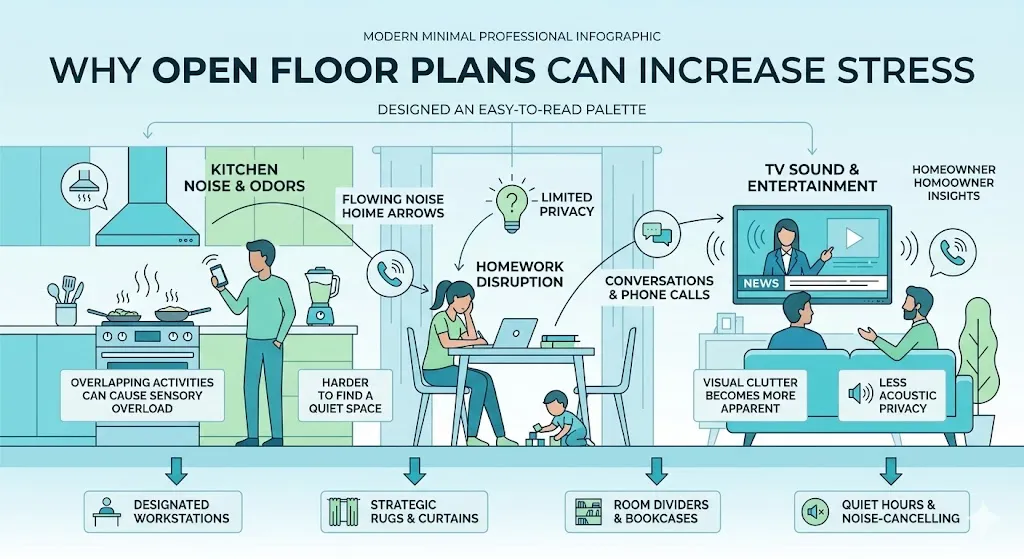
Open layouts can look spacious, but they often make daily life louder, busier, and harder to separate.
Now, let's talk about ceilings. We all love high ceilings. We all love walking in and the room feeling more spacious, more light coming into the room. But here's what you probably don't understand. The average ceiling used to be about 8 ft. Today, it's 9, 10, even 12 feet in some cases. And I realize it sounds luxurious, but for a lot of people, it creates discomfort. Psychologists call this the cathedral effect. Higher ceilings lead to more abstract thinking, but they can also make you feel unsettled, disoriented, and even anxious. Your brain struggles to ground itself in a space that feels too large or out of proportion.
And if that wasn't enough, when you pair it with minimal furniture and reflective surfaces, you get reverb, echoes, noise, a subtle constant tension, which is exactly why a lot of people don't feel comfortable in these spaces.
Now, the next one is something I've been talking about a lot recently, and that's open floor plans. Open floor plans look great on paper. The idea of a big flowing space is very, very appealing. But here's the thing. A lot of things have changed since 2020, since the pandemic when everybody was stuck in one house. We used to love the whole open space concept because you could entertain, you could flow from one room to another. But after being locked in a home for months on end, a lot of people realize that that open space wasn't all it cracked up to be.
And that's because it creates chaos. Everything starts to bleed together. The noise from the kitchen, the TV in the living room, conversations in the dining area. Think of the kids trying to do homework while someone's watchinging a TV in the other room. It's almost impossible. On top of that, I like to read TV. I like to read sports. And this shouldn't be a surprise to you, but my kids love to play. They love to run around. And when you're in a big open room, it's very, very difficult to do both.
So, while I love open floor plans, if you're in a smaller square footage home, where there's only a small living area, a small kitchen, and there's no other space to really get away, open floor plans can actually do more harm than good in many cases.
Now, on the other side, if you live in a big luxurious house, you got a ton of square footage and you've got offices and you've got dens that are separate from that space where people can go get away, then I think open concepts are great. But the reality is most people don't have that space.
Simple Ways to Make a Modern Home Feel Warmer and More Comfortable

Small design changes like soft textures and layered lighting can make a modern home feel far more livable.
In addition to that, with open floor plans, there's no visual break, no acoustic separation, and like I said, there's no privacy. And here's what's wild. Studies have shown that open concept offices actually raise stress levels and reduce productivity. And you probably already know this, but at home it's even worse. You don't get to go home to decompress. You now live in the stress zone where everything is going on at one time.
Now, here's the thing. A lot of people out there thought that the openness would feel freeing. I've had many clients want open concept homes only to realize later on that they actually still want some separation. So, if you're somebody that's considering this whole open concept, just make sure you think it through before you pull the trigger.
But that's where I want to ask you a question. What are your thoughts on the whole open concept design? Let me know in the comments.
Now, if the vated ceilings and the whole open concept wasn't enough, let's talk about lighting. Lighting is another piece that people overlook. In older homes, you had layered lighting, lamps, sconces, fireplace, and natural light all blended together. Now, you've got bright white LEDs, overhead only, which is harsh, cold, and in many cases uninviting. That kind of lighting keeps your brain in a state of alert. Your circadian rhythm gets confused. Studies show that people sleep better and feel calmer with warm lighting, and that includes during the day. If your home is lit like a grocery store, it's no wonder it doesn't feel restful.
Now, let's talk about the death of the hallway. If you haven't noticed it, hallways are disappearing. Builders call them wasted space, but in reality, they serve a purpose. They're transition zones. They create mental resets between rooms. They also create privacy, in many cases, boundaries.
Now, your primary bedroom opens right off the great room or kitchen. There's no separation, no signal to your brain that you're moving into a new mode. And psychologically, that matters a lot. It's not just about doors. It's about rhythm, flow, protection. We need those transitions.
So, why do older homes still feel better to many people out there? I'm actually seeing more and more buyers gravitate towards homes from the '60s, the '7s, the 80s. And here's the thing, they're not flashy, but they feel real. They have boundaries. They have scale. They were designed for humans. They're not optimized for Instagram. They're optimized for life. You walk in, feel safe, grounded, peaceful.
So, what can you do to actually fix some of these problems? If you're already living in a modern home, here are a few things that you can actually do. You can add soft surfaces to absorb sound like curtains, rugs, bookshelves. Break up wide open spaces with furniture placement. Use lamps and warm bulbs for layered cozy light. and add character with things like trim, paneling, paint, texture, crown molding. Little changes can make a big difference in how your home feels.
Now, if you've been wondering why your home doesn't feel quite right, now you probably know. Modern design isn't broken, but the intent behind it has shifted. And if you're looking for a home that feels like home, not a product, let's talk. This is what I do. I actually help people find homes that actually fit the way they live. So, make sure you reach out anytime using that link in the description of the article. I'd love to help.